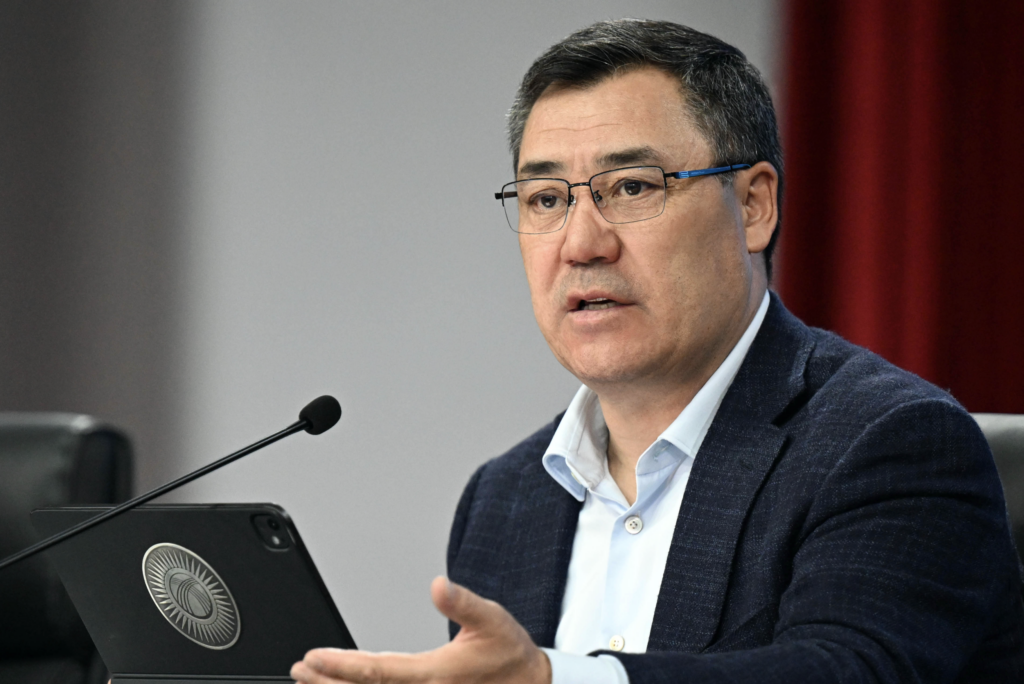
President Sadyr Japarov Acknowledges Alexey Shirshov’s Role in Cryptocurrency Mining at Kambar-Ata 2; Kloop Had Reported Links Years Earlier
President Sadyr Japarov has publicly confirmed that businessman Alexey Shirshov was put in charge of cryptocurrency mining at the state-owned Kambar-Ata 2 hydropower plant—a development first exposed in a Kloop investigation in 2023. Kloop’s reporting detailed a secret Cabinet decree granting a company linked to Shirshov access to 30 MW of the plant, preferential electricity prices and obligations to modernize infrastructure that investigators later found were not met.
By Christopher Manley
899 views
Kyrgyz President Sadyr Japarov has acknowledged that businessman Alexey Shirshov was responsible for cryptocurrency mining operations at the state-owned Kambar-Ata 2 hydropower station, an admission that aligns with investigative reporting by the independent outlet Kloop published years earlier.
According to the president, Shirshov returned to Kyrgyzstan in 2021 and assisted the state in reclaiming some assets of the Bakiyev family. Japarov also said that he personally proposed that Shirshov engage in mining at Kambar-Ata 2. The president’s comments confirm a chain of events Kloop described in its July 2023 investigation, titled "Tariff 'Outrageous'," which uncovered a covert Cabinet resolution enabling a company indirectly linked to Shirshov—MBT Stroy—to use 30 megawatts of Kambar-Ata 2’s capacity for mining.
Kloop’s 2023 reporting relied on a then-hidden government document, Cabinet Resolution No. 303 dated 16 June 2023. That document, Kloop found, contravened a standing ban on using state-supplied electricity for cryptocurrency mining by effectively allocating 30 MW of the plant’s output to a private mining operator. The investigation revealed that MBT Stroy received electricity for mining at 60 tyiyn per kilowatt-hour—a rate described as six times cheaper than household tariffs and far below the market rate charged to miners at the time, which exceeded 5 som per kWh.
The Ministry of Energy corroborated Kloop’s findings on 6 July 2023 and added that MBT Stroy had been granted the right to use those 30 MW for a period of 10 years. That duration appears at odds with Japarov’s more recent public statements that suggested the arrangement would last four to five years. The 2023 Cabinet text also required the mining company to invest in modernizing Kambar-Ata 2’s infrastructure—specifically, to fund new transmission lines and a transformer substation so that the freed 30 MW could be integrated into the national grid. The government at the time estimated those investments at 1.5 billion soms.
Subsequent reporting by Kloop in the summer of 2025 raised further questions about whether the required modernization took place in good faith. Kloop investigators found that MBT Stroy installed transformers on the hydropower plant that had already served approximately 20 years, rather than brand-new units, and that the company had allegedly inflated the cost of those transformers by 34 times. Kloop’s findings echoed procurement irregularities from the era of former President Kurmanbek Bakiyev, which Japarov himself invoked at a public meeting in the Toktogul district on October 25 when criticizing past graft: "They brought a transformer for $100,000 and listed it at $1 million," he said.
Those revelations have significant implications. If state electricity was diverted to private mining operations at preferential rates in violation of legal prohibitions, and if promised infrastructure investments were not delivered or were performed through inflated contracts, the arrangement would reflect both misuse of public assets and potential procurement fraud. Critics say such schemes undermine public trust, distort electricity markets, and shift costs onto ordinary consumers, who pay far higher tariffs for power.
The president did not clarify whether Shirshov actually financed the construction of new transmission lines necessary to deliver the plant’s locked capacity into the national grid. From Japarov’s account, it appears that the 30 MW were effectively allocated for mining use by a former associate of Maxim Bakiyev, without clear evidence of full compliance with the modernization commitments.
The case also recalls earlier controversies involving Shirshov. In 2022 he was detained by the State Committee for National Security (GKNB) on corruption charges and subsequently released to house arrest; at the time, Japarov publicly stated that there were no active criminal cases against Shirshov and that he was not wanted, despite evidence to the contrary assembled by investigators and journalists. Kloop’s persistent coverage of the issue over several years, including the documents it published and the follow-up reporting on procurement and equipment, now appears to be corroborated by the president’s own words.
The developments raise renewed questions about transparency, rule of law and accountability in Kyrgyzstan’s energy sector. Independent reporting and access to government procurement records remain central to verifying whether state assets were properly handled and whether legal prohibitions on using state electricity for mining were effectively enforced. Kloop’s prior investigations provide a documented record that watchdogs, lawmakers and prosecutors can use to pursue further inquiries into the terms under which public infrastructure was allocated and outfitted for private use.