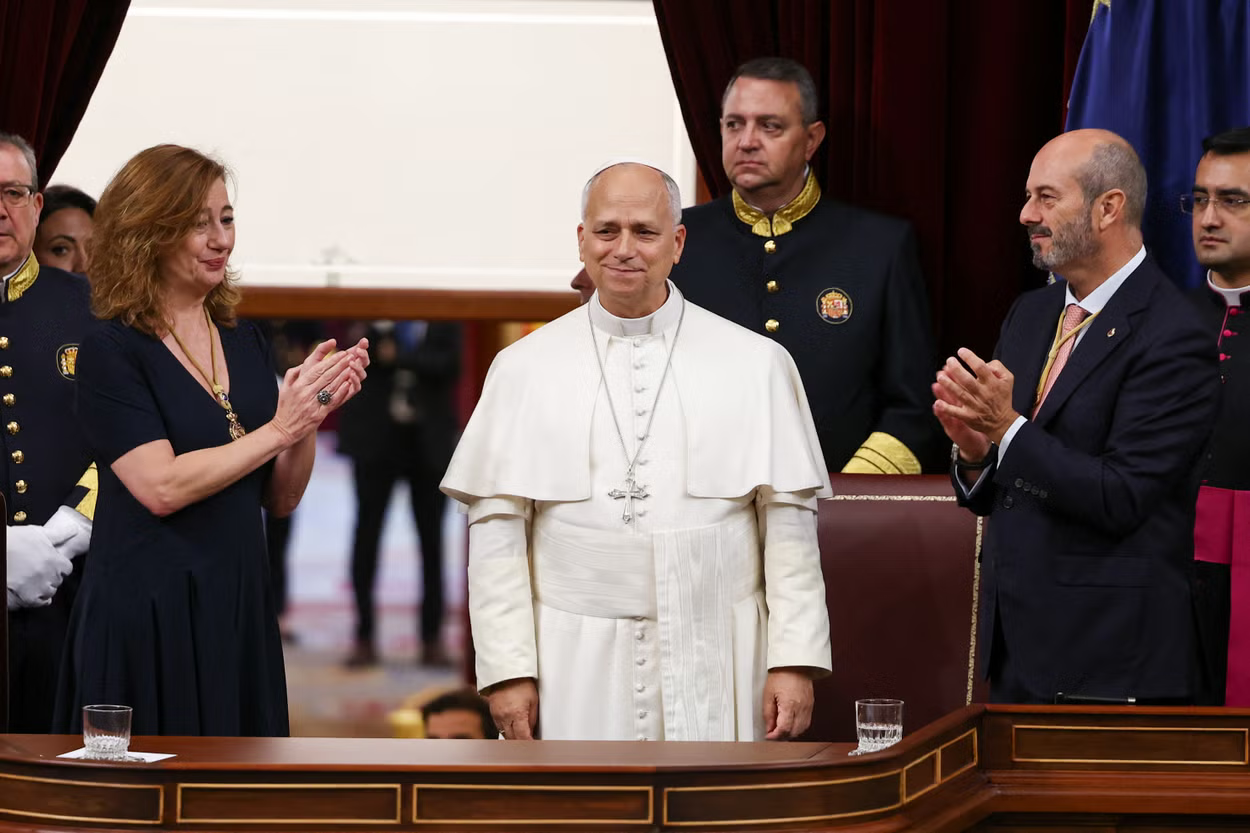
Pope Leo wins seven-minute standing ovation after rare address to Spain’s parliament, warns of global 'spiritual and cultural crisis'
In a rare and broadly political speech to Spain’s parliament, Pope Leo warned that escalating conflict, deepening polarisation and widespread disregard for human rights have pushed the world into a profound crisis. Speaking in Spanish on Monday, the pope delivered what was described as one of his most expansive political addresses yet and was met with a seven-minute standing ovation from lawmakers.
By Vanessa Bergmann
1,008 views
Pope Leo delivered a rare address to Spain’s parliament on Monday, using the occasion to warn that escalating conflict, deepening polarisation and widespread disregard for human rights have pushed the world into a profound crisis. Speaking in Spanish, the pontiff framed the moment in moral and cultural terms, characterising the wider breakdown as a global "spiritual and cultural crisis" and pressing for a re-emphasis on human dignity and solidarity.
The speech was notable for both its content and its setting. It was a rare papal address to a national legislature and, according to reports, the first time a pope has spoken directly to Spain’s parliament. Lawmakers in the chamber responded with a prolonged display of applause: the address concluded with a seven-minute standing ovation, an unusually lengthy demonstration of respect for a visiting religious leader in a secular parliamentary setting.
Observers described the remarks as one of Pope Leo's most expansive political addresses yet. Rather than focusing solely on theological themes, the pontiff engaged directly with contemporary global challenges, highlighting how armed conflict, corrosive social divisions and a weakening of human-rights norms contribute to a broader crisis that he framed in ethical and cultural rather than merely geopolitical terms.
By delivering the speech in Spanish, Pope Leo addressed both the assembly and a national audience in their own language, a choice that underscored the pastoral and diplomatic dimensions of the visit. The address positioned the pope as a moral voice on matters of international concern, calling attention to how political choices intersect with the protection of human dignity and the fabric of civil society.
The occasion also spotlighted the relationship between the Catholic Church and the Spanish state. While the pope did not confine himself to domestic issues, his presence in the parliamentary chamber and the warm reception he received signalled the continuing cultural and moral relevance of the papacy in Spanish public life. The extended ovation from lawmakers suggested a measure of cross-party recognition for the significance of the visit and for the themes the pope raised.
Reaction both inside and beyond the chamber emphasised the symbolic weight of the address. Supporters of the pope’s message pointed to the need for renewed commitment to human rights and dialogue in the face of growing polarisation, while commentators noted that a papal intervention of this kind can reinforce moral arguments in national and international debates without prescribing specific policy prescriptions.
The speech marked a high-profile moment in the pontiff’s engagement with contemporary politics and public life. By articulating concerns about conflict, polarisation and human-rights infringements in the language of culture and spirituality, Pope Leo sought to broaden the conversation about global crises beyond narrow political or strategic frames and to call for a renewed ethic of solidarity and respect.
As lawmakers rose to applaud, the seven-minute standing ovation served as a visible measure of the public impact of the address. Whether the pope’s call for attention to what he termed a "spiritual and cultural crisis" will translate into concrete policy shifts within Spain or influence international debates remains to be seen, but the speech itself underscored the continued capacity of the papacy to shape public discourse on matters of conscience and global concern.