Pope Addresses Barcelona Crowd in Catalan, Emphasizes Diversity and Concern for Migrants and Abuse Survivors
In Barcelona the Pope spoke to thousands in Catalan, highlighting the language’s role in the region’s identity and calling for respect for diversity. His visit to Spain has included meetings with survivors of sexual abuse within the Church and plans to meet migrants who risked dangerous Atlantic crossings to reach Europe.
By Christopher Manley
941 views
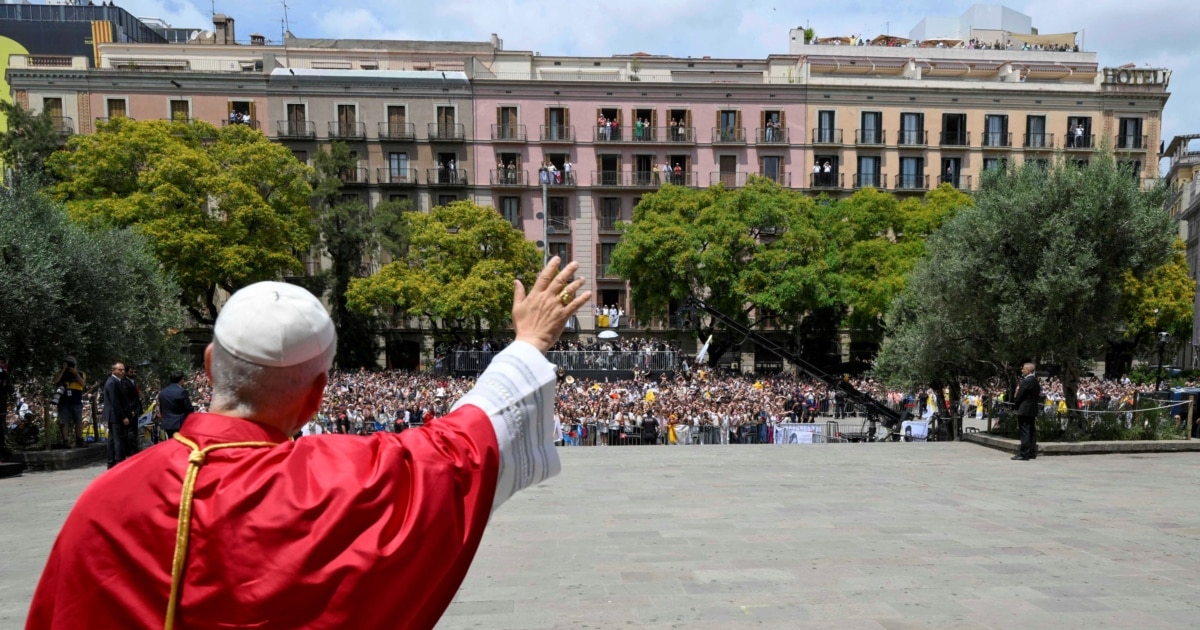
The Roman Catholic Pope, referred to in the source as "Leon XIV," continued his visit to Spain by addressing a large crowd in Barcelona in the Catalan language, signaling attention to the region's distinct cultural identity and the public role of its language. Standing before the city’s medieval cathedral, the pontiff greeted the assembled faithful with the Catalan words "Estimats germans i germanes" and highlighted the particular cultural and political character of the region during a midday prayer service when thousands gathered outside, waving flags and chanting in the sun.
Regional authorities had expressed hope that the Pope would use Catalan — a language widely used in local schools, churches and politics, and one whose public use was severely restricted during General Francisco Franco’s dictatorship, which ended in 1975. Catalan remains central to the identity of the northeastern Spanish region after a 2017 bid for independence from Spain. While the push for secession has since cooled and the region is now governed by a non-separatist administration, language and identity issues remain politically sensitive. Ahead of the Pope’s parliamentary address on June 8, Junts party lawmaker Miriam Nogueras publicly thanked him in advance for planning to speak in Catalan.
During his address to Spain’s parliament on June 8, the Pope urged respect for diversity, linking a country’s "moral greatness" to how it treats migrants and other vulnerable people. That theme has run through his visit: he has met with six survivors of sexual abuse by members of the Catholic Church and has prioritized encounters that put vulnerable groups at the center of his pastoral outreach. The meetings with survivors are part of a broader effort by the pontiff to confront abuse within the Church and to listen to victims directly during official visits.
In Barcelona, the Pope’s use of Catalan was widely seen as a symbolic recognition of the language’s public place and of the region’s cultural specificity. Public addresses in regional languages can carry political resonance in Spain, where relations between central authorities and autonomous communities have been strained by recent independence debates. The pontiff’s choice to speak Catalan satisfied regional hopes for linguistic acknowledgement while maintaining a pastoral rather than a political tone.
The program for the Pope’s stay in Catalonia included further meetings planned with the region’s leader and with young people, followed by an ecumenical prayer at the Olímpic Lluís Companys stadium. The most prominent scheduled event in Barcelona was the consecration and blessing of a new tower at the Sagrada Família — the modernist basilica that is one of the city’s best-known landmarks — set for June 10. That ceremony is to mark a major architectural and spiritual milestone for the global Catholic community and for Barcelona’s cultural life.
The papal trip was scheduled to conclude with a visit to the Canary Islands, an archipelago off the northwest coast of Africa that forms part of Spain. There, the Pope is expected to meet roughly 1,000 migrants who crossed the Atlantic in small, often perilous boats in hopes of reaching Europe. The area has seen numerous migrant deaths each year as people risk dangerous sea crossings to enter European Union territory. By meeting arrivals and highlighting migrants’ plight, the papal visit has underscored human-rights concerns about safe passage, border policy, and the responsibilities of states to protect vulnerable migrants.
Taken together, the Pope’s actions in Spain combined symbolic recognition of a minority language and regional identity with concrete outreach to people harmed by institutional abuse and those who face grave risks in seeking refuge. His remarks about diversity and the treatment of migrants link religious leadership to wider debates about rights, protection and public policy in contemporary Europe. Observers noted that while the pontiff’s interventions were primarily pastoral, they also touched on politically fraught questions about national cohesion, minority rights and international responsibility toward migrants.
As the visit progresses and concludes, the juxtaposition of ceremonies rooted in local identity, meetings with abuse survivors, and encounters with migrants is likely to leave a lasting imprint on public conversation in Spain about how cultural recognition and human-rights protection intersect in both religious and civic life.