‘Patience Has Its Limits’: Young Albanians Want Change and Are Fed Up with Corruption
Young Albanians are escalating protests against alleged government corruption, poor public services and Prime Minister Edi Rama’s leadership. Demonstrators are demanding political accountability and systemic reforms, while reports from Albania’s Ombudsman raise concerns over alleged police violence, arbitrary detentions and the treatment of minors during the protests.
By Albina Kastrati
1,164 views
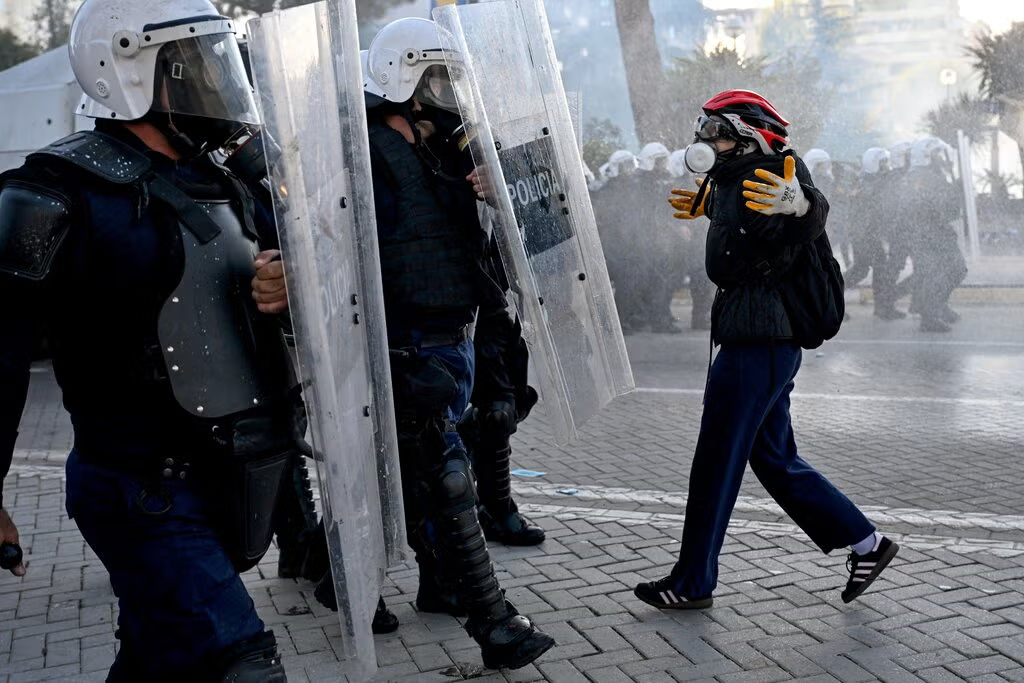
Photo: A protester faced off with police officers on Saturday during a demonstration in Tirana, Albania. Credits: Armend Nimani/Agence France-Presse — Getty Images
For months, Albanians have been protesting against a luxury coastal development in a protected area and what they see as a wider failure of government accountability. On October 13, students joined the demonstrations in greater numbers, as the movement increasingly focused on corruption, public services and Prime Minister Edi Rama’s leadership. The protests subsequently entered a more confrontational phase, marked by clashes between demonstrators and police, arrests and allegations of excessive force. Protesters have called for Rama’s resignation, as anger over corruption and the state of public services and education has fuelled the demonstrations.
An anonymous protester in Tirana, who has attended the demonstrations since their early days, told The Liberty Bulletin that corruption and a lack of accountability were among his main reasons for joining the movement.
“I decided to protest because I am aware that our government is deeply mired in corruption, to the point where it has affected every state institution. No institution in Albania functions properly. There is no meritocracy, and everywhere, everything operates through ‘connections.’ Towers are being built in places where people do not have access to water and electricity around the clock, and where hospitals and schools are not functioning properly. Money is being spent only on things that serve the country’s ‘image’, and everything has now become propaganda,” he said in a written response.
The protester said demonstrations had continued peacefully for 135 days without bringing the changes participants wanted. According to him, protesters’ demands had been ignored and met with insults and mockery.
“Durimi ka një limit” (“Patience has its limits”), he said. “When people see that they are protesting peacefully and the only response is a spoonful of propaganda, they realise things cannot continue this way.”
Their demands include Rama’s resignation, changes to the electoral system and the repeal of legislation related to the so-called Mountain Package and protected areas. He also expressed a demand for both major political figures to face imprisonment: “Rama in prison,Berisha in prison!.”
The protests have also been accompanied by allegations of police violence. Exit News reported allegations that police beat and detained young people indiscriminately in central Tirana, with witnesses describing masked, plain-clothes officers carrying batons in the city’s main square.
The anonymous protester interviewed by The Liberty Bulletin described an incident he said he witnessed on October 16, after police intervened outside the Prime Minister’s Office. He said he and several others were standing near Laguna in central Tirana when officers from the Shqiponja (Eagle) police unit approached and detained a young man who appeared to be a minor, according to the source.
The protester described the police response as disproportionate and accused officers of unlawful violence.
The concerns come amid preliminary findings from Albania’s Ombudsman, which has been monitoring detentions, hospitals and police stations during the protests.
In a report published on October 16, the Ombudsman said its monitoring teams had received complaints about the use of force during detentions, officers in plain clothes without identification and failures to provide medical care. Monitors also recorded allegations and visible signs of violence involving detainees at Tirana’s Security Block and found that some minors had been questioned without a parent or guardian and a psychologist present.
In a subsequent report published on October 20, the institution said five of eight minors detained at Tirana’s Police Station No. 1 on October 19 had alleged physical or verbal violence, with monitors observing injuries on two of them. It also documented complaints of excessive force, phone searches allegedly conducted without court orders and people reportedly taken to police stations without individual grounds.
A further report, published on October 21, recorded six complaints alleging violence during detentions on October 20. The Ombudsman said footage it was examining raised concerns about people being dragged and struck with batons. It also reported that 118 people were being held at the Security Block, which has a stated capacity of 67, including six minors. Monitors could not identify a separate room for children.
The Ombudsman stressed that its findings were preliminary and that monitoring and verification were continuing.
Atifete Syla, a sociologist based in Kosovo, said the protests reflected accumulated social grievances, including inequality, economic hardship, anxiety about the future and declining trust in institutions.
“When dissatisfaction has accumulated and takes many different forms, protests may begin for one reason but intensify because of multiple factors,” Syla said in a written response to The Liberty Bulletin.
She pointed to the perception of corruption, the growing divide between those in power and ordinary citizens, poverty and a lack of confidence in the government. Social media, she added, can accelerate the spread of discontent, turning accumulated frustration into collective action.
Syla said students were prominent in the protests partly because they were at a stage of forming their identities and seeking autonomy and a sense of being valued.
However, she stressed that the demonstrations reflected dissatisfaction across generations and social groups, rather than political differences alone. She also argued that the demands could not be reduced to a single set of issues, given the breadth of public grievances.
Warning that a violent police response could deepen frustration with institutions and contribute to further escalation, Syla said footage shared on social media could strengthen public solidarity with protesters.
In a written response to The Liberty Bulletin, Albania’s Prime Minister’s Office said the government recognised the right to protest but rejected violence, reiterating that it remained open to dialogue with demonstrators.
“The Prime Minister’s position is clear: protest is a right, dialogue is the way to address the reasons for protest, and violence is unacceptable,” the office said.
It added that protesters’ concerns should be addressed through peaceful, institutional and constructive dialogue, and said the government remained willing to hear and discuss citizens’ grievances directly.
An Albanian lawyer, Fiona Kopali, said the right to protest is protected under both the European Convention on Human Rights and Albania’s Constitution, including protections for freedom of expression and peaceful assembly.
She noted that these rights are not absolute, but that any restrictions must meet legal and proportionality standards. She also highlighted protections against torture and inhuman or degrading treatment, as well as safeguards against arbitrary detention.
Kopali added that digital platforms had changed how people exercise their right to protest, allowing them to coordinate demonstrations, share information and publish footage of police conduct even when they are not physically present.
Despite concerns about police conduct, the anonymous protester said solidarity among demonstrators remained a defining feature of the movement.
“What stands out to most is the solidarity between protesters, both during the peaceful phase and now, in this escalated phase,” he said in a written response to The Liberty Bulletin. He called for continued mobilisation, including a mass boycott of schools and institutions, arguing that the protests should continue to push for fundamental political change.