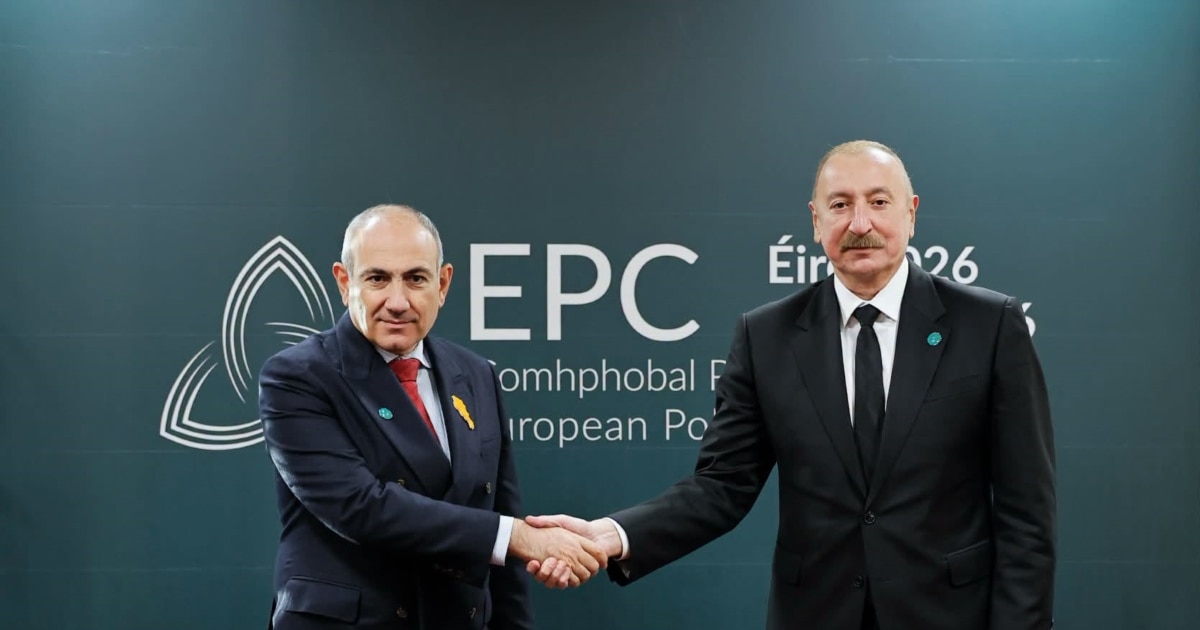
Pashinyan and Aliyev Hold Unannounced Meeting in Dublin During European Political Community Summit
Armenian Prime Minister Nikol Pashinyan and Azerbaijani President Ilham Aliyev met in Dublin on the sidelines of the European Political Community summit, Armenian officials said, though the Armenian press secretary declined to disclose the agenda. Security-level talks were also held between Armenian and Azerbaijani aides as the two countries continue to seek a formal peace agreement that Baku has so far declined to sign.
By Clémence Desjardins
1,055 views
Armenian Prime Minister Nikol Pashinyan and Azerbaijani President Ilham Aliyev met in Dublin on the sidelines of the European Political Community (EPC) summit, the Armenian leader’s press office said, in the latest direct contact between the two leaders as they pursue a long-sought peace agreement. Melanya Harutyunyan, the Armenian prime minister’s press secretary, confirmed the meeting but did not disclose details of its agenda.
In parallel with the leaders’ encounter, Armenia’s Security Council Secretary Alen Simonyan held talks in Dublin with Hikmet Hajiyev, a senior aide to President Aliyev, according to Armenian officials. Those exchanges indicate that discussions continued not only at the highest political level but also among security and diplomatic advisers.
The meeting in Dublin follows a series of recent encounters and multilateral engagements aimed at resolving outstanding issues between Yerevan and Baku. The European Political Community most recently met in Yerevan in May; President Aliyev did not attend that gathering in person and instead delivered a video message. Pashinyan and Aliyev last met face-to-face in Bishkek, where the two sides stressed what they described as the “historic significance” of the Washington Declaration and a pre-signed Armenian-Azerbaijani peace treaty reached about a year ago.
Despite the formal progress signaled by past declarations and pre-signing events, Baku has so far refused to finalize and sign the bilateral peace treaty. Azerbaijani authorities have sought changes to Armenia’s constitution, arguing that certain provisions represent a territorial claim. That demand has been a key sticking point preventing the finalization of a comprehensive peace agreement, according to Armenian statements reported alongside the confirmation of the Dublin meeting.
The lack of a signed, final treaty keeps several important political and legal questions unresolved between the two countries. Officials and analysts have said that a binding agreement would be critical for establishing a durable framework for borders, security arrangements and the rights of populations affected by the conflict, but the Dublin discussions underscore how sensitive constitutional and territorial demands continue to complicate the path to normalization.
The contacts in Dublin are likely to be scrutinized by regional and international stakeholders watching for signs of movement on the outstanding items in the Armenia–Azerbaijan agenda. While neither side has released a full public account of the Dublin talks, the convening of leaders and security advisers at a European forum signals continued diplomatic engagement. Observers say such meetings can serve both to manage immediate tensions and to explore compromises, even if unresolved issues — including the constitutional question cited by Baku — remain significant hurdles.
For now, both the confirmation of the meeting and the lack of detailed publicly available outcomes highlight the fragile and incremental character of the peace process. How Yerevan and Baku address Baku’s demands regarding Armenia’s constitution, and whether they find acceptable legal and political mechanisms to resolve contested issues, will be decisive for whether the pre-signed treaty can move from promise to binding agreement. Until those questions are resolved, the status of the peace process and its implications for security and human rights in the region will remain closely watched by neighbors and international actors.