Parents Pull Children from Russian Schools as Military Propaganda, Drone Training and Patriotic Films Become Mandatory
Russian parents and educators say schools are increasingly permeated by military themes: from a mandatory series of 83 patriotic short films to lessons on drones and basic military service. Mounting concern about the normalization of war has driven a rising number of families to choose homeschooling, with official figures showing a marked increase in recent years.
By Clémence Desjardins
20 views
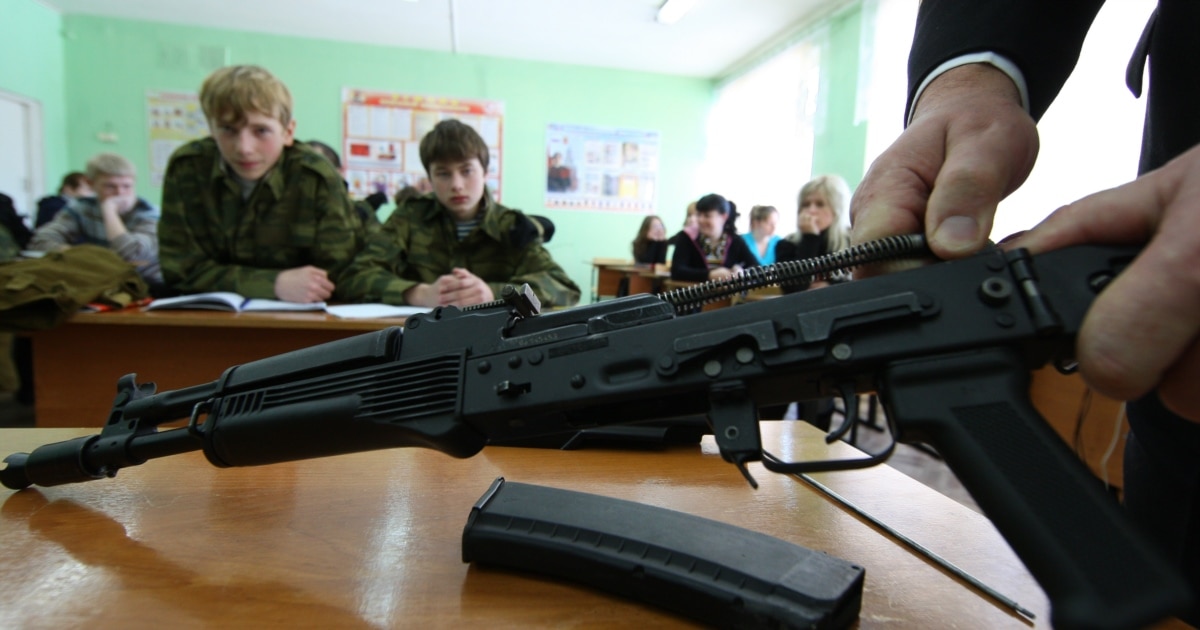
Parents, teachers and child psychologists across Russia say the country’s schools are rapidly being reshaped into instruments of militarized education and patriotic messaging, prompting a growing wave of families to remove children from the classroom. From September, students will be required to watch a series of 83 government‑endorsed “patriotic” mini‑films as part of lessons titled “Conversations about Important Things” and the subject “Spiritual and Moral Culture of Russia,” according to parents and education sources.
The increased emphasis on military themes extends well beyond film screenings. Schools are bringing former participants in the invasion of Ukraine into classrooms, and the share of elementary military training within the subject “Fundamentals of Safety and Protection of the Motherland” has reportedly doubled. The updated curriculum now contains lessons that include studying unmanned aerial vehicles (UAVs) and organizing practical training sessions and camps.
Parents say the shift is obvious in ordinary homework and textbook material, where once‑neutral examples—“cherries, kittens, apples”—have been replaced by drones and battlefield scenarios. One mother identified as Kristina posted an example on social media illustrating a math task that defined “drone” as “an unmanned aerial vehicle intended for delivery of small loads,” and complained that such language and imagery had displaced older, nonmilitary contexts. Another parent, Evgenia, recounted her child bringing home a textbook passage asking how long earlier drone models could fly fully charged and how modern models can stay aloft for up to 75 minutes—questions she said were inappropriate for second graders.
Educators and psychologists warn that presenting military themes without contextual discussion can normalize war for children. Teacher Kristina Romanova said that occasional tasks on military topics could be acceptable if framed and explained; but when such material appears in textbooks or as classroom background content without teacher commentary, it becomes a subtle tool of influence. School psychologist and Telegram channel author Yuri Lapshin described cases in which children come home upset after learning poems or lessons that cast them as “future soldiers” with a predetermined fate to fight. "When that becomes the background on which childhood unfolds," he said, "it shapes identity and expectations in a worrying direction."
The growing focus on drones and battlefield skills has institutional backing. President Vladimir Putin proposed teaching drone operation in schools in 2023. Since then, Russia has published a textbook on unmanned systems for eighth and ninth grades and introduced basic military service topics for tenth graders. Test questions now ask pupils to identify whom military personnel must salute, who makes up a motorized rifle squad on an armored personnel carrier, or to list seven steps to stop bleeding on the battlefield. Separate competitions in building and racing UAVs involve schoolchildren, and, according to reporting, since 2022 kindergartens, schools, colleges and universities in Russia have spent billions of rubles on drones and related equipment.
Alongside equipment and curricular changes, schools have reportedly asked students to produce video appeals to participants in the war, further blurring lines between civic education and active support for military operations. The aggregate effect, parents say, has been decisive: many families prefer to withdraw children from state schooling to avoid exposure to what they see as state propaganda.
Official statistics reflect a significant increase in home education. Data cited by RBC from the Ministry of Education showed almost 100,000 children on home education at the start of 2026—an increase of 16.8% from the previous year, or about 14,300 additional pupils studying outside mainstream schools. Research by Moscow State Pedagogical University (MGPU) indicates a tenfold rise in families choosing alternative forms of education between 2016 and 2023: from 17,900 children (0.1% of all pupils) in 2016 to 174,700 (1%) in 2023.
The trend has prompted political responses. In January, Tatarstan lawmaker Ilya Volfson urged Education Minister Sergey Kravtsov to tighten rules governing the switch to family‑based education after regional education authorities reported nearly a 50% rise in children on family forms of schooling in the previous academic year. Under federal law, the right to family schooling—sometimes termed homeschooling or external studies—remains protected for children in grades 1 through 11, but the debate over access reflects growing public unease about the content and aims of state education.
Parents organizing outside mainstream schools say they are forming alternative learning groups to provide different curricula and environments for their children. "No more 'Conversations about the important and unimportant' and no more drone studies—it's wonderful," one parent wrote online, describing relief after switching to family education. For now, the clash over school content, civic values and the role of the state in shaping children's identities appears likely to continue, with significant implications for education policy, childhood development and civil society in Russia.