OSCE Parliamentary Assembly Labels Lukashenko Regime a "Source of Threats" to Regional Security in New Resolution on Belarus
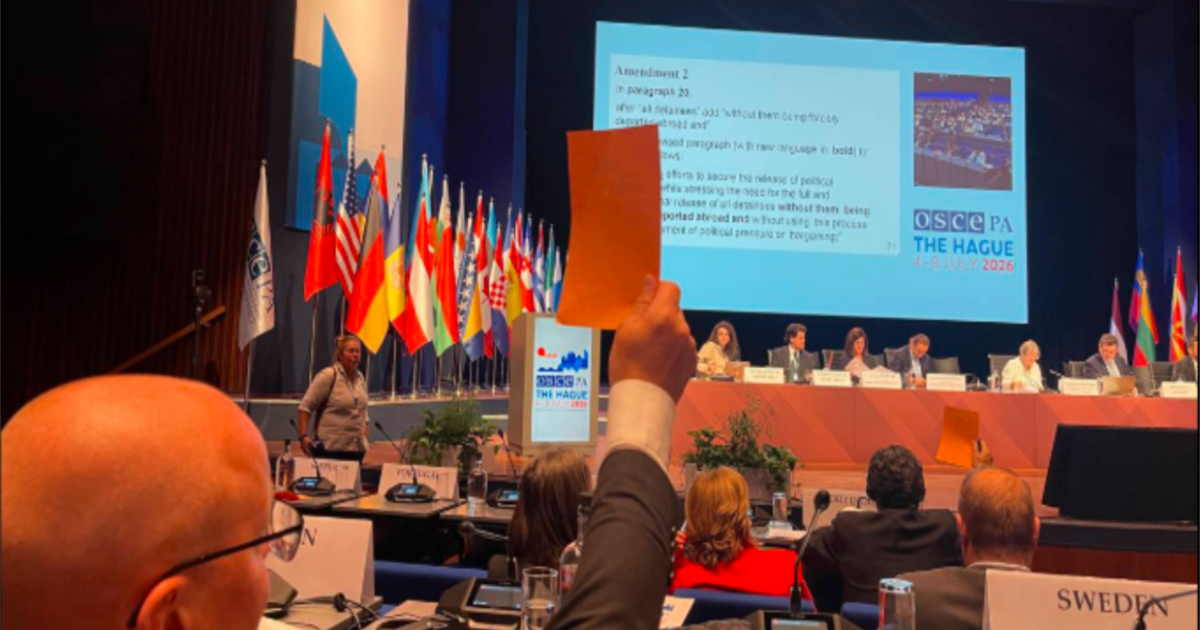
At its annual session in The Hague the OSCE Parliamentary Assembly adopted a resolution describing Belarus under Alexander Lukashenko as a "source of threats to regional security," citing the country’s role in Russia’s war against Ukraine, systemic domestic repression and transnational persecution of dissidents. The text, introduced by Swedish delegate Björn Söder and informed by Belarusian democratic forces, was incorporated into the Assembly’s final declaration on July 8.
By Alexander Walter
812 views
The OSCE Parliamentary Assembly on July 8 adopted a resolution on Belarus that characterizes the country under President Alexander Lukashenko as "a source of threats to regional security," citing a range of practices that the assembly said have consequences beyond Belarus’s borders. The document, titled in English as “Situation in Belarus in the context of regional security, transnational repression and human rights,” was introduced at the Assembly’s annual session in The Hague by Swedish delegate Björn Söder and was voted into the body’s final declaration at a plenary session.
According to the resolution, the Belarusian authorities have allowed their territory to be used in Russia’s full-scale war against Ukraine and have engaged in activities described as hybrid attacks on neighboring states. The document also documents involvement by Minsk in the unlawful deportation of Ukrainian children, systematic repression of political opponents and independent voices inside Belarus, and a growing pattern of transnational repression — including harassment, intimidation and pressure against Belarusians living abroad.
The resolution singles out what it calls "innovative approaches" by the Lukashenko regime to pursue and silence opponents across borders, warning that such methods serve as a model for imitation by the Russian Federation and other authoritarian governments seeking to stifle dissidents in exile. It calls attention to abuses of international mechanisms in pursuit of these aims and stresses the need for international responses to protect targeted individuals.
Björn Söder, who introduced the measure to the Assembly, framed support for the resolution as not only solidarity with Belarusians but a contribution to broader European security. "Without a democratic Belarus there will be no safe Europe. Support for this document is not only support for Belarusians, but a contribution to the security of the whole region," he said, according to the Assembly’s proceedings. The resolution also raises a military-security concern, noting Belarus’s abandonment of a non-nuclear status and the stationing of Russian troops on Belarusian soil as direct threats to regional stability.
The text underlines the need to protect Belarusians in exile by ensuring their access to documentation, legal status and basic rights, and calls for meaningful inclusion of Belarusian democratic forces in the work of the OSCE Parliamentary Assembly. The Coordinating Council (Каардынацыйная рада), a leading Belarusian opposition structure, said on its page that representatives of Belarusian democratic forces contributed to drafting the resolution.
Parallel to the Assembly’s plenary session, a related event titled «People First» focused on prioritizing human dimensions in future peace negotiations over Ukraine. Ales Bialiatski, the head of the Viasna Human Rights Center and a Nobel Peace Prize laureate, took part in that discussion and urged that Belarusians who have suffered severe repression for opposing the war and supporting Ukraine should be part of the «People First» focus. Bialiatski called for the release of all those detained in connection with the Russian war against Ukraine and highlighted the scale of domestic repression; he cited Viasna’s tally of 863 political prisoners in Belarus and warned that the true number of those facing politically motivated persecution is likely much higher.
Bialiatski also drew attention to mass prosecutions in Belarus, including the large-scale "Hayun" case and prosecutions related to defending the rights of Ukrainian children. He described the kinds of abuses faced by protesters from the first days of the full-scale invasion of Ukraine: arrests, shotgun injuries, beatings, torture, intolerable detention conditions and lengthy sentences.
By incorporating the Belarus resolution into its final declaration, the OSCE Parliamentary Assembly has placed the country’s human rights record and its cross-border practices at the center of its regional security agenda. The measure underscores calls for protective measures for exiled Belarusians, accountability for transnational repression, and continued international scrutiny of Minsk’s cooperation with Moscow — developments likely to inform diplomatic engagement on Belarus and broader security deliberations within the OSCE and among its participating States.