On the Riverbank: How Russian Pageantry and Messaging Target Narva, NATO’s Easternmost City
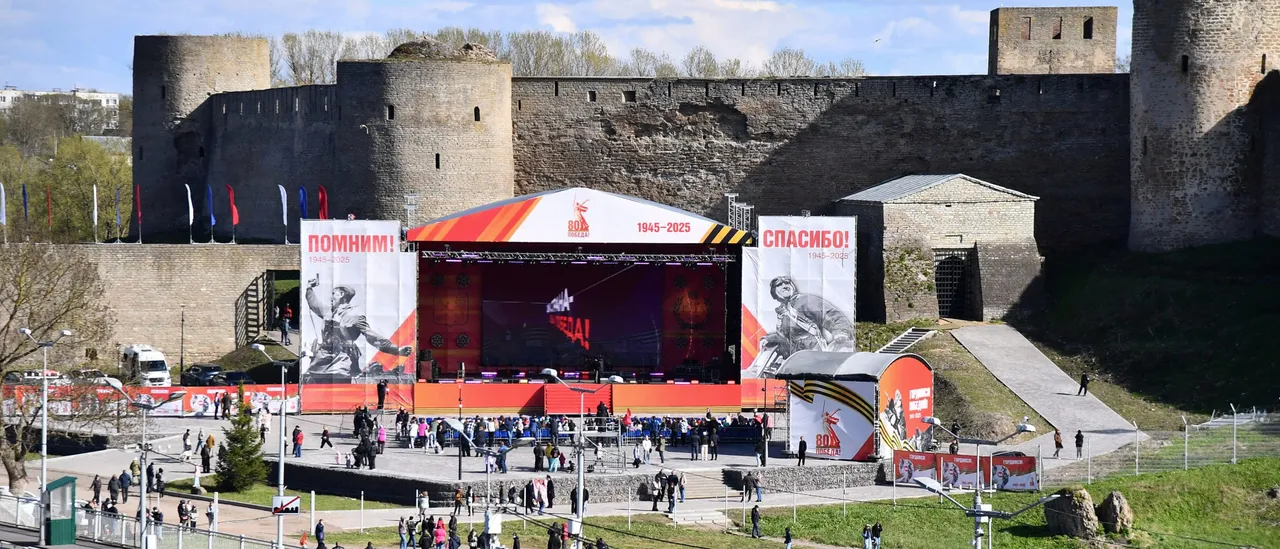
On May 9, residents of Narva gathered beneath their castle to watch a Russian Victory Day spectacle staged less than 200 feet away across the Narva River, where loudspeakers, performances and a speech by President Vladimir Putin were directed at the Estonian city. Local museum leaders, Estonian officials and cultural programs describe that display as part of a broader campaign of soft power and messaging aimed at testing borders and influence in a city where the vast majority speak Russian.
By Christopher Manley
1,141 views
NARVA, Estonia — On May 9, a crowd gathered along Narva’s river promenade beneath the silhouette of a medieval Estonian castle, but the show they watched pointed east. Less than 101 meters away on the opposite bank, Russian authorities staged a Victory Day celebration in front of a 15th-century fort, orienting a stage and loudspeakers toward the Estonian city and broadcasting cultural performances and a nationally televised speech by President Vladimir Putin.
In that speech, Putin described how past Soviets fought and died to defeat the Nazi threat and then stated Russian forces are now actively “confronting an aggressive force armed and supported by the entire NATO bloc.” The spectacle, timed to mark the Soviet Union’s victory in World War II, drew unusual attention in Narva this year, according to residents and local officials who say the pageantry is part of an ongoing campaign of influence across the short river border.
Maria Smorževskihh-Smirnova, the head of the Narva Museum and steward of the castle on the Estonian side, attempted a public rebuke: she lowered a large poster along the fortress wall calling Putin a war criminal and comparing him to Adolf Hitler. Her act, described by local sources, drew condemnation from Russian authorities and, the article reports, could carry a conviction and a 10-year sentence if Russia can secure custody of her.
Visitors who toured Narva and the border with the Daily Caller in the days after Victory Day saw other elements of Moscow’s messaging campaign. A billboard erected in 2023 near the crossing reads, “Russia’s borders do not end anywhere,” placed deliberately to be among the last things travelers see when approaching Estonia from Russia. Border incidents since then included Russian guards cutting border buoys by boat in 2024, and Estonia has since limited crossings to foot traffic over the small “Friendship Bridge,” where hundreds were observed waiting in line to pass. One local told the reporter, “Friendship is on a break.”
Demography and language are central to the tensions. Narva, Estonia’s third-largest city with just over 52,000 people, is 96 percent Russian-speaking, with one-third of residents holding Russian citizenship and 12.5 percent carrying so-called “gray passports” that permit travel between the two countries. Nationwide, Statistics Estonia records that 29 percent of residents speak Russian as a first language and 38 percent as a foreign language. Estonian officials say that language, more than religion or culture, forms the core of Estonia’s national identity.
Jonatan Vseviov, Secretary General for Estonia’s Ministry of Foreign Affairs, told the visiting reporters that the nation’s identity is largely language-based, a reality that has driven policies intended to strengthen Estonian-language use. Such measures intensified after Russia’s 2022 invasion of Ukraine: in 2024, Estonia required that kindergarten, first-grade and fourth-grade instruction be only in Estonian in state schools, a policy that has prompted complaints to the European Court of Human Rights and criticism from some human rights groups, which say the requirement risks forced assimilation.
The policy mix has included political and religious moves as well. In 2024, a constitutional amendment removed the ability of Russian and Belarusian residents of Narva to vote in local elections, a change reported by Interfax. In 2025, the Estonian government enacted a law compelling the Estonian Orthodox Church to sever ties with the Moscow Patriarchate, a step Kyiv has taken and Moscow has used in the past to justify interventions. Those actions are viewed by many in Tallinn as necessary defensive steps; Moscow frames them instead as attacks on ethnic Russians it says it must protect. The Russian constitution itself pledges to support “compatriots” — ethnic Russians and Russian speakers living abroad — and Russian officials have previously cited such language to justify interventions.
Amid the heightened politics, a countervailing cultural effort in Narva embraces the city’s cross-border character. The Narva Art Residency in May presented projects that probe borders and connections, including an installation in the abandoned textile factories of the Kreenholm Manufactory: two transnational beehives described as introducing 7,000 new female workers, whose resident bees commute between Estonian and Russian sides to produce honey from wildflowers on both banks. Organizers framed the work as a “living monument” to the region’s intertwined ecology, suggesting that while political lines are contested, human and natural connections endure.
Taken together, the events and policies along the Narva-Ivangorod frontier underline a broader strategic contest. Moscow’s use of historical commemoration, signage and border incidents aims to project influence and remind residents of cultural and linguistic ties across the river, while Tallinn’s language and civic measures seek to consolidate national identity and security under NATO’s protective umbrella. For a city where most inhabitants are Russian speakers and where ties, official and unofficial, cross a narrow stretch of water, the contest for hearts and minds on the riverbank is both highly localized and emblematic of wider tensions between Russia and the West.