On Kenya’s coast, ocean pledges confront the reality of damaged reefs
As Kenya hosts the first African Our Ocean Conference and its $7.5 billion in pledges, divers rebuilding bleached reefs at Shimoni and turtle rescuers in Watamu show both the promise of community-led conservation and its fragility, posing the real test of whether grand commitments become lasting protection.
By Martin Bertrand
1,034 views
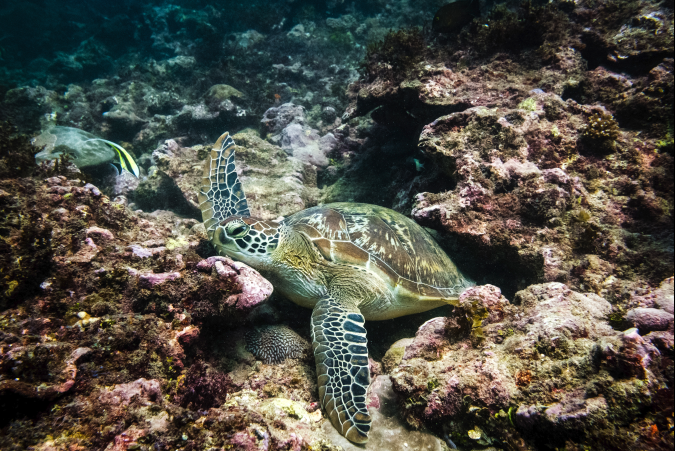
Photo: Underwater view of a green sea turtle, also called green turtle (Chelonia mydas, Cheloniidae family), resting and swimming across a rocky coral reef habitat in the Indian Ocean off Diani, Kwale County, Kenya on June 14, 2026.
Off Shimoni, near Kenya’s border with Tanzania, the seabed has become an unusual underwater garden. Rounded cages resemble small greenhouses. Other structures look like trees, their branches holding coral fragments that hang like leaves. Fish move among the growing colonies. Behind this remarkable sight is painstaking work: divers from REEFolution return to the water every day to attach, check and monitor the corals. Much like a damaged forest replanted tree by tree, the reef is being rebuilt fragment by fragment.
Shimoni feels distant from Kenya’s busier seaside resorts, yet its peaceful surroundings conceal serious damage underwater. Dzivula Gube, who has worked with REEFolution for four years, describes reefs in very different conditions. Some still support abundant marine life, while others have suffered significant coral mortality. Rising sea temperatures, fishing pressure and pollution have weakened ecosystems on which local fishing communities and tourism depend.
REEFolution’s work relies heavily on the surrounding communities. Its Reef Ranger programme trains local residents to dive, restore corals and monitor marine life. More than 30 people have acquired these skills, according to Dzivula. Across the organisation’s restoration projects, more than 56,000 coral fragments have been planted on over 6,000 structures. Dzivula reports that some monitored restoration areas have recorded up to seven times greater fish biomass than comparison sites. The return of marine life to these artificial habitats demonstrates the potential of restoration, but the work remains vulnerable to forces far beyond Shimoni.
In 2024, exceptionally warm water triggered devastating coral bleaching. REEFolution’s annual report recorded bleaching in 80% to 90% of corals in its working region, including those growing on artificial reefs. Dzivula estimates that coral losses around Shimoni exceeded 70% during the event. Colonies painstakingly grown and transplanted over several years were destroyed. “Restoration cannot simply mean replacing what was lost,” he warns.
From international commitments to local conservation
These challenges were particularly relevant when Mombasa hosted the 11th Our Ocean Conference in June 2026, the first edition held in Africa. The final conference figures record 370 commitments worth $7.5 billion, including 42 Kenyan commitments valued at approximately $1 billion. They cover marine protection, sustainable fisheries, climate action and the blue economy. These figures represent announced commitments rather than money already spent on conservation.
Some announcements directly concern the pressures observed around Shimoni. Kenya signed an international commitment to protect climate-resilient coral reefs, with measures covering reef monitoring, pollution, destructive fishing and community participation. The government also committed to finalising marine conservation and restoration regulations that would recognise and support community-led conservation initiatives. Both could help organisations such as REEFolution, although neither constitutes a confirmed direct grant to its restoration work.
Further north, in Watamu, marine conservation takes a different form. At Local Ocean Conservation’s peaceful rehabilitation centre, injured and sick turtles receive care, with a veterinarian visiting to perform operations when necessary. Staff venture into the sea with masks and snorkels to collect seagrass to feed the animals. Some turtles have swallowed plastic or fishing hooks; others have been injured by boats or entangled in abandoned nets. Their recovery can take months.
Marine biologist Joey Ngunu Wandiga works with Local Ocean Conservation, an organisation whose origins date back to 1997, when it began as Watamu Turtle Watch. He describes a considerable change in attitudes over nearly three decades. Turtles were once commonly hunted for meat, oil and shells. Today, many fishers report animals accidentally trapped in their fishing gear.
A network of more than 100 local fishers participates in the organisation’s Bycatch Release Programme. Each reported turtle is identified, measured, examined and released when possible, while fishers receive modest compensation for their time and damaged equipment. Approximately 97% of turtles reported through the programme return to the ocean alive. Joey stresses that conservation works best when fishing communities are treated as partners rather than obstacles.
Protecting nesting beaches presents another challenge. Joey’s figures show that Watamu averaged approximately 37 to 39 nests per season both in the early 2000s and in recent years, suggesting a relatively stable nesting population rather than rapid recovery.
Average hatching success increased from about 73% in the early 2000s to 79% between 2021 and 2025. But nearly two-thirds of nests monitored during that recent period required relocation, compared with about half two decades earlier. Coastal erosion, high tides and beachfront development threaten the sand turtles need to nest. “Relocation helps, but it's a sign of a problem, not a solution,” Joey explains.
The challenge of making protection last
Among Kenya’s conference announcements was a $200 million commitment to introduce electronic monitoring on industrial fishing vessels. Such a measure could strengthen oversight of large-scale fishing, but it does not directly finance turtle rehabilitation, cooperation with small-scale fishers or coral transplantation.
Both Dzivula and Joey want greater continuity in conservation funding. Short-term projects cannot replace long-term monitoring, effective protection of marine habitats and opportunities for coastal communities to earn a living while protecting their resources.
The conference has produced ambitious commitments, but their effects will depend on implementation. In Shimoni, divers will continue returning to their underwater coral gardens. In Watamu, fishers will continue reporting turtles caught in their nets. Their daily work offers a concrete measure of what ocean conservation requires, long after delegates have left Mombasa.