Norway has Europe's largest deposit of the "military minerals" Found 360 billion USD
Far between mountains and valleys, Norwegian geologists have made a sensational
discovery. The ground is full of the metals neodymium and praseodymium. These rare
earths are vital for NATO and the defence industry in the USA. Now the battle for rights and
extraction is in full swing.
By Jesper Enerstvedt
1,198 views
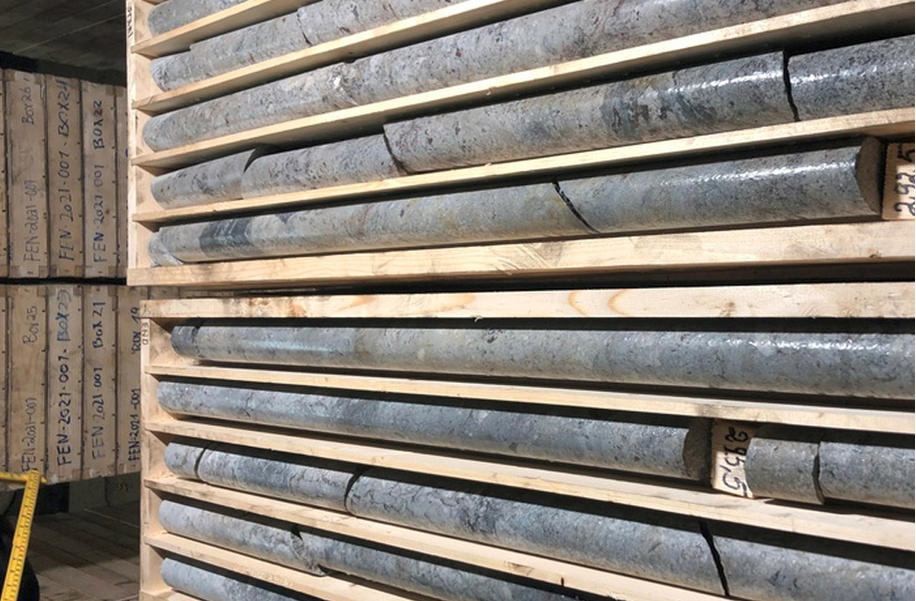
Photo: Drill cores from the Fen field in Telemark, Norway. The rock samples are used to estimate how much rare earths are hidden in the ground. Photo: Rare Earths Norway
Without neodymium, missiles cannot hit their targets with the required precision. That is why neodymium and praseodymium are vital for NATO. They are so important that the alliance has classified rare earth elements as defence-critical raw materials. Both NATO and the United States are continuously working to improve access to these materials. Now, Norway’s Fen field is emerging as a major candidate for extraction, although several pieces of the puzzle must still fall into place.
A new estimate published by Rare Earths Norway and WSP in March 2026 suggests that the Norwegian Fen field contains approximately 15.9 million tonnes of total rare earth oxides (TREO). Of this amount, neodymium and praseodymium (NdPr) account for around 19 percent, equivalent to approximately 3 million tonnes of NdPr oxide.
Updated prices from October 2026 indicate that China sells NdPr oxide for approximately $95,000–$106,000 per tonne. Benchmark reported that NdPr oxide had fallen to $95,000 per tonne CIF in Europe and North America, while the Platts assessment dropped to $115 per kilogram in July. Using a rough valuation of $120,000 per tonne for the NdPr component alone, the estimated gross value of the 3 million tonnes underground would reach approximately $360 billion.
Russia’s war in Ukraine has made discoveries of these so-called "war metals" in Norway particularly interesting to private investors, NATO, the United States and the defence industry in general. Neodymium (Nd) and praseodymium (Pr) together account for approximately 19 percent of the total rare earth oxides in the Norwegian deposit. They are among the most important metals used in high-performance magnets — materials that military powers are increasingly seeking. The Liberty Bulletin examines why, using tanks as an example.
Tanks illustrate why the battle over Norway’s Fen field matters so much to NATO countries, whose armed forces rely on neodymium in various military systems. Modern upgrades to the Abrams and Leopard 2, as well as the development of future hybrid-electric tanks, are expected to increase demand for neodymium.
The metal is used in rangefinders and targeting systems, as well as in numerous sensors and self-protection systems. Modern laser technologies, including neodymium-doped YAG lasers, are used in Western tanks such as the M1 Abrams, Leopard 2 and Challenger 2. Neodymium is an essential component in these systems, enabling precise range measurements over several kilometres.
Neodymium is therefore crucial for accuracy, but its military applications extend beyond laser rangefinders. It is also important in optical systems, thermal sights and night-vision equipment.
Advanced missiles also depend on rare earth materials. The Tomahawk uses rare earth elements in its tail-fin systems, while JDAM and other precision-guided bombs also incorporate these materials. The same applies to missiles such as AMRAAM, Javelin and Stinger, where rare earth elements are used to manufacture specialised magnets for guidance systems. Without these magnets, missile guidance and precision could be compromised. No military commander wants that.
There is considerable uncertainty over who will ultimately control the strategic minerals buried beneath the ground in Norway, the oil-rich nation. The Norwegian state has now taken over the zoning and planning process for the Fen field, but no final decision has been made regarding ownership. The state already holds significant positions in both the Norwegian oil industry and hydropower sector. In addition, it generates substantial revenue by taxing other industry players.
The United States and NATO face a major challenge: they have not secured reliable access to strategic materials such as neodymium. China dominates the mining, separation and refining industries. According to the International Energy Agency (IEA), China accounts for approximately 60 percent of global rare earth mining and more than 90 percent of refining. Its share of high-performance magnet production reaches 94 percent. By comparison, Western countries have limited capacity to produce both processed rare earth materials and finished magnets.
The West is attempting to build alternative supply chains, but, despite considerable efforts, many Western projects have struggled to survive financially. Several have accumulated substantial losses. Perhaps Norway’s Fen field could help reverse this trend. Its particularly high neodymium content offers hope that production could eventually become competitive with China. This is why both NATO and the United States are closely monitoring developments in Norway. They want better access through extraction and production, while also investing heavily in stockpiling and recycling.
Within Norway, debate is already intensifying over what should happen to the deposit. Some favour opening the field to private investors and creating a new "Klondike", while others argue that the resource should be nationalised. Norway has taken a similar approach with parts of its oil and gas industry. There are also groups within the country that, for various reasons, oppose developing the field altogether.
Comparing the Fen field’s estimated 15.9 million tonnes of rare earth oxides with the operations of the two largest producers outside China reveals another potential problem for the West. Both Australia's Lynas Rare Earths and the United States' MP Materials have faced significant financial challenges. Their market capitalisations have hovered around the equivalent of NOK 100 billion. This demonstrates that enormous estimated underground resource values do not necessarily translate into profitable mining operations.
In Australia, Lynas Rare Earths' market value has fallen from $10.61 billion in February to approximately $8.7 billion. This decline has occurred despite signs that the company is becoming profitable. Lynas' financial results for FY2026, ending in June 2026, show revenue of AUD 977.9 million and a net profit of AUD 222.4 million — a substantial improvement compared with the previous year, when the company was close to breaking even.
By comparison, Lynas reported revenue of only AUD 556.51 million in mid-2025. Although this represented an increase of 20.12 percent compared with the previous year, its financial results showed a decline of approximately 90 percent in profitability. Despite rising revenue, very little remained on the bottom line. Even if the 2026 figures represent a positive development, they do not prove that competing with Chinese producers is easy. On the contrary, the challenges remain considerable. Unfortunately for shareholders, Lynas does not pay dividends.
In California, the Mountain Pass mine is operated by MP Materials, which is also struggling to make its business model work. Its market capitalisation is broadly comparable to that of Lynas in Australia. The company reported annual revenue of $224.4 million, representing a 10 percent increase compared with 2024. Nevertheless, MP Materials recorded a net loss of $85.9 million, 31 percent higher than the previous year. American shareholders received no dividends either.
Many people may wonder how companies can operate at a loss while producing such exclusive and highly sought-after materials. One of the main reasons is the pressure exerted by Chinese production and pricing on the global market.
Both MP Materials and Lynas have benefited from government price-support mechanisms involving floor prices of approximately $110 per kilogram. When market prices fall below this level, governments cover the difference. However, even government subsidies have not made production straightforward or consistently profitable.
The fact that NATO and American authorities want to become self-sufficient is not enough to drive prices to levels that guarantee profitable production in the United States or Australia. And, as Norway may soon discover, developing the Fen field could prove just as challenging.