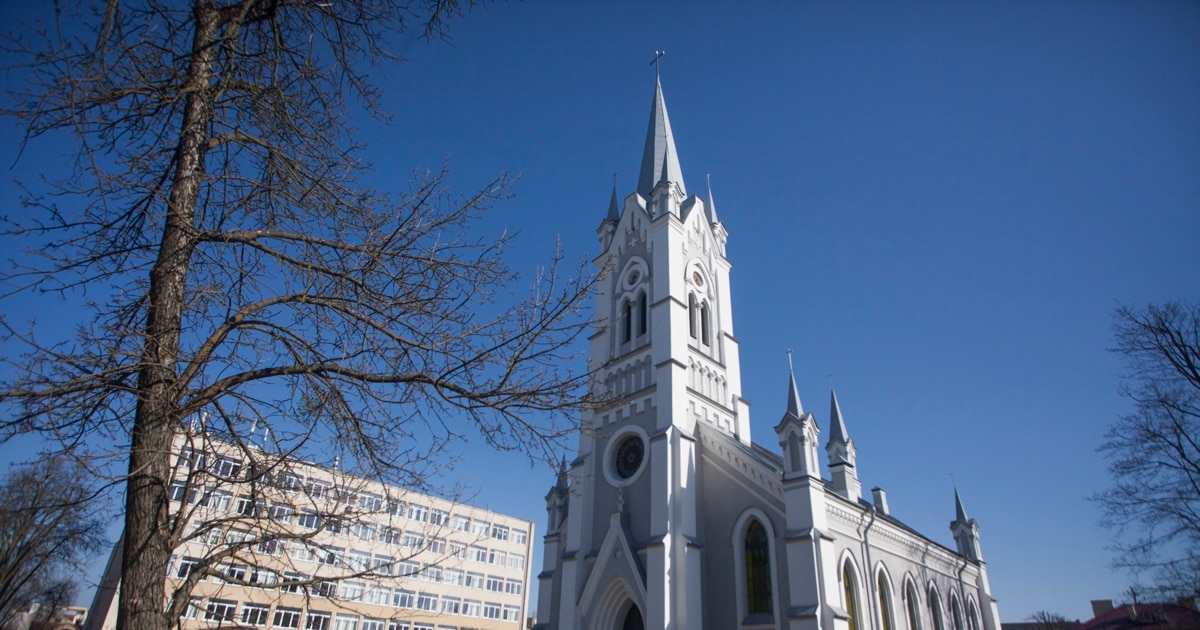
Nearly Half of Belarusian Lutheran Congregations Removed After State Re-registration, Religious Monitors Say
An analysis of state records and public databases has revealed that Belarusian authorities have liquidated or struck from the register a large share of the country’s Lutheran parishes since mandatory re‑registration began after the 2020 protests. Monitors say the removals — recorded in Ministry of Emergency Situations files and other sources — amount to almost half of the 24 Lutheran communities that existed at the start of 2024 and form part of wider pressure on non‑Orthodox churches.
By Christopher Manley
1,039 views
Independent researchers and religious monitors say that official and publicly available databases show a sharp fall in the number of legally registered Lutheran congregations in Belarus after authorities carried out a mandatory re‑registration process following the 2020 protests.
An analysis by the interfaith monitoring group Christian Vision, cross‑checked with the Kartoteka.by database that aggregates state information, identified 13 Lutheran religious organisations for which there are records of liquidation or exclusion from state registers between 2024 and 2026. According to the research, eight congregations were marked as liquidated in data attributed to the Ministry of Emergency Situations (MNS), while four other organisations have court decisions ordering liquidation in 2026, and one congregation disappeared from records in 2024.
The impact is concentrated in several regions. In Vitebsk Region, six Lutheran communities reportedly failed to complete re‑registration. Four of those — the parishes of Saints Peter and Paul and Saint Peter in Polotsk, the Resurrection of Christ in Orsha, and the John the Baptist congregation in the village of Mazalova, Vitebsk district — were listed as having been dissolved on the same day, 22 December 2025. Two additional Martin Luther congregations in the city of Vitebsk, which had different registration numbers, were also removed: one was liquidated on 15 April (year not specified in public notes), and another was deleted from registers on 2 July 2024.
Researchers found further cases in Gomel Region. Records attribute the abolition of the Holy Communion community in Khvoiniki to 13 October 2025, and they also show that an evangelical‑Lutheran congregation in Gomel was struck from registers. Kartoteka.by entries include notes that some deletions come specifically from MNS sources, while corresponding entries are absent in the official Unified State Register (the EDR/ADR), complicating transparency about the legal grounds and procedures used.
At the start of 2024 Belarus officially had 24 Lutheran congregations. Christian Vision’s findings and register cross‑checks indicate that information about liquidation or court rulings to liquidate around 10 congregations — plus the exclusion of at least one congregation from the Unified State Register — amounts to the loss of nearly half of the Lutheran parishes that existed before the re‑registration requirement.
Religious monitoring groups and church representatives say the campaign against non‑Orthodox communities follows a broader pattern of pressure on religious bodies since the mass protests of 2020. The mandatory re‑registration process, implemented by the state in the years after the protests, has coincided with prosecutions, detentions and forced departures of clergy. Christian Vision reports that more than 90 Belarusian priests across Christian denominations have faced repression since 2020; 35 of those were Catholics. The Catholic Church has not issued an official comment in Belarus or from the Vatican addressing the political persecution of its clergy, according to the report.
In April 2026 Belarusian courts ordered the liquidation of all Greek‑Catholic parishes in Brest Region, dissolving parishes in Brest, Ivatsevichi and Baranavichy. Observers note that only one Greek‑Catholic parish remained in the Pinsk diocese (in Gomel), and that nationwide there are roughly a dozen to a dozen‑and‑a‑half Greek‑Catholic parishes left.
Some clergy and analysts link the selective enforcement and liquidation of religious communities to the state’s open support for the Orthodox Church of the Moscow Patriarchate. Orthodox priest Aleksandr Shramko told monitors in 2025 that authorities’ clear backing of the Moscow Patriarchate helps explain continued pressure on other Christian confessions. Observers also point to the role of state officials; Christian affairs and nationality commissioner Aleksandr Rumak — the predecessor to the current commissioner — has regularly participated in synod sessions, underscoring the tight relationship between state structures and the dominant Orthodox institution.
The deletions and court decisions documented by Christian Vision and public registries raise questions about legal transparency, the protection of minority religious rights and the future of congregational life for Lutheran and other non‑Orthodox believers in Belarus. With large numbers of clergy detained or forced into exile since 2020, the reduction in legally recognised congregations has left many communities without formal status and, according to legal experts and church leaders contacted by monitors, with diminished capacity to operate openly or manage property and communal activities under Belarusian law.
The findings rely on a combination of state‑sourced notes in public databases and analysis by independent monitors. Authorities have not published comprehensive public explanations for the cluster of liquidations and exclusions that researchers have catalogued, and some of the MNS entries noted in secondary databases do not yet appear in the official Unified State Register, leaving unresolved questions about procedure, grounds and appeal routes for affected congregations.