Migration & Schengen Controls: Poland Extends Lithuanian Border Checks Through Spring 2027
As Poland sharply reduces unauthorized crossings from Belarus, migration pressure has increasingly concentrated on Latvia and Lithuania, while recent smuggling cases show secondary routes running through Lithuania and Poland toward Germany.
By Pawel Cybulski
1,040 views
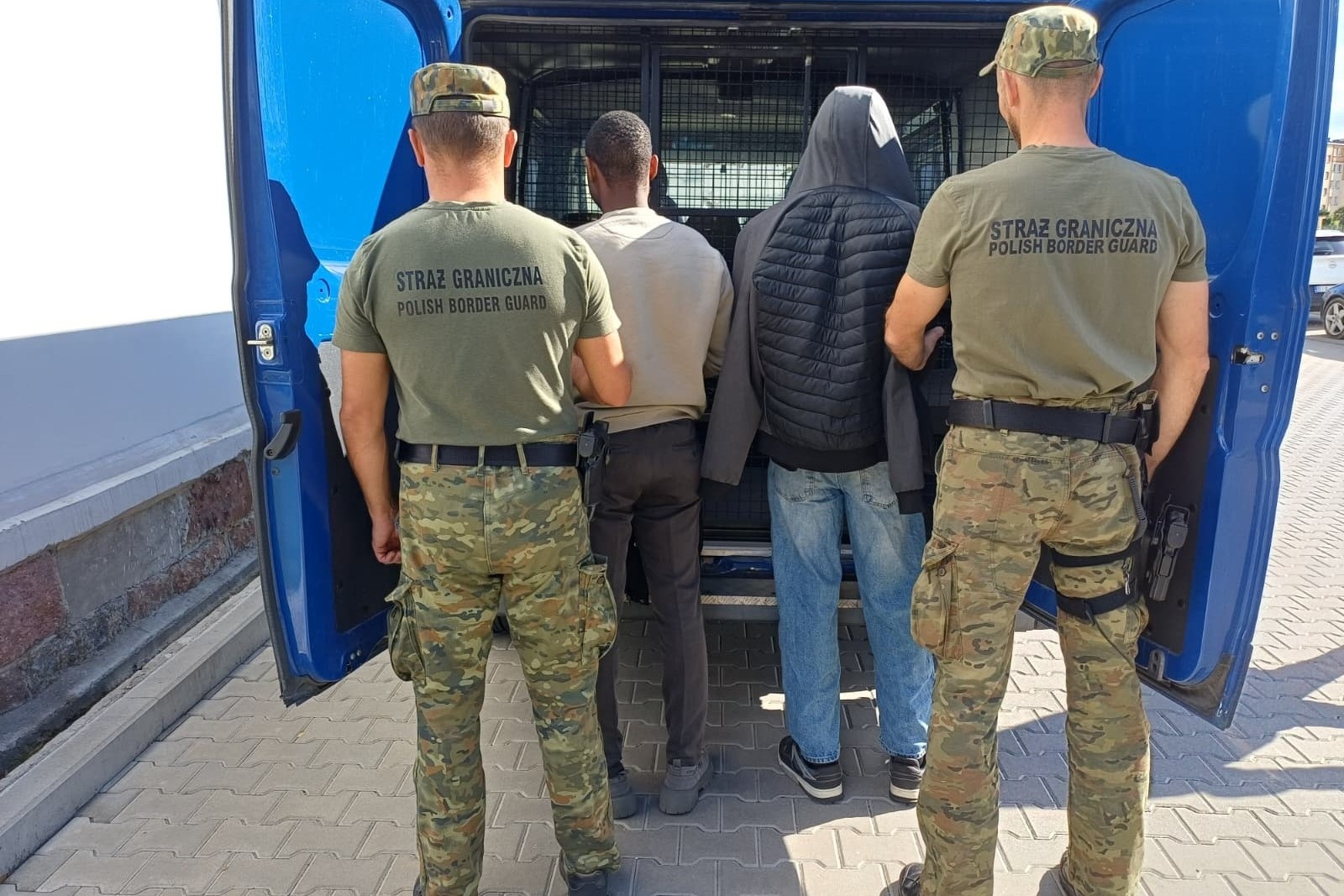
Photo: POSG Content: Detention of irregular migrants by the Border Guard.
On October 2, 2026, the Polish Ministry of Interior and Administration formally extended temporary border controls along its internal Schengen frontier with Lithuania through March 30, 2027. The six-month prolongation underscores a structural shift in Central Europe’s security landscape: while Poland’s multi-layered defensive infrastructure has choked off direct illegal crossings from Belarus, state-sponsored smuggling networks have adapted by rerouting transit vectors through Lithuania and Latvia before attempting to cross back into Poland and move westward toward Germany.
The Evolving Transit Vector: From Eastern Shield to Baltic Rerouting
The extension of checks on the Polish-Lithuanian border—initially reinstated on July 7, 2025—comes as law enforcement agencies report that tightening the direct Polish-Belarusian line has changed the geography of regional migration routes without fully eliminating the pressure.
According to a July 2026 report by the Centre for Eastern Studies (OSW), comparative data for the first half of 2026 highlights a dramatic geographic redistribution of illegal crossing attempts along the EU’s eastern frontier:
● Latvia: Over 8,000 attempted illegal crossings recorded.
● Lithuania: 905 attempted illegal crossings recorded.
● Poland: Slightly over 260 direct attempted illegal crossings recorded.
The current primary pipeline for unauthorized entry into the European Union follows a multi-stage path: Belarus → Lithuania/Latvia → Poland → Germany. With direct pressure on Poland as an external EU border drastically diminished, the burden has shifted heavily onto Latvia and, to a lesser extent, Lithuania, turning internal Schengen boundaries into secondary defensive lines.
From Hybrid Attack to 100% Interception: Poland’s Border Fortification The systemic crisis began in the spring of 2021, when the regime of Alexander Lukashenko systematically organized travel pipelines for migrants from the Middle East and other regions, funneling them toward EU borders in coordination with human trafficking networks.
On August 23, 2021, the leaders of Poland, Lithuania, Latvia, and Estonia jointly characterized the maneuver as a hybrid attack—an assessment formally backed by NATO and the European Commission, which noted Minsk's strategy to generate a "continuous and chronic crisis" aimed at destabilizing the bloc.
In response, Warsaw instituted a progressive, multi-layered defense strategy:
● Physical and Electronic Barriers: In 2022, Poland constructed a 186-kilometer, steel perimeter wall. To prevent breaches, the barrier was supplemented with a comprehensive electronic monitoring network featuring thermal cameras and motion sensors.
● Infrastructure Upgrades (2024–2025): By late 2024, the steel wall was reinforced with double horizontal bracing and additional concertina wire. In 2025, secondary camera lines overlooking the Belarusian side, LED lighting along patrol roads, and specialized sensors at water culverts were installed.
● Buffer Zones and Legal Reforms: Poland established a restricted buffer zone along the border to curb organized smuggling operations. Furthermore, 2025 legislative amendments recognized the "instrumentalization of migration" as a distinct national security threat, allowing temporary restrictions on filing international protection applications at the Belarusian border—causing official asylum filings along that specific sector to drop precipitously.
● Integration into "East Shield": Border infrastructure was integrated into Tarcza Wschód (East Shield), an 800-kilometer defense initiative combining physical fortifications and military readiness.
By April 2026, Deputy Prime Minister and Minister of National Defense Władysław Kosiniak-Kamysz declared that the effectiveness of the physical and electronic barrier along the Belarusian border had reached 100% in halting unauthorized entries.
Baltic Vulnerabilities and the Latvian Bottleneck
While Poland fortified its border, Baltic nations deployed similar multi-tiered defense systems. Lithuania constructed over 450 kilometers of fenced perimeter and brought its entire Belarusian border under electronic surveillance. Latvia completed roughly 145 kilometers of physical barriers by 2024.
However, Latvia remains the most vulnerable entry point on the eastern flank. Latvian authorities prevented 12,046 illegal crossing attempts in 2025 and approximately 8,000 in the first half of 2026 alone. OSW analysis attributes Latvia's heightened vulnerability to several key factors:
● Unfinished physical barrier sections and an electronic surveillance system still under active deployment.
● Personnel shortages within the Latvian Border Guard and resource constraints.
● Difficult natural terrain dominated by dense forests and expansive wetlands.
Despite Latvia launching Operation "VILKATIS" in 2026 to bolster joint military-police border patrols, intense pressure on its frontier continues to spill over into neighboring Schengen transit corridors.
Interceptions on the Polish-Lithuanian Frontier
To stem secondary transit, Polish authorities have established 13 dedicated control points along the Lithuanian border, including major highway stations at Budzisko and Ogrodniki, alongside a rail inspection post in Trakiszki. Operational duties are carried out by a multi-agency task force comprising the Border Guard (Straż Graniczna), Territorial Defense Forces (WOT), Polish Armed Forces, Police, National Revenue Administration (KAS), Railway Protection Guard (SOK), Road Transport Inspection (ITD), and Forest Guard.
Between July 2025 and July 2026, Polish officers on the Lithuanian border inspected over 1.7 million individuals and 930,000 vehicles, issuing over 1,060 entry refusals and returning over 1,100 foreign nationals to Lithuania under readmission agreements.
By October 2026, Ministry of Interior data showed total entry refusals rising to nearly 1,300, with over 130 individuals arrested for organizing and facilitating illegal border crossings.
Recent interdictions highlight the organized nature of the transit corridor:
● September 14–16, 2026: Border Guard officers intercepted a refrigerated truck on the A2 highway carrying 34 migrants heading toward Germany. Two Serbian drivers were arrested on organized human trafficking charges. Several migrants carried documentation confirming they had recently submitted international protection applications in Latvia and Lithuania.
● June 18, 2026: A joint operation by the Podlaskie and Maritime Border Guard divisions intercepted two Ukrainian drivers transporting eight migrants (five Afghan and three Pakistani nationals) who had crossed into Poland from Lithuania en route to Germany.
Geopolitical Takeaway
With Germany extending its own internal border controls through March 30, 2027, to catch secondary migration flows originating from Poland, Central Europe's internal Schengen borders are increasingly operating under semi-permanent surveillance regimes. Warsaw's decision to maintain checks on the Lithuanian border demonstrates that sealing an external border on one sector inevitably forces state security apparatuses to maintain active vigilance over internal transit corridors across the wider region.