Merz’s Germany and the EU’s Enlargement Dilemma: Merit-Based Accession or Geopolitical Priorities?
Germany has traditionally been one of the most influential countries in the European Union’s enlargement policy. But with Friedrich Merz leading a CDU/CSU–SPD coalition government, Berlin’s approach to bringing new countries into the bloc is entering a new political phase.
By Albina Kastrati
823 views
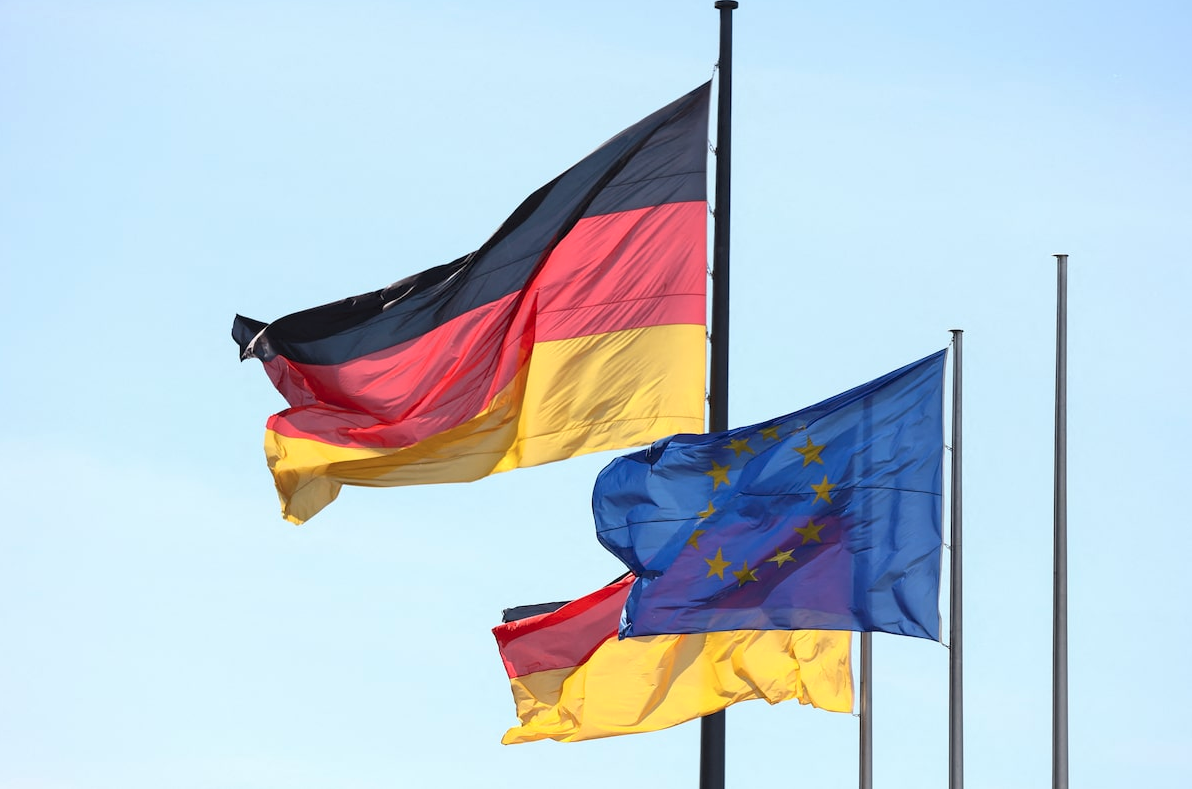
Photo: The flags of Germany and the European Union flutter on the day of a session of the lower house of the German parliament, the Bundestag, in Berlin, Germany, May 21, 2025.
In June 2026, Germany and France proposed a model of gradual integration that would allow candidate countries to participate more closely in EU structures before becoming full members. The initiative envisages earlier access to parts of the single market, EU programmes and political cooperation, while keeping full membership as the ultimate objective. The proposal reflects growing recognition among European governments that the traditional accession process has struggled to maintain momentum.
Merz had already put forward a separate proposal for Ukraine. In a letter to EU leaders dated 18 May, he suggested creating an associate membership status that would allow Ukraine to participate in EU institutions, including meetings of the European Council and the European Parliament, without voting rights. The proposal also envisaged access to certain EU programmes, while Ukraine continued its formal accession process. Merz presented this as an interim arrangement, arguing that full membership could not be achieved in the short term given the country's circumstances and the political and legal obstacles involved.
The same letter also addressed the Western Balkans, proposing observer status in EU institutions and closer access to the single market. At the EU-Western Balkans Summit in Montenegro in June, Merz reiterated that full membership remained the objective for the region. He rejected the suggestion that he wanted different speeds of integration, arguing instead that Ukraine and the Western Balkan countries faced different circumstances and had made different levels of progress. He pointed to Ukraine's ongoing war and Montenegro's advanced accession negotiations as examples.
The proposal has also raised questions in Kyiv. Ukrainian President Volodymyr Zelenskyy described associate membership without voting rights as unfair, arguing that Ukraine should pursue full and equal membership rather than a status that would leave it without a voice in EU decision-making. The European Commission, meanwhile, has said that any innovative arrangements must be assessed carefully and remain anchored in the merit-based accession process.
A position paper published by Germany’s Social Democratic Party (SPD) parliamentary group on 22 September proposes that new member states initially join without veto powers. The restrictions would eventually apply equally to all member states, with a transition period of no more than ten years. The paper also calls for stronger safeguards for democracy and the rule of law, and changes to the EU's decision-making procedures.
The SPD is part of Germany's current governing coalition, alongside the CDU and its Bavarian sister party, the Christian Social Union (CSU). However, the paper represents the SPD parliamentary group's position, not an agreed policy of the German government.
In written answers to *The Liberty Bulletin*, Dr David Preisendanz, a CDU/CSU member of the Bundestag, said he supported giving new momentum to EU enlargement while maintaining the accession criteria.
“It is crucial to strike a balance between these two goals: pursuing a strategically ambitious enlargement policy without compromising our own standards,” Preisendanz said.
He described gradual integration as a way of bringing candidate countries closer to the EU before full membership, including through phased access to the European single market. He also argued that institutional reform and enlargement should advance simultaneously, rather than one being made a precondition for the other.
“Rather than waiting until full accession to benefit from comprehensive integration, these countries should be more closely integrated into selected areas of the EU during the accession process itself,” he said.
Preisendanz also called for changes to the EU's decision-making structures, including reducing the number of European Commissioners and expanding the use of majority voting in additional policy areas. He referred to the possibility of safeguard clauses in accession treaties to protect the EU's fundamental values after new members join.
On the Western Balkans, Preisendanz said Germany was committed to bringing candidate countries closer to the EU during the current legislative period. However, he stressed that progress would remain conditional on reforms, particularly in the fight against corruption, strengthening the rule of law and ensuring an independent judiciary.
“Any country that is serious about becoming part of the EU and is consistently pushing forward with the necessary reforms can count on our full support,” he said.
Under Merz, the CDU holds the chancellorship and the foreign ministry. Research by the German Council on Foreign Relations (DGAP) suggests that enlargement policy within the government is shaped primarily by the CDU, while the CSU takes a more cautious position, emphasising internal EU reforms before decisions on a new accession model. The same analysis describes differences in how Berlin assesses the Western Balkan candidates. This means the government's support for enlargement should not be mistaken for a unified political position.
Corina Stratulat, Associate Director and Head of the European Politics and Institutions Programme at the European Policy Centre, told *The Liberty Bulletin* in a written response that Germany remains one of the countries best positioned to turn support for enlargement into agreement among EU member states. However, she argues that its influence will ultimately depend on whether Berlin can build consensus on the difficult questions surrounding accession, including budgets, institutional arrangements and the conditions attached to membership.
Gradual integration could offer candidate countries tangible benefits before accession. Earlier access to EU programmes and parts of the single market could support economic convergence, strengthen administrative capacity and make the process more meaningful for citizens. Yet Stratulat warns that these arrangements cannot resolve bilateral disputes or create political consent where member states are unwilling to approve accession.
“Any intermediate arrangement must offer a credible route to full membership. An indefinite status with limited rights would be unacceptable. Participation in EU policies before accession and restrictions on a country's rights after accession raise different questions. Before accession, the danger is an indefinite position in which countries implement more and more EU law with limited influence over its adoption. After accession, exceptional restrictions on newcomers could create a two-tier Union if they become entrenched or difficult to lift. Transitional arrangements and safeguards need clear conditions, proportionate measures and credible exit mechanisms. The EU also needs effective ways to uphold its rules across all member states,” Corina wrote.
The consequences of Germany's approach are particularly relevant across the Western Balkans, where countries are progressing at very different speeds.
Montenegro and Albania are currently the most advanced candidates in the region. Montenegro has opened all 33 negotiating chapters and provisionally closed 21, while Albania has opened all 33 and provisionally closed four, according to the EU's October 2026 accession conferences. The European Commission has identified both countries among the four enlargement partners that have made particularly significant progress this year. (Council of the EU, October 2026).
Serbia presents a different challenge. Germany's conservative politicians have maintained political connections with Serbia's ruling Serbian Progressive Party (SNS), which is associated with the same European political family as the CDU and CSU. But, as DGAP notes, concerns about democratic backsliding, the treatment of student protesters and Serbia's continued ties with Russia have complicated Berlin's relationship with Belgrade. Germany's approach therefore involves balancing political engagement with pressure for democratic and institutional reforms.
For Kosovo, the debate carries a different significance. Kosovo remains a potential candidate for EU membership and has not opened accession negotiations. The European Commission's November 2026 assessment describes progress as uneven, placing Kosovo among the countries facing significant obstacles in their accession paths.
A more flexible enlargement process could bring Kosovo closer to European institutions and offer practical benefits before membership. But it would not resolve the political obstacles that continue to shape its European path, including the unresolved relationship with Serbia and the fact that not all EU member states recognise Kosovo's independence.
For Stratulat, the challenge extends beyond agreeing on a new accession model. Political readiness among member states remains uneven, and governments must build public and parliamentary support for the admission of new countries.
“Political readiness remains uneven, and governments still need to build consent for concrete accessions. Internal reform should advance alongside enlargement, with clear agreement on which adjustments are essential before a new country joins… The immediate political task is to explain enlargement's benefits, costs and safeguards to national parliaments and publics well before they are asked to approve an accession treaty,” she concluded.