Mayon erupts again, leaving families caught between danger and home
Mount Mayon’s latest eruption has forced thousands of residents in the Philippines to evacuate once again, highlighting the recurring disruption faced by communities living in the volcano’s shadow. Beyond the immediate danger, families continue to struggle with damaged farmland, lost livelihoods and the difficult choice between remaining near their homes or relocating to safer areas.
By Martin Bertrand
907 views
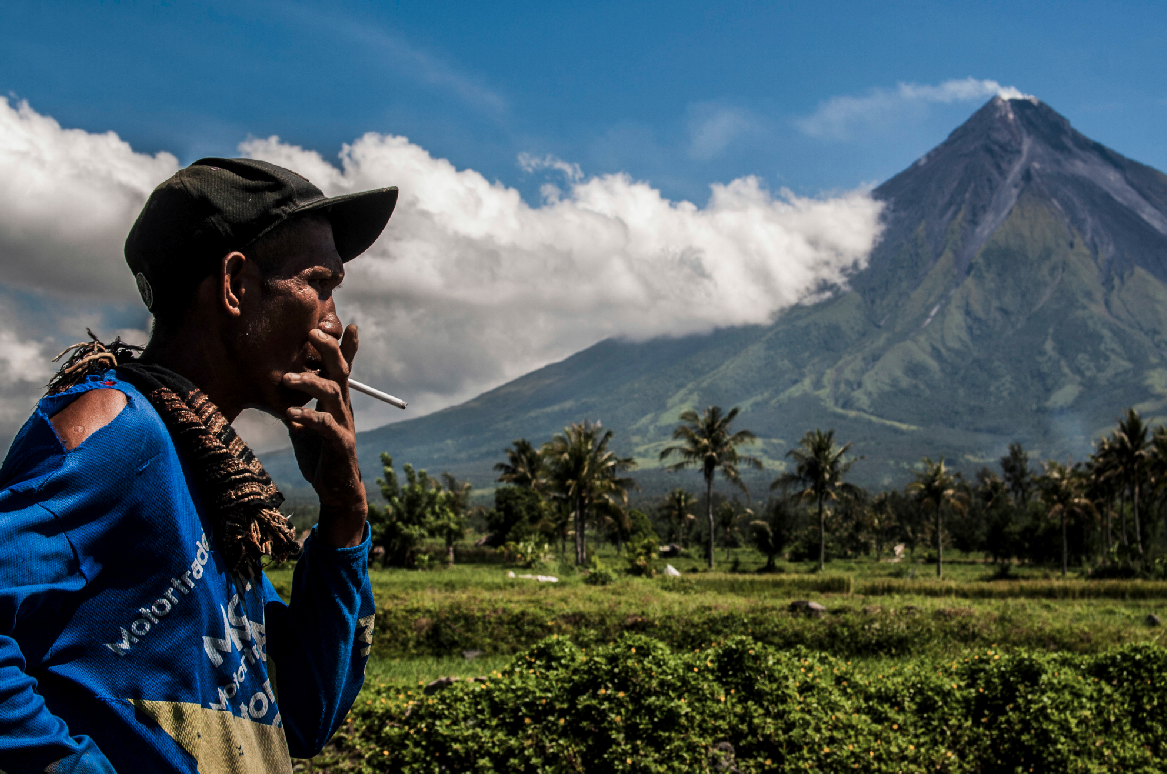
Photo: Mount Mayon, the man facing a giant of nature. Mount Mayon , the most active volcano in the Philippines and its people living in its vicinity who undergo forced evacuations as well as the constraints of a risk area. Lava flows of rivers dug dangerous because landslides are common. Despite this, men are often forced to go there to get the earth and stones to build or rebuild their homes.
When Mount Mayon erupted in the Philippines on October 30, sending a thick column of ash three kilometres above its summit, thousands of people living around the volcano faced a familiar prospect: leaving their homes, their fields and sometimes their animals behind. By the end of the afternoon, 746 families, representing 2,041 people, had already been evacuated from communities in Albay province. The latest evacuation added to a year of repeated disruption around the mountain, after an earlier period of volcanic activity had kept thousands of residents away from their homes for months.
The eruption began at 11:53 a.m. and lasted six minutes. The Philippine Institute of Volcanology and Seismology (PHIVOLCS) immediately raised its warning to Alert Level 3, describing a "new phase of magmatic eruption". The institute warned of possible lava flows and pyroclastic density currents, extremely hot mixtures of gas, ash and volcanic debris that can travel rapidly down the slopes. Residents were ordered to leave the sixkilometre permanent danger zone. In the following days, the volcano continued to show signs of unrest, with ash emissions, rockfalls and minor explosive activity.
Living beneath the volcano
For those living on Mayon's slopes, such warnings have shaped everyday life for generations. Roughly a decade ago, in Magapo, a village reached along a difficult path through dense vegetation away from the surrounding towns, Amalia Ansing, a mother of four, described the difficulties of raising a family so close to an active volcano. Here, ashfall could destroy the sweet potato crops on which they depended and volcanic tremors were part of their experience. Water was another constant concern. Their well had dried up years earlier, leaving the family dependent on rainwater collected during downpours. But Ansing's greatest fear was another evacuation. Between October and December 2014, her family had been displaced to a school, where around 90 people from 17 families shared a single classroom. Overcrowding, poor hygiene and limited access to toilets and water made those months particularly difficult. When they finally returned home, their poultry and other domestic animals had died.
Her experience illustrates the consequences of living beside Mayon that rarely appear in volcanic monitoring reports. The mountain may remain quiet for months, sometimes years, but its inhabitants must organise their lives around the possibility of another departure. On its slopes, volcanic activity has carved unstable channels through which residents have nevertheless travelled to collect earth and stones needed to build or repair their homes. The same landscape that sustains these communities can suddenly become too dangerous to enter.
Almost twelve years after Ansing's evacuation, the problem remains strikingly similar. In January 2026, renewed volcanic activity forced thousands of residents to leave their homes. Many spent seven months in temporary shelters before authorities allowed them to return in August, after PHIVOLCS lowered the alert level.
Returning did not necessarily mean returning to normal life. "Volcanic ash covered our fields. We will have to replant and revive our farms so we can provide for our families," Vilma Mostera, a resident of Anoling in Camalig, said in an account published by the Philippine Information Agency on September 1. Other returning families reported losing livestock and crops during their absence.
The economic damage was substantial. According to the Philippine Department of Agriculture, by early May 2026, months before the latest eruption, ashfall had damaged 102 hectares of agricultural land, affecting 228 farmers and causing an estimated 13 million pesos in losses. More farmland remained inaccessible because of safety restrictions.
Between protection and displacement
Rising 2,462 metres above Albay, Mayon is famous for its almost perfectly symmetrical cone. Its name is linked to the local legend of Daragang Magayon, a beautiful young woman whose tragic love story is said to have given birth to the mountain. Yet its history is marked by destruction. On February 1, 1814, an eruption buried the town of Cagsawa, killing approximately 1,200 people. The surviving church ruins remain one of the region's best-known landmarks.
Today, the volcano is closely monitored. As of November 2, PHIVOLCS maintained Alert Level 3. Its latest observations included volcanic earthquakes, rockfalls and short episodes of Strombolian activity, involving bursts of incandescent material at the summit. The agency also warned that heavy rainfall could trigger lahars, dangerous mudflows carrying volcanic debris down the mountain's river channels.
The authorities have worked to reduce the population exposed to these hazards. In January, Albay Governor Noel Rosal said relocation programmes had reduced the number of residents living inside the danger zone in several municipalities from nearly 9,000 in previous years to fewer than 3,000. In a statement published on January 21, the Philippine Department of the Interior and Local Government (DILG) said it was prioritising permanent relocation rather than repeated emergency evacuations. Interior Secretary Jonvic Remulla argued that providing permanent housing in safer areas was essential to prevent families from being displaced every time Mayon became active.
But relocation raises another question. Where can families rebuild their lives without losing access to the land on which they depend? Moving away from the volcano may provide greater safety, but agricultural livelihoods cannot always be transferred so easily. Meanwhile, emergency shelters, financial assistance and food distributions offer temporary relief without necessarily resolving the economic consequences of displacement. For communities around Mayon, the October eruption has revived that uncertainty.