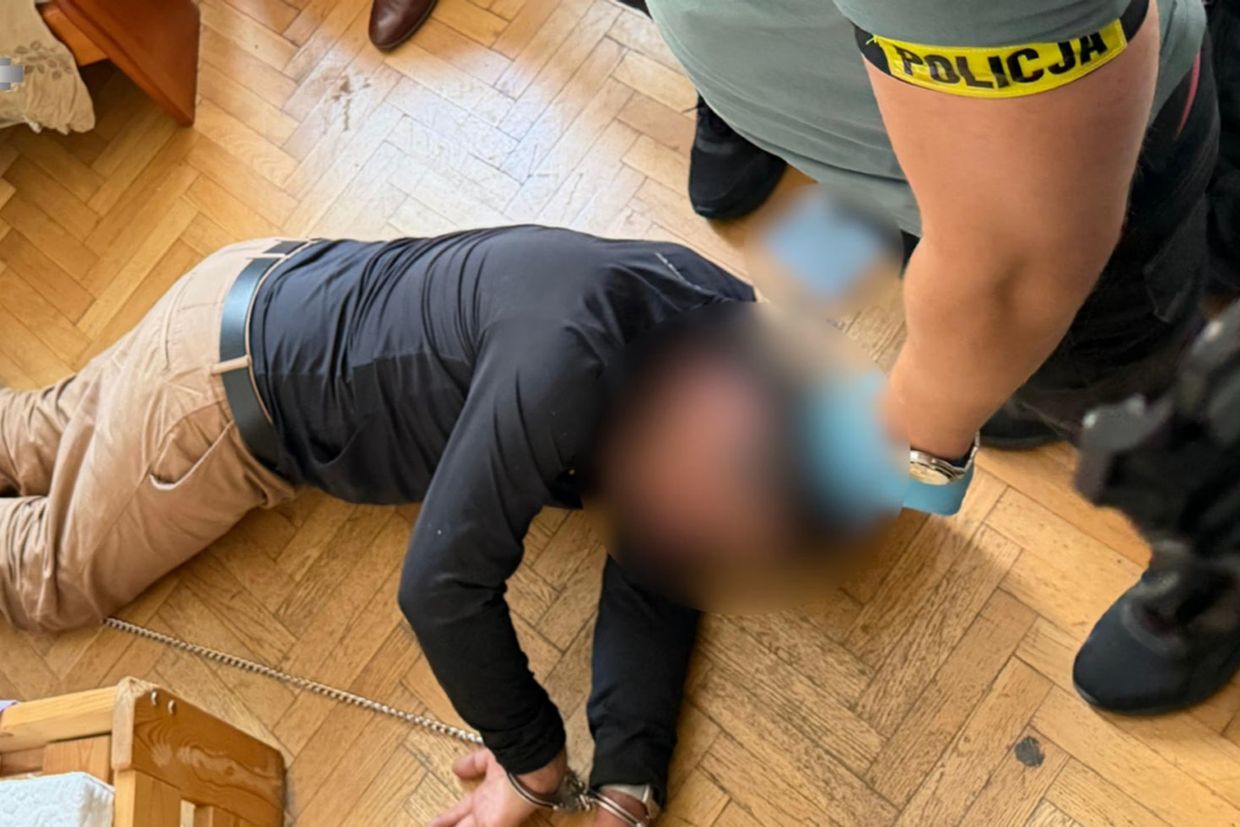
Man carrying Georgian passport detained in Poland on suspicion of murdering Russian satirical artist Robert Kuzovkov
Polish authorities have arrested a suspect carrying a Georgian passport on suspicion of killing Russian satirical artist Robert Kuzovkov, known as Semyon Skrepetsky, who was shot dead in Biała Podlaska on 15 June. Officials say the arrest was made near Warsaw and are investigating whether the killing was politically motivated and possibly linked to foreign intelligence services.
By Elizaveta Chukharova
824 views
Polish law enforcement announced the arrest of a man carrying a Georgian passport on suspicion of involvement in the killing of Russian satirical artist Robert Kuzovkov, also known by the pseudonym Semyon Skrepetsky. The arrest was confirmed on social media by Prime Minister Donald Tusk, who said officers from the Lublin province police and the Internal Security Agency (ABW) detained the suspect on Thursday morning in the town of Piastów near Warsaw.
Polish media outlets reported slightly different accounts of where the arrest took place: Oney said the man was detained at a Georgian restaurant, while RMF FM reported the arrest occurred at a workers’ hostel. Authorities have said the passport used by the detainee was issued in the name of a 36-year-old Georgian citizen. Some outlets, including Onet and RMF FM, meanwhile reported that the passport may be forged and that the individual could be from Chechnya; Polish officials have not officially confirmed those reports.
Prime Minister Tusk has described the murder as most likely politically motivated, warning that if evidence emerged of Russian state involvement “the case would take on a serious international dimension.” Polish officials said investigators are working to determine who ordered the killing and to establish whether the attack was the result of an operation by a foreign intelligence service.
Minister-Coordinator of Special Services Tomasz Siemoniak said the identity of the alleged killer was pieced together using analysis of surveillance camera footage, communications data and witness statements. Interior Minister Marcin Kierwiński added that the detainee is suspected of committing other crimes in Poland since 2022, though he did not provide further details.
Siemoniak suggested that the use of criminals by foreign intelligence services is a known method: “This may be a method used by foreign intelligence services to recruit criminals to carry out various tasks. We have already encountered similar cases in previous years, although at that time they involved not murders, but attacks.” He also noted, without naming specific incidents, that “in recent years killings allegedly organised by Russian intelligence services had taken place in various countries.” On the possibility that Russia could be behind the killing, Siemoniak said: “We must seriously consider the possibility that if a person who openly criticised Putin and Kadyrov dies in this way, it is a plausible hypothesis. But it must be confirmed by evidence.”
Kuzovkov, recognised for his anti-war performances and sharp criticism of Russian, Ukrainian and Chechen officials, was shot dead on the morning of 15 June in a car park near shopping pavilions on Queen Jadwiga Street in the eastern Polish city of Biała Podlaska. The site is close to the Belarusian border and around 500 metres from the Belarusian Consulate. Investigators say Kuzovkov was shot at close range and died at the scene.
The artist had emigrated from Russia to Poland in 2021, citing fears of political persecution, and continued to participate in events organised by the Russian opposition. He was known for caricatures of Russian President Vladimir Putin, Chechen leader Ramzan Kadyrov, Kadyrov’s son Adam and Akhmat battalion commander Apti Alaudinov. Shortly before his death, Kuzovkov staged a performance with a discarded Russian flag near the Brandenburg Gate in Berlin, after which he began receiving threats.
Immediately after the killing police detained two Belarusian citizens; one of them attempted to enter the Belarusian Consulate in Biała Podlaska. Investigators subsequently released both Belarusians the following day, concluding they were not involved in the murder. Polish authorities say their current focus is establishing the suspect’s true identity, the provenance of the Georgian passport, whether it was forged, whether the detainee has ties to criminal networks operating in Poland, and ultimately who ordered and carried out the killing.
As the investigation proceeds, Polish officials have underscored the potential international implications if evidence points to state-sponsored involvement. The case has renewed concerns about the safety of exiled dissidents and activists in Europe and the methods used by foreign services to silence critics abroad. Polish authorities have said they will provide updates as forensic and communications analyses continue and as they seek to confirm the suspect’s origins and any links to foreign actors.