Malta's water paradox: less rain, more demand and a Mediterranean dilemma
Malta is facing growing water stress as consecutive years of below-average rainfall coincide with population growth and record tourism numbers. Although desalination supplies around 70% of the island’s drinking water, experts warn that long-term water security will also depend on reducing demand, expanding wastewater reuse and balancing tourism and agriculture with the limits of the Mediterranean’s scarce freshwater resources.
By Martin Bertrand
1,093 views
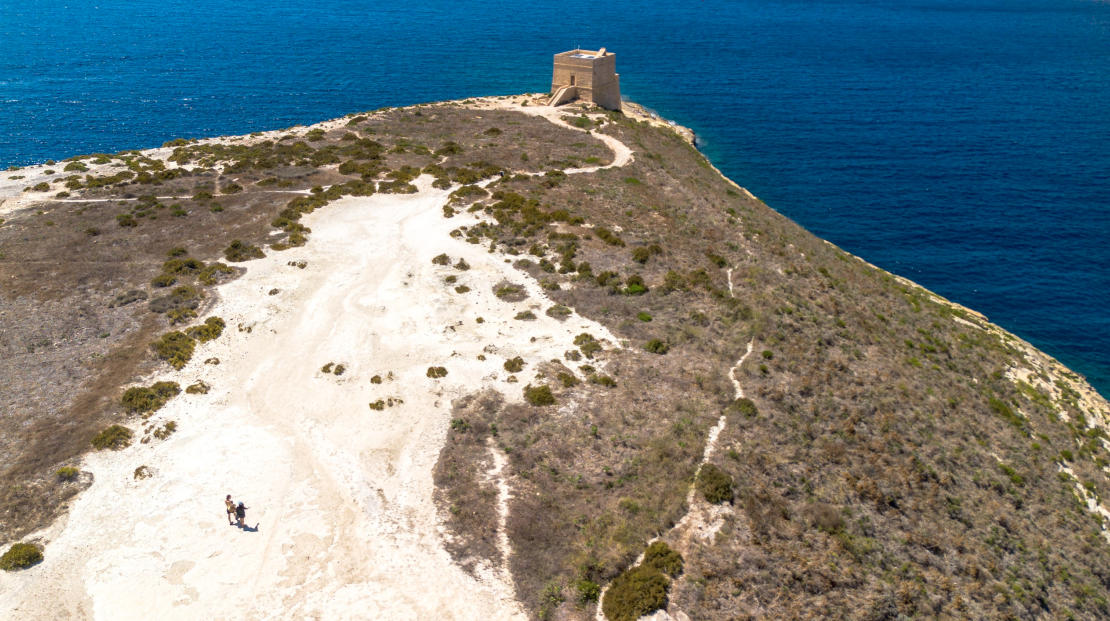
Photo: Aerial view of a coastal watchtower on a rocky headland above the Mediterranean Sea in Xlendi Bay in Munxar in Gozo in Malta. Photo by - Martin Bertrand
In summer, Malta turns yellow. Across much of the archipelago, vegetation dries out, trees are scarce and the landscape takes on an almost barren appearance. With the return of winter rains, fields and hillsides gradually regain their green colours. This seasonal contrast is familiar, but recent rainfall records point to a more persistent problem.
Between 1 June and 31 August 2026, the official weather station at Luqa registered no measurable rainfall. Over the precipitation year from September 2025 to August 2026, 443.5 millimetres fell, almost 19% below the climatic norm. It was Malta's third consecutive year of below-average rainfall. An analysis published by Malta's Energy and Water Agency in July 2025 found that average annual rainfall between 2008 and 2024 was 17% below the longer-term average. Twelve of the previous sixteen years had been drier than normal. Repeated annual shortfalls make replenishing the country's limited groundwater more difficult.
More people, more pressure
At the end of 2025, Malta had 588,254 residents, 2.4% more than a year earlier. It also welcomed 4.02 million tourists over the year, accounting for 25.4 million overnight stays. The effective population, including visitors, peaked at 671,576 in August. The additional demand therefore arrives during the hottest part of the year, when rainfall is usually scarce.
Malta's pressures reflect a wider Mediterranean dilemma. Rising temperatures increase evaporation, while drought can reduce the freshwater available for farming, ecosystems and urban populations.
Keeping the taps running
Malta has long relied on seawater desalination to compensate for its limited natural resources. In 2025, the public utility produced 39.5 million cubic metres of drinking water, 70.7% of it from four reverse-osmosis plants; the remainder came from groundwater. "Malta's water strategy is backed by a decade-long national investment plan," said Miriam Dalli, Malta's minister responsible for the environment and energy. "Desalination currently accounts for roughly 70% of the island's drinking water," she added. The plan includes upgrading plants, improving pumping infrastructure and connecting reservoirs to strengthen supply. "Our strategy is designed to fully align water security with Malta's climate and energy objectives," Dalli said. That infrastructure has helped secure drinking water. But dependable production does not resolve the question of how much the country should consume.
A question of limits
Robin Degron, former director of Plan Bleu, a Mediterranean environmental research centre, argues that increasing supply has dominated the regional response. "We are forced, in an emergency, to find water. So we act as quickly as possible, and often badly, without questioning how water is used,".
"Essentially, we ask how to increase the resource without ever asking about restraint, meaning how to act on demand. And that is the major blind spot," he added. For Degron, this principle of sobriety extends beyond households to agriculture and tourism. "It is not only about restraint in agriculture; it is also about restraint in welcoming tourists. That is a major question," he said. In Malta, where tourism provides substantial economic activity, such choices are politically sensitive. Yet demand is not fixed: irrigation practices, building design, leakage and reuse can all influence it.
The country is already developing alternatives. Its New Water programme treats wastewater for reuse, particularly in agriculture. In 2025, the Water Services Corporation reported producing 1.6 million cubic metres of reclaimed water. Such measures may reduce pressure on aquifers and help farmers adapt to water scarcity, although their benefits depend on the volumes available, infrastructure and access to reclaimed water. Malta has shown that technology can keep drinking water flowing through dry summers. As the Mediterranean grows hotter and water becomes less predictable, the harder test is whether governments can manage demand alongside supply.