Malta's desalination lifeline, and the costs it cannot eliminate
Malta relies on desalination for around 70% of its public drinking-water supply, making reverse osmosis essential to the island’s water security. But as production expands, questions remain over rising energy costs, dependence on electricity, private-sector water production and the environmental impact of concentrated brine discharges.
By Martin Bertrand
851 views
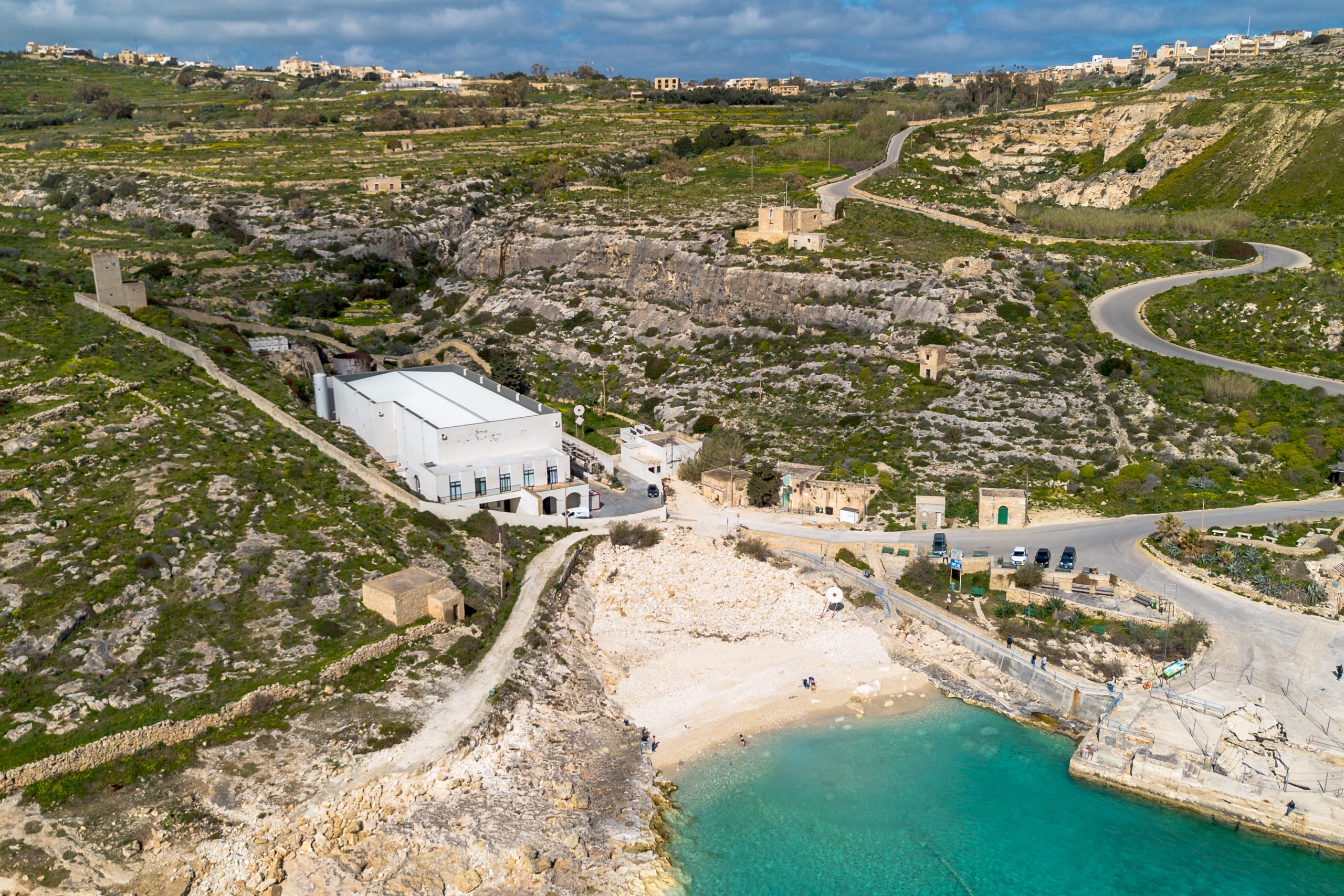
Photo: Aerial view of the Hondoq ir Rummien ir-rummein desalination plant beside the rocky coast and small bay in Qala, Gozo.
On Gozo's southern coast, a white industrial building overlooks the turquoise waters of Ħondoq ir-Rummien. Visitors gather among the rocks below, while inside, six technicians operate equipment that converts seawater into drinking water. The contrast captures Malta's dependence on an industrial solution to a natural shortage.
In 2025, the Water Services Corporation (WSC) produced 39.5 million cubic metres of drinking water, 70.7% of it through four public reverse-osmosis plants. The rest came from groundwater. These figures concern WSC production, not desalination carried out privately by hotels and other businesses. "Desalination currently accounts for roughly 70% of the island's drinking water," Malta's environment and energy minister, Miriam Dalli, said in responses for this investigation. She described a ten-year investment programme to strengthen water production and distribution.
From seawater to drinking water
Malta relied on energy-intensive seawater distillation in the 1960s. In the early 1980s, the first reverse-osmosis facility was built at Għar Lapsi, followed by other plants, including Pembroke in the 1990s. Instead of evaporating seawater, reverse osmosis forces it under pressure through membranes that separate freshwater from dissolved salts. The water is then treated before entering the drinking-water network.
The latest public plant, Ħondoq, began operating in 2021. Until then, Gozo depended on desalinated water sent from Malta through an underwater pipeline exposed to storm damage. Production on the island has reduced that vulnerability. The plant can produce 9,000 cubic metres daily but normally operates at around 6,000. "The majority of this water is utilised in Gozo, and the remaining volume is sent to Malta," explained Pablo Micallef, head of communications at WSC.
Ħondoq also shows how desalination is becoming more energy-efficient. Seawater is drawn through coastal wells that act as a natural pre-filter. According to Micallef, an efficient positive-displacement high-pressure pump is a central difference from older installations. He puts electricity consumption for the conversion stage at 2.2 kilowatthours per cubic metre. WSC's 2025 annual report places average energy consumption for the full desalination process across its four plants at 4.7 kWh/m³. These figures cover different stages and cannot be compared directly.
The electricity bill
These improvements matter financially. WSC's electricity expenditure rose from €19.5 million in 2024 to €20.1 million in 2025, according to its annual report. That bill covers the corporation's activities, including services other than desalination. It cannot be treated as the cost of reverse osmosis alone. Nor does electricity account for spending on pumps, membranes, maintenance and infrastructure. Reducing energy consumption helps control operating costs, but producing freshwater remains an expensive industrial process. Micallef says consumption has fallen substantially since Malta's first reverse-osmosis installations, helped by newer membranes and improved energy recovery. WSC intends to extend the technology used at Ħondoq to its older facilities.
Yet efficiency does not eliminate dependence on electricity. "In a way, if it is done with fossil fuels, it is a vicious circle," warned Robin Degron, former director of Plan Bleu, in an interview. Desalination helps countries adapt to drought, but fossil-powered production generates greenhouse gas emissions that contribute to further warming. Dalli says Malta's water strategy aims to "fully align water security with Malta's climate and energy objectives". Renewable-energy equipment began being installed at the older desalination plants in 2025, although the process will continue to require considerable electricity.
Beyond the public network
The technological response extends beyond WSC. At the Hilton Malta, beside Portomaso's marina, private desalination equipment supplies the hotel. This is not a recent development: contemporary reporting already described two reverse-osmosis units operating there in early 2007. For the hotel, the motivation is partly economic. James Muscat, the engineer responsible for its desalination system, cited "cost, sustainability, safety and the reliability of a continuous water supply" among the reasons for maintaining an independent source.
But private production complicates attempts to calculate Malta's total desalination activity. WSC's 70.7% figure excludes it, while the total quantity produced by private operators is not established in the documents examined.
There is also a physical limit to the technology. Reverse osmosis leaves concentrated brine behind. At older sites such as Għar Lapsi, discharges can be seen flowing across coastal rocks; at Ħondoq, WSC says an offshore diffuser disperses the concentrate. Micallef says a contractor is studying possible changes to the seabed and reporting to Malta's Environment and Resources Authority. Monitoring is essential, although its existence alone does not establish whether ecosystems have been affected.
Malta has found a way to produce drinking water where freshwater is scarce. The challenge now is to limit the electricity consumption, financial costs and environmental pressures required to keep that system running.