Law Passed, Now the Test of Peace Begins: İmralı Delegation Outlines Next Steps and Risks
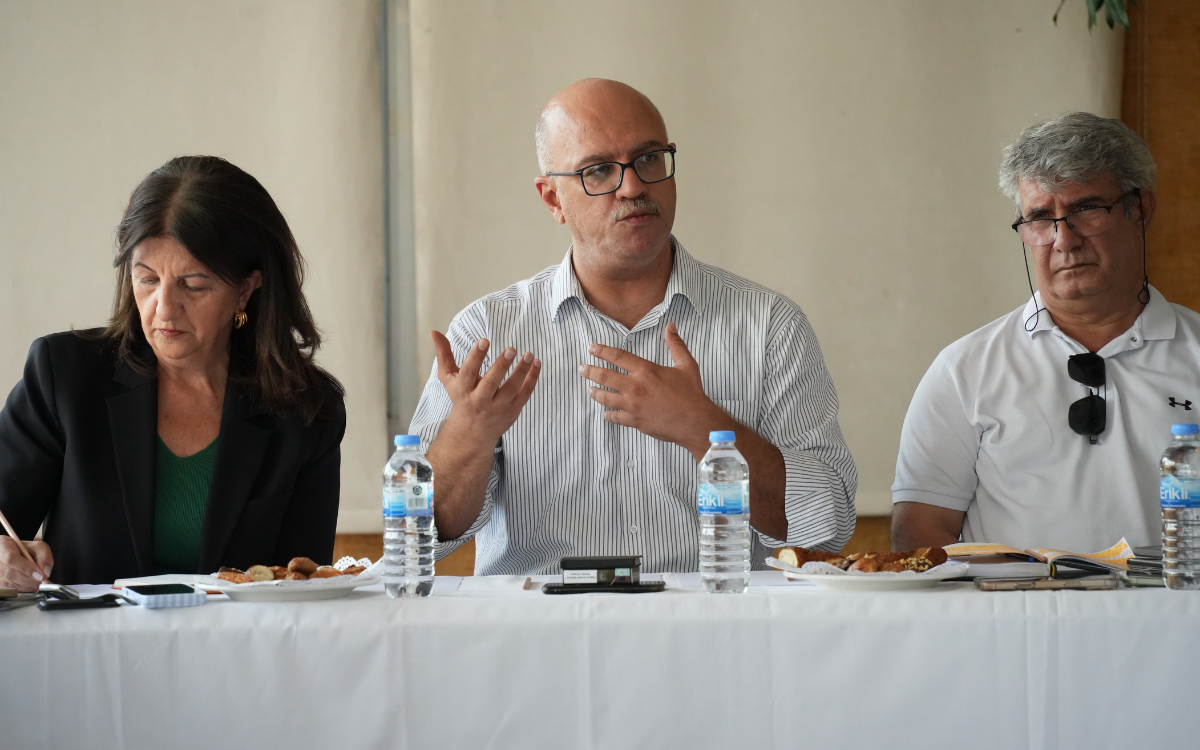
Members of the DEM Parti İmralı delegation and İmralı Secretariat met with journalists in Istanbul on 19 August to discuss the new framework law aimed at initiating disarmament and political transformation. Delegation members described the law as a narrow but significant first step—a “door opening”—and warned the crucial questions now are how the law will be implemented, whether disarmament will be verified, and whether legal and political guarantees will follow to secure a durable peace.
By Nalin Öztekin
940 views
Representatives of the DEM Parti İmralı delegation—Pervin Buldan and Faik Özgür Erol—and İmralı Secretariat member Veysi Aktaş met with journalists in Istanbul on 19 August for a two-and-a-half-hour briefing that sought to explain the implications of a recently passed framework law connected to a potential end to active hostilities. The delegation said they only saw the final text of the law on the morning it was published, after last-minute consultations between government legal advisers from the AKP and opposition parties.
Delegation members framed the law as an initial step rather than a comprehensive settlement of the decades-long conflict. Faik Özgür Erol described the legislation as a “kapının aralanması” — a door opening — and said its immediate legal impact could be substantial: the release of roughly 4,000 political prisoners currently in jail and effects on more than 75,000 ongoing investigations and prosecutions outside prison. Erol noted that about 900 people remained outside the law’s coverage for the time being, but their situations could be revisited through the new body’s authority to make requests.
Pervin Buldan and others emphasized that the text still contains heavy references to “terör” and “terörist,” language they opposed. Buldan said DEM Parti had sought to reduce securitized terminology and to focus on the underlying issues; nevertheless, the final law was published with those terms intact. She urged a reframing of the issue in public discourse from a “terör” headline to a “barış meselesi” — a peace matter — as the process shifts toward political settlement and social reintegration.
A central and sensitive matter discussed was the expected role of Abdullah Öcalan in what the delegation described as disarmament and siyasallaşma (politicization) mechanisms. Delegation members said Öcalan was anticipated to take a more direct role, beyond symbolic messaging, particularly in organizing the returns and the logistics of disarmament. The precise institutional position, status and powers Öcalan would hold in any commission or committee were not finalized, but speakers signaled a shift toward a more implementational role for him.
Linked to this was the prospect of opening İmralı prison to a wider set of interlocutors. DEM Parti co-leaders Tülay Hatimoğulları and Tuncer Bakırhan have formally requested meetings with Öcalan, and journalists, academics, civil society groups and women’s organizations have pressed for access. Buldan said there was also a specific demand for a women-focused mechanism to manage returns, anticipating significant female participation among those expected to come from Europe and from the Kandil region.
The delegation outlined an institutional architecture due to begin meeting on 24 August: an upper executive council to meet first, followed by the establishment of subcommittees, including a “silahsızlanma ve siyasallaşma kurulu” in which Öcalan would take part to organize arrivals and returns. Faik Özgür Erol described three coordinated bodies — an executive upper council, the “barış ve siyasallaşma kurulu” or “silahsızlanma ve siyasallaşma kurulu,” and a parliamentary monitoring commission — whose synchronized activity will be necessary for implementation.
While legal steps are advancing, delegation members stressed that major political questions remain unresolved. They accused the government of not giving explicit commitments on several politically charged issues, notably the cases of Selahattin Demirtaş, Figen Yüksekdağ and the removal of municipal trustees (kayyums). Pervin Buldan said the delegation urged the immediate implementation of Anayasa Mahkemesi (AYM) and European Court of Human Rights (AİHM) rulings and early release of jailed politicians, but acknowledged that definitive guarantees had not yet been secured. Veysi Aktaş framed the next phase as “democratic integration,” asserting that the process must go beyond the disarmament of armed groups to include the political and legal inclusion of Kurds “with their identity” within state institutions.
The delegation also flagged regional implications. Veysi Aktaş said there was a “karşılıklı talep” — a mutual request — for Mazlum Abdi (commander of the Syrian Democratic Forces) and Ilham Ahmed to meet Öcalan, but no confirmed timetable. He said any such visit would likely depend on progress in the Turkish process and could signal how developments in Turkey might influence Kurdish politics in Syria.
On domestic party politics, Buldan cautioned that the DEM Parti’s 6 September congress would not constitute the “esas dönüşüm” — the main transformation — of the movement. She said a broader revamp of program, statutes and personnel, potentially involving a new movement or founders’ council, was anticipated around Newroz in 2027, either shortly before or after that festival.
Delegation members repeatedly returned to a core unanswered question: will this legal opening simply end an armed confrontation, or will it be accompanied by substantive and timely democratic guarantees that transform disarmament into lasting peace? For rights advocates, the critical tests to come include verification of disarmament, the effective application of court rulings in favor of jailed politicians, the removal of trustees from elected municipalities, and the creation of legal and institutional protections that ensure Kurdish political, cultural and civic inclusion in Turkey’s democratic framework.