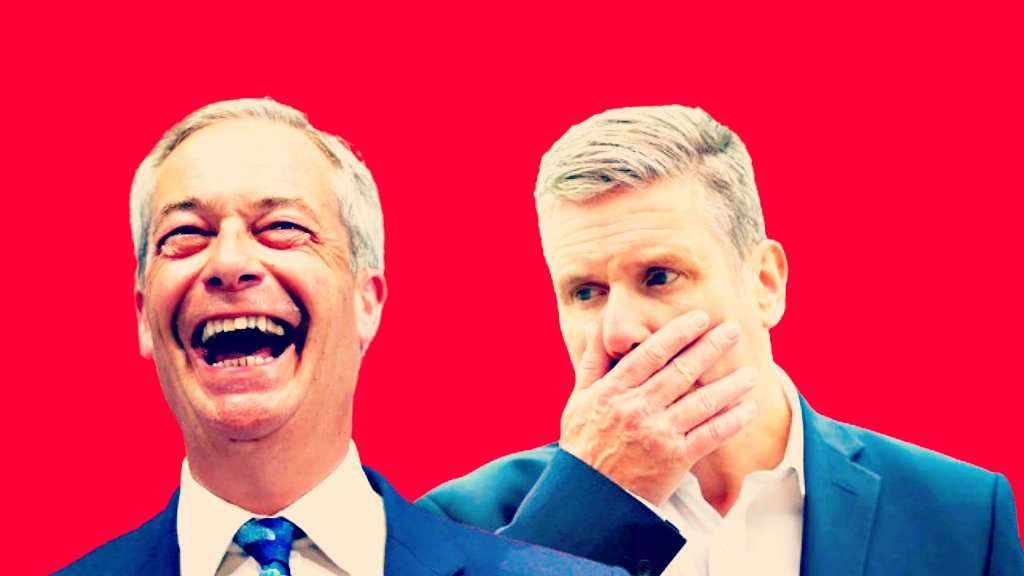
Labour Suffers Heavy Local Losses as Starmer Accepts Responsibility but Refuses to Resign; Farage Celebrates Reform UK Surge
With around one third of councils reporting, Labour has lost 204 councillors while Reform UK has gained 311, prompting calls for Prime Minister Sir Keir Starmer to quit. Starmer said he "takes responsibility" for the results but will remain in office, while Reform UK leader Nigel Farage called the outcome a "truly historic shift" and celebrated the party's first London borough win in Havering.
By Paul Serran
999 views
Partial results from England's local elections released as counting continued showed a sharp shift in local political fortunes on Friday, with the governing Labour Party shedding councillors across the country while Nigel Farage's Reform UK posted dramatic gains. With around one third of councils having reported, Labour had lost 204 councillors while Reform UK had gained 311 — a swing that prompted opposition figures and some commentators to call on Prime Minister Sir Keir Starmer to resign. Starmer said he "takes responsibility" for the results but signalled he would remain in office, while Farage hailed the outcome as a "truly historic shift" and celebrated his party's first win in a London borough, Havering.
The contests were far larger in scope than the previous year's round, which had heightened the stakes of the verdict. More than 4,500 councillors were being elected across 136 councils in England, along with a number of local borough mayoralties, in what was widely framed as the most significant nationwide test of opinion since the 2024 general election. Voters in Scotland and Wales were simultaneously choosing members of the Scottish Parliament and the Welsh Senedd, with those counts still ongoing. Coming roughly two years into Labour's term, the elections were treated by many as a referendum on Starmer's leadership and a verdict on his government's record, lending the early returns outsized political weight even as full results remained incomplete.
The early picture was bleak for Labour and striking for Reform. Beyond the raw councillor tallies, Labour was reported to have already lost control of several councils, in what observers suggested could prove among the party's worst local-election performances. The losses appeared to bite hardest in the kind of working-class areas Labour has historically dominated — the so-called Red Wall — which has become a central battleground in Reform's effort to displace the established parties. Reform, by contrast, was not merely accumulating seats but breaking into territory long considered out of reach, with its capture of Havering, previously under no overall control, standing as a symbolic marker of how far the party's appeal now extends, including into parts of the capital.
Starmer addressed the results directly and without euphemism, acknowledging the scale of the setback while rejecting the idea that it should cost him his job. "The results are tough, they are very tough, and there's no sugarcoating it," he said, adding that the party had lost "brilliant Labour representatives across the country." In a widely quoted passage, the prime minister said: "It hurts, and it should hurt, and I take responsibility." He framed the defeat as a spur rather than a deterrent, insisting that "tough days like this don't weaken my resolve to deliver the change that I promised. They strengthen my resolve." Starmer confirmed he would not step down, casting the results as a reason to accelerate his agenda rather than abandon it.
Farage, speaking to reporters outside Havering Town Hall, cast the night as a watershed for British politics. "I think overall, what's happened is a truly historic shift in British politics," he said, arguing that Reform's ability to win in areas "that have always been conservative" pointed to a deeper realignment beyond the traditional left-right divide. "It's a big, big day not just for our party but for a complete reshaping of British politics in every way," he said, describing Havering as the party's first major victory in a London borough. He also quipped about the prospect of Starmer resigning, saying: "I suspect when you see the full results in the Red Wall, there'll be a rebellion. Personally, I'd be very sad to see the Prime Minister go. I would be very, very sad indeed, he's the greatest asset we've got." In social media posts accompanying his remarks, Farage told supporters: "It's been a very good morning. The best is yet to come. Thank you for voting Reform."
The pressure on Starmer was not confined to his opponents. Within Labour, the results reignited a debate over strategy and leadership, with some figures arguing that the problem ran deeper than presentation. The veteran left-wing MP Diane Abbott wrote that there was "no denying that these election results are going to be very bad for Labour," and contended that while Starmer is unpopular, it is the government's policies that drive that unpopularity — warning that "simply changing the leader without changing the policies will not avert disaster" at the next general election. Others traced the losses to the party's national direction set in Westminster rather than to local factors, sharpening an internal argument about whether course-correction or continuity is the right response.
The early results prompted broader debate over what the local shifts mean for national politics. Analysts cautioned that local elections often reflect short-term voter sentiment and issues specific to individual councils, and that sizeable swings do not automatically translate into parliamentary outcomes — but also that such results can reshape momentum and perception ahead of a general election, which is not due until later in the decade. Reform's supporters argued the gains signalled broad dissatisfaction with the major parties and could convert into a stronger showing nationally, pointing to polling that has at times placed the party level with or ahead of both Labour and the Conservatives. Labour officials countered that local results do not map neatly onto Westminster contests and stressed that counts across all councils remained incomplete, urging against drawing definitive conclusions from partial returns. The Conservatives, meanwhile, faced their own difficult night, with their vote continuing to erode as Reform consolidated support on the right — a dynamic that has fuelled talk of an end to the long-standing two-party order.
Counting will continue over the coming days, and the final national picture will depend on the remaining returns, including the devolved contests in Scotland and Wales. For now, the early returns have injected fresh uncertainty into Britain's political landscape: Labour confronts internal debate over strategy and leadership after losing ground on councils, while Reform UK has an opportunity to capitalise on its surge and press its case to voters nationally. As the parties recalibrate in response to the results, the immediate question hanging over Westminster is whether the shift visible at the local level proves a midterm protest or the leading edge of a more durable transformation in how Britain votes.