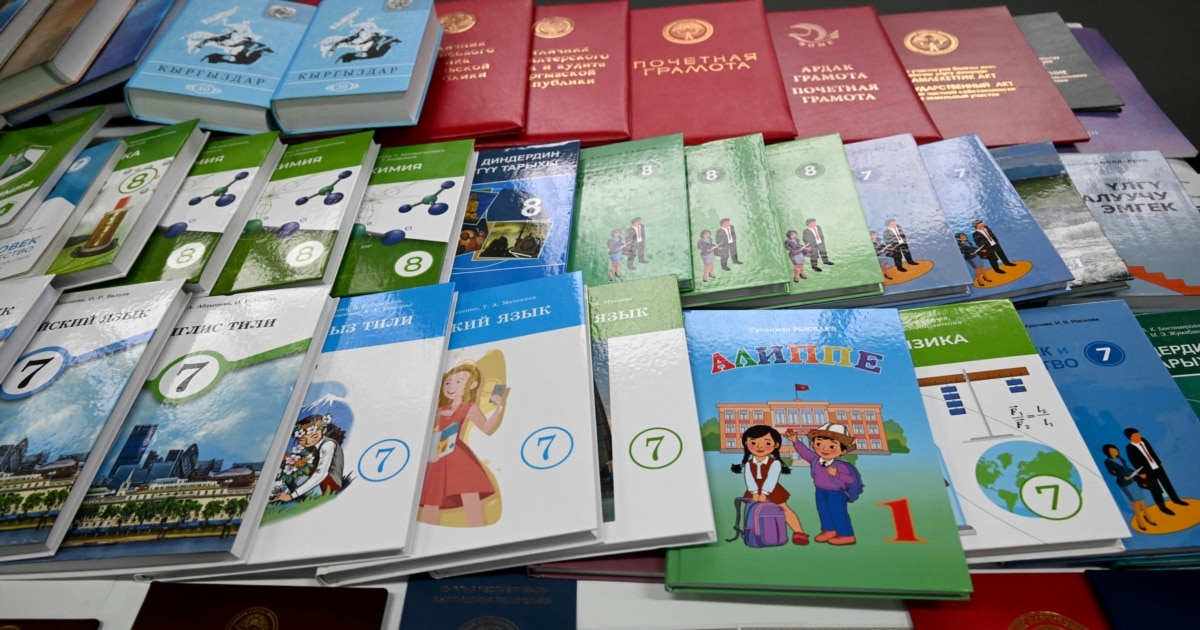
Kyrgyz President Orders 8.5 Billion Som to Print School Textbooks amid Shortage and Probe into Market Sales
President Sadyr Japarov has signed a decree allocating 8.5 billion som from the state budget to print textbooks and teaching-method kits for general education institutions and ordered the Cabinet to develop a state programme to oversee production and distribution. The decision follows parental complaints and parliamentary warnings that pupils lacked books at the start of the school year and reports that some state-prepared textbooks were appearing for sale in markets, prompting a criminal investigation.
By Alexander Walter
1,015 views
President Sadyr Japarov signed a decree on September 26 instructing the state to allocate 8.5 billion som to print textbooks and teaching-methodological complexes for Kyrgyzstan’s general education institutions, the presidential residence Yntymak Ordo reported. The decree also tasks the Cabinet of Ministers with developing a state programme for the production and distribution of the books and establishing an interagency commission to review and create new curricula, textbooks and methodological kits.
Under the decree, the interagency commission — to be formed under the Cabinet of Ministers — is to ensure that newly developed and revised educational literature meets the state education standards and contemporary methodological requirements. The ministry will select and approve the authors responsible for preparing textbooks, and each textbook will carry a QR code intended to allow authorities to trace its distribution down to the region, school, class and, where applicable, the pupil.
The presidential action comes after the start of the new school year on September 15, when parents in state schools began reporting that pupils did not have enough textbooks, with some children receiving only one or two books. The shortage prompted complaints to schools and widespread public concern about the state's capacity to supply the required learning materials.
On September 16, Member of Parliament Dastan Bekeshev raised the issue in parliament, saying that while pupils in state schools lacked books, the same textbooks were being sold at markets. The allegation of state-issued materials appearing in private commerce intensified scrutiny of the textbooks’ production and distribution chain.
In response, Cabinet Chair Adylbek Kasymaliev ordered checks on the sale of school textbooks at markets. The Interior Ministry, the State Committee for National Security (SCNS) and the Ministry of Education were instructed to identify individuals or entities selling the textbooks and to take appropriate measures. The Education Ministry had previously stated that textbooks prepared for state schools were not to be put up for sale.
On September 17, Uchkun open joint-stock company — a printing firm — held a press briefing saying it prints textbooks for the Ministry of Education and for private schools, but that it does not monitor how printed books are used once delivered. The Education Ministry said it had already asked the SCNS and Interior Ministry to investigate suspected irregularities in textbook distribution even before public complaints about market sales surfaced.
According to reporting, a criminal case was opened on September 22 concerning the sale of textbooks that should not have been on the market. Authorities have not publicly disclosed details of the suspects or the scale of the alleged diversion. Separately, earlier announcements indicated that the president had approved an additional allocation of 7 billion som to eliminate the textbook shortage; the latest decree specifies an 8.5 billion som allocation to printing, suggesting further or revised measures to meet demand.
Officials say the measures in the decree — from author selection and expert reviews of content to the use of QR codes for tracing distribution — are aimed at both resolving the immediate shortage and strengthening transparency and control over public procurement and distribution chains. Human rights and education advocates, however, say the emergence of textbooks in private markets while children remain without materials points to deeper procurement and oversight failures that must be addressed to guarantee children’s right to education.
The Cabinet of Ministers has been charged with drafting the state programme and operational rules; meanwhile, criminal investigators from the Interior Ministry and SCNS are expected to report on the market-sales probe. The outcome of those investigations and whether anyone will be held accountable remain key to restoring public confidence and ensuring that state-funded educational materials reach the pupils they are intended to serve.