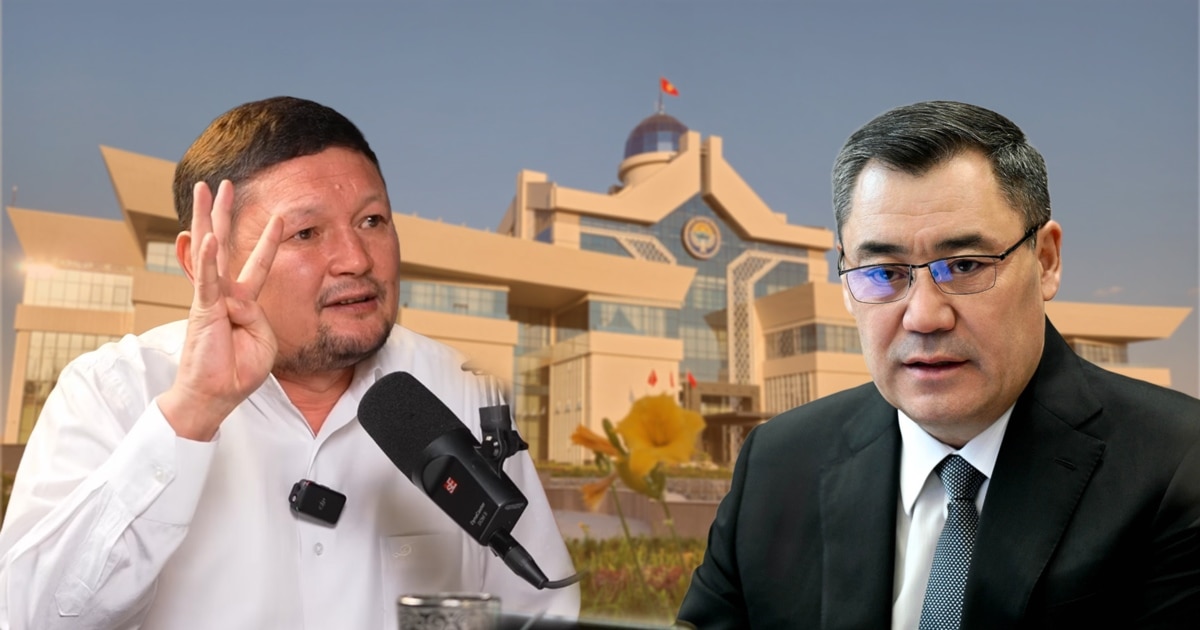
Kyrgyz opposition figure’s blistering criticism of president sparks debate over whether his candidacy is a government 'project'
Symyk Zhapykeev, an opposition-minded politician who has filed to run in Kyrgyzstan’s presidential election, has made forceful public criticisms of President Sadyr Japarov’s administration on issues including foreign debt, personnel policy and rising prices. The unusually prominent platform given to Zhapykeev by state broadcasters and a response from the Yntymak Ordo movement has prompted analysts to disagree over whether his candidacy represents genuine opposition or a managed government ‘project’.
By Clémence Desjardins
1,165 views
Symyk Zhapykeev, a politician who has positioned himself as an opposition-minded candidate ahead of Kyrgyzstan’s presidential election, has drawn attention and controversy after delivering a string of sharp public criticisms of President Sadyr Japarov and the current government. Zhapykeev has raised concerns about the administration’s handling of external debt, personnel appointments, freedom of expression and the surge in the cost of living—remarks that have provoked debate about whether his role is an authentic challenge or a carefully managed form of dissent.
In recent days, Zhapykeev’s remarks have been broadcast by state-owned television channels and reported on by national media. The Yntymak Ordo movement, with which he has a contested political past, responded to his criticism by describing it as a ‘‘democratic phenomenon’’ and emphasizing that no one is barred from criticising the authorities—an assertion that appears intended to underscore the presence of free speech in the run-up to the vote.
The prominent coverage of an otherwise marginal opposition figure has prompted suspicion among some observers. Commentators and members of the public have asked whether authorities are deliberately elevating a controlled or pliable opponent to create the appearance of pluralism and competitiveness in the electoral arena. Those suspicions have only intensified because Kyrgyzstan’s political climate in recent years has at times been hostile to critics.
Zhapykeev rejected suggestions that he is part of any government-orchestrated plan. In an interview responding to questions from Azattyk, he said he had a moral right to criticize the president and the government because he had played a role in bringing them to power. “If I don’t speak, who will? Everyone fawns over Sadyr Nurgoghoevich. Are we to continue like this? What did I say that was wrong? These are actually sensational facts,” he said.
He also addressed allegations that he was a government ‘project’. “How could I be a government project? You see what the authorities are doing to me. They take me from home, they detain me. At one in the morning they knock, I open the door and they drag me away. Later they edit everything and release it to shame me. Is giving a podcast enough to call it a project? I have a moral right to speak about Sadyr Japarov. Other politicians do not have that right.”
Legal analyst Aydin Bakytbek uulu told reporters he viewed the development skeptically. “Without the government’s blessing, these topics cannot be raised in public in the current political situation. That suggests the authorities are permitting it to happen. It looks like a project. They studied many politicians, assessed their activities and potential, and concluded that Zhapykeev could serve as a flexible opposition,” he said.
Not all analysts agree that a staged scenario would be wholly negative. Journalist and political analyst Adil Turdukulov argued that even if there were an element of orchestration, the effect could be beneficial insofar as it signals that the authorities have an interest in presenting the election as competitive. “Even if it’s scripted, that’s not necessarily too bad. It shows the authorities are interested in allowing at least the semblance of electoral competition. There have been cases where such scripts have gone off-script. I don’t think Zhapykeev could have been fully controlled in advance; even if there were talks, outcomes can vary,” Turdukulov said.
Zhapykeev himself is not a newcomer to national politics. He was known to the public during the popular upheavals of October 2020 as one of the leaders of the Chon Kazat party and has been described as a moderator or driving force during those protests. His recent prominence comes as candidates prepare for the presidential vote set for January 27 next year; as of the current reporting, four citizens have filed applications to stand.
The debate over Zhapykeev’s role highlights wider concerns about political openness and the nature of dissent in Kyrgyzstan ahead of the election. The combination of state media exposure, the Yntymak Ordo movement’s public response and the mixed readings from analysts illustrates the difficult task voters and observers face in distinguishing genuine opposition from managed political competition. As the campaign period progresses, scrutiny of who is allowed to speak and how their messages are amplified will be a key indicator of how free and competitive the presidential contest will be.