Kyrgyz Officials Say President Can Run Without Resigning; Legal Provision Dates Back to 2004
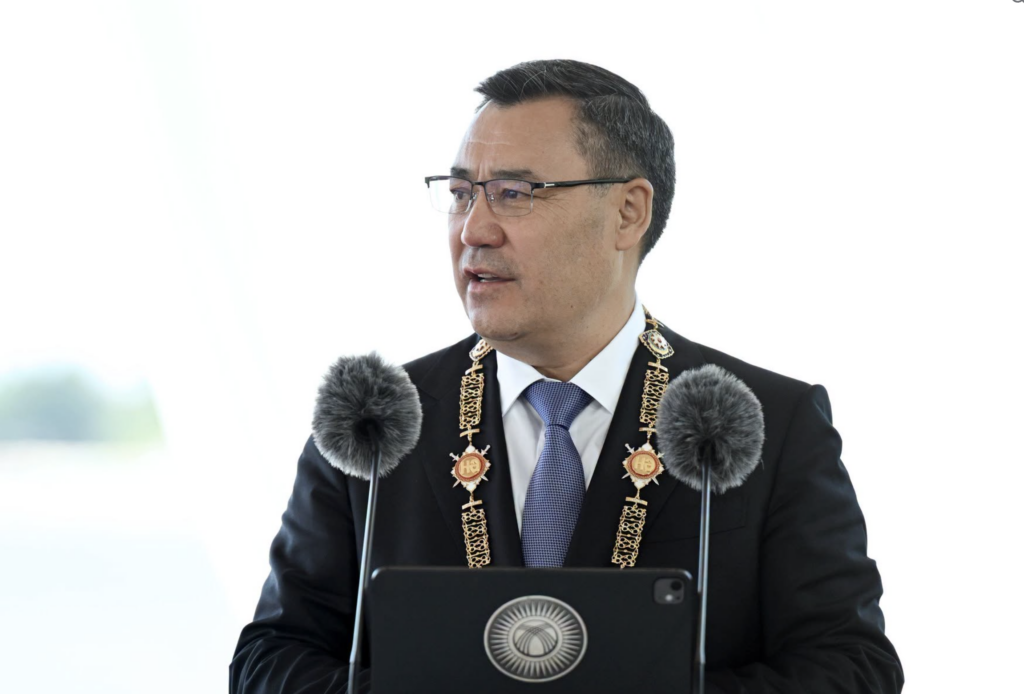
Speaker of Parliament Marlen Mamataliyev and Central Election Commission head Tynchtyk Shainazarov have stated that President Sadyr Japarov is not required under Kyrgyz law to give up his office to run for re-election. The rule allowing a sitting president and members of parliament to remain in office while standing as candidates was introduced in 2004 and long predates Japarov’s tenure, but critics say it gives incumbents a significant advantage, particularly as many potential rivals face criminal convictions.
By Alexander Walter
1,193 views
Kyrgyzstan’s parliamentary speaker and the head of the Central Election Commission have publicly affirmed that President Sadyr Japarov is not legally required to resign his post in order to campaign for re-election — a confirmation that has rekindled debate about electoral fairness and the balance of political power in the country.
Marlen Mamataliyev, speaker of the Jogorku Kenesh (parliament), and Tynchtyk Shainazarov, head of the Central Election Commission, told reporters that current Kyrgyz law permits a sitting president and members of parliament to remain in their official roles while standing as candidates. Their statements prompted renewed discussion online and among political observers about whether this arrangement confers an unfair incumbency advantage.
The provision at the center of the controversy was, however, not introduced by Japarov. The legal rule allowing presidents and deputies to retain their powers while nominated for election first appeared in Kyrgyz election legislation in 2004 during the presidency of Askar Akaev. Under the same legal framework, other state and municipal officials, as well as media workers, must suspend their duties from the moment they become official candidates.
Observers have pointed out that the provision has been controversial in the past. In 2009 human rights activist Aziza Abdirasulova petitioned the Constitutional Court, arguing that “a sitting president who does not relinquish his powers during the electoral process gains significant advantages compared to other candidates.” It is not publicly clear how the court resolved that challenge, and the provision remains on the books.
The current debate also reflects Kyrgyzstan’s turbulent recent political history. Sadyr Japarov did relinquish his duties ahead of the 2021 presidential contest, but that case was different: at that time he held the post of prime minister and acting president, and law required him to step down from the prime ministership to register as a candidate. His formal powers were then exercised by Talant Mamytov, the parliamentary speaker and Japarov ally.
There are other precedents. In 2005, Prime Minister Kurmanbek Bakiyev resigned as prime minister to stand in the presidential race but reportedly retained the role of acting president for a time. More broadly, three presidents between Bakiyev and Japarov — Roza Otunbayeva, Almazbek Atambayev and Sooronbay Jeenbekov — did not win second terms, reflecting Kyrgyzstan’s recent cycles of political turnover.
What has changed under Japarov, critics note, is a broader set of constitutional and legislative amendments that have reshaped presidential terms and eligibility. Prior to amendments enacted during Japarov’s time in power, the constitution allowed only a single six-year presidential term. Japarov’s changes opened the way for him to seek another term: he has already told journalists he intends to run in 2027.
Campaign dynamics have been further affected by recent prosecutions of potential challengers. Japarov’s one-time ally Kamchybek Tashiyev was removed from his post in February 2026 and on 10 September 2026 a Bishkek city court convicted Tashiyev and seven others of “obstructing electoral rights,” then released them on probation. Tashiyev’s lawyer has appealed to the Supreme Court, but with the Bishkek ruling in force, Kyrgyz law currently bars people with criminal convictions from standing for president. That limitation, combined with the incumbency provision, has alarmed critics who argue it narrows the field and undermines competitive elections.
Supporters of the current government argue the legal framework is clear and that provisions predate any single leader. Detractors counter that the combination of legal changes, selective prosecutions, and the existing rule allowing a sitting president to remain in office while campaigning creates an uneven playing field. The debate is likely to intensify in the coming months and years as Kyrgyzstan approaches the 2027 presidential election and as courts continue to adjudicate high-profile political cases.
For many observers, the issue goes to the heart of Kyrgyzstan’s democratic resilience: whether laws and institutions will protect a genuinely competitive electoral environment, or whether legal arrangements and judicial decisions will be used to entrench power. The Constitutional Court and the country’s higher courts could play a decisive role if disputes over eligibility and electoral fairness reach them, but past challenges have left open questions about how such matters will be resolved in practice.