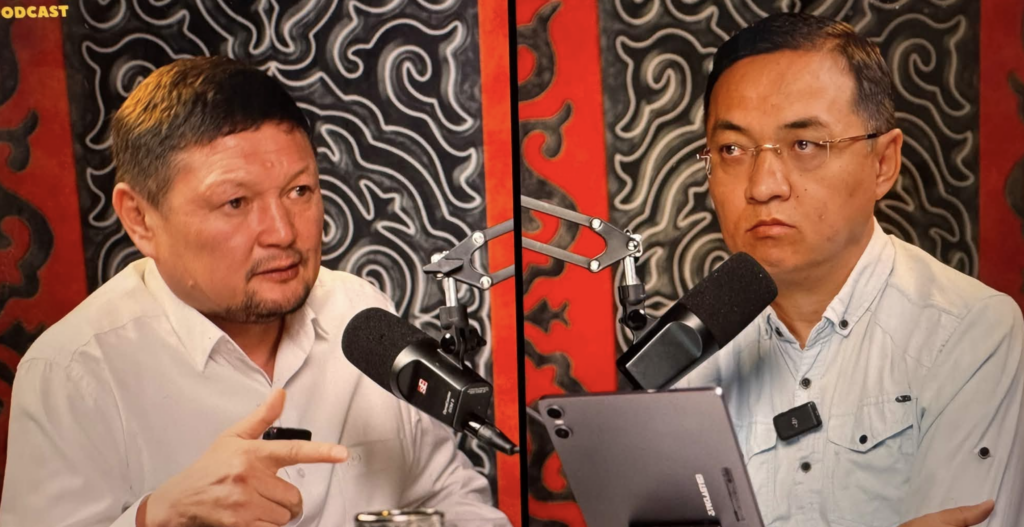
Kyrgyz Journalist Ernis Kyyaz Summoned by Interior Ministry After Publishing Interview with Former Financial Police Chief
Journalist Ernis Kyyaz says he was contacted by an officer from the Ministry of Internal Affairs’ 10th department and asked to meet after he released an interview with Syimyk Zhapykeev, a declared presidential hopeful and former head of the financial police. Kyyaz had previously been summoned by the State Committee for National Security (GKNB) following an earlier interview with Zhapykeev in January, and he says the new summons follows wider use of excerpts of the conversation by state television.
By Clémence Desjardins
987 views
A Kyrgyz journalist who recently published an interview with a former senior official says he has been summoned to the Ministry of Internal Affairs, a development he links to the politically sensitive timing of the conversation. Ernis Kyyaz told his social media followers that a man identifying himself as Azamat Ryspekov, from the MIA’s 10th department, called politely and asked whether Kyyaz could come in for a meeting to “clarify something.”
Kyyaz said the caller spoke with a smile and without overt threats, but that he was nonetheless wary of discussing the matter at the ministry’s offices. He proposed meeting instead in a neutral location. After a pause, the official reportedly agreed to speak at the address Kyyaz provided and to come with a couple of colleagues.
The summons comes after Kyyaz published a recently recorded interview with Syimyk Zhapykeev, the former head of Kyrgyzstan’s financial police, who has in recent months publicly criticized the authorities and announced plans to run for president. Kyyaz said he recorded the interview at the end of September. In an earlier instance following a January interview with Zhapykeev, Kyyaz was summoned by the State Committee for National Security (GKNB).
Kyyaz said he had anticipated renewed attention after releasing the video. He noted that excerpts of the interview were subsequently broadcast on state television channels KTRK and ElTR, and that Askat Alagozov, the president’s press secretary, commented on social media that “different opinions” would be voiced in the run-up to the election. Kyyaz wrote that seeing both Zhapykeev and state channels use different parts of his interview led him to conclude the podcast had been “objective and impartial,” and left him wondering how the polite-looking ministry officials would treat a meeting framed as “just chatting.”
The interview’s publication follows a period in which Kyyaz had hesitated to release the material, citing concerns about election campaigning rules. In early October he said he would not publish the Zhapykeev interview prior to the official start of the campaign period, pointing to guidance from political analyst Bakyt Baketaev about campaign regulations. Kyyaz said then that he would publish the interview only when the official campaign period began—when campaign financing from a candidate’s fund would be in effect.
The campaign period for Kyrgyz presidential elections is scheduled to begin on December 23, 2026. Candidate nomination submissions close on November 13, 2026, and the presidential vote is set for January 27, 2027. Zhapykeev and former interior minister Omurbek Suvanaliev have both indicated intentions to run; Kyyaz also said he had not published an interview with Suvanaliev for the same stated legal concerns. Both Zhapykeev and Suvanaliev initially failed the Kyrgyz language test required for candidacy, although Zhapykeev later retook it successfully and is now registered with the Central Election Commission (CEC).
The CEC has already registered several other candidates, including Akai Kadyrov, Aymen Kasenov and Azamat Esenbekov. Former MP Iskhak Masaliev has also taken the language test, and incumbent President Sadyr Japarov has indicated he intends to run again; neither Masaliev nor Japarov nor Suvanaliev had been registered with the CEC at the time of reporting.
Kyyaz’s account highlights tensions between media reporting on political figures and the state agencies that monitor election-related activity. Press freedoms advocates often view summonses by security or interior ministry officials as a source of chilling effect on journalism, particularly in the sensitive pre-election period. Kyyaz has characterized the latest contact as polite and non-threatening in tone, but has framed it in the context of prior pressure following his earlier interview work.
At this stage, the Ministry of Internal Affairs has not publicly commented on the summons, and Kyyaz said the meeting was arranged after he proposed an alternative meeting location. The broader implications for media freedom in Kyrgyzstan will depend on whether state agencies use administrative or legal measures to challenge journalistic content in the run-up to the presidential vote.