Kraków Shooting: What We Know One Week After the Attack That Shook Poland
KRAKÓW, Poland — One week after a gunman killed six people in Kraków’s historic centre and three members of his own family in Ostrowiec Świętokrzyski, investigators are still trying to establish his motive, while the attack has raised urgent questions about firearm licensing, public safety and the spread of disinformation during national emergencies.
By Pawel Cybulski
961 views
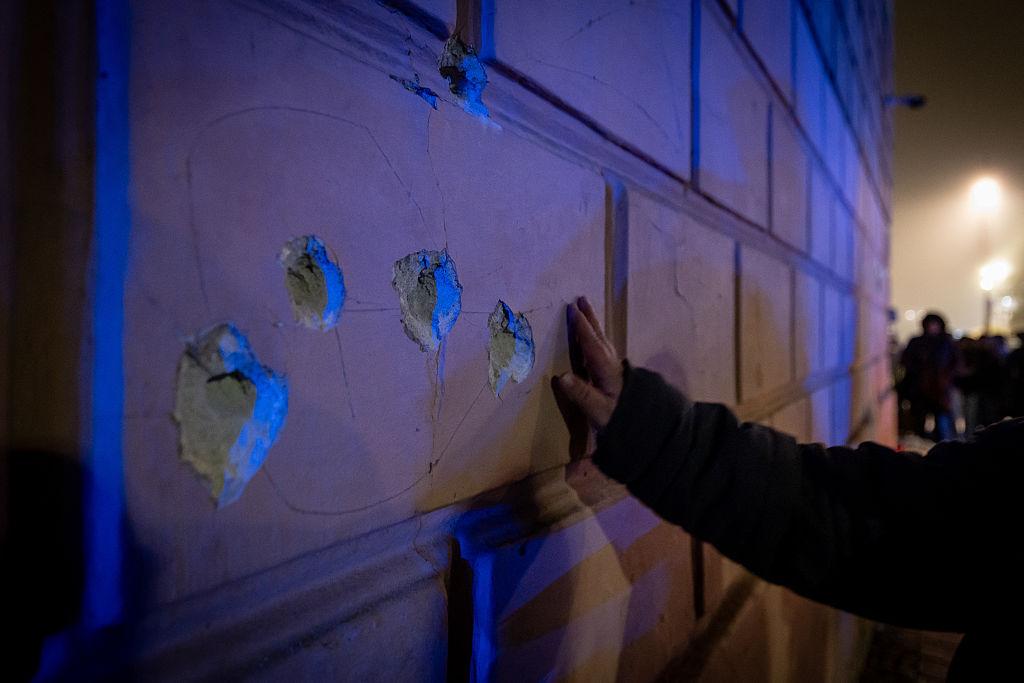
Photo: Szturnek, CC BY-SA 4.0. - Bullet impacts at the site where the gunman was stopped by police in Kraków.
Gunfire in the Historic Centre
On November 7, shortly before 3 p.m., a black Subaru Impreza entered Kraków’s Main Market Square from Szczepańska Street. The driver stopped near the entrance to Sławkowska Street and began firing a Diamondback DB-15 long firearm at people in the area.
According to police, the gunman continued shooting as he moved through the historic centre. Six people were killed in Kraków. The victims included four Polish citizens, a 51-year-old Austrian woman and a 32-year-old British man.
Two police officers confronted the attacker and were seriously wounded during the exchange of fire. They were identified as Jakub Kulik and Artur Morański. Kulik was hit by three bullets and required surgery. Their intervention helped prevent further casualties.
The suspect was wounded by police and taken to hospital. He died on November 9 before prosecutors could formally charge him.
The National Prosecutor’s Office opened an investigation into the killings and the attempted murder of numerous other people, including the two officers. Prosecutors classified the Kraków attack as a terrorist offence under Polish law. This is a legal classification of the act, not a finding that investigators have established the attacker’s ideology or motive.
Early reports referred to 16 people being injured, including the suspect. Subsequent information from authorities and hospitals put the number of injured victims at 15. The two police officers were among them.
The Ostrowiec Killings and the Wider Investigation
The investigation soon expanded beyond Kraków.
Police found the bodies of three members of the suspect’s family in his apartment in Ostrowiec Świętokrzyski, approximately 160 kilometres north-east of Kraków. The victims were his parents and his 21-year-old sister.
The National Prosecutor’s Office said the evidence gathered so far indicated that the same person was responsible for both the Kraków attack and the killings in Ostrowiec. The two cases are being investigated together.
The suspect was identified as 24-year-old Michał Oksiński, a resident of Ostrowiec Świętokrzyski. Prosecutors said he had killed his relatives with a firearm before travelling to Kraków.
Investigators have not yet established why he carried out the killings. They are also examining whether anyone else encouraged, assisted or otherwise contributed to the crimes.
That part of the investigation remains particularly important. The suspect’s death means he cannot be questioned or face criminal proceedings, but it does not end the investigation into the events or the possibility of third-party involvement.
Legally Owned Weapons and Unanswered Questions About Radicalisation
One of the most significant findings concerns the weapons available to the attacker.
According to the National Prosecutor’s Office, investigators recovered four firearms in the suspect’s car and in his possession. They included two AR-15 rifles and two pistols. Authorities also reported finding approximately 500 rounds of additional ammunition.
A further seven firearms were discovered during a search of his apartment in Ostrowiec. Four mobile phones were also secured in the vehicle. Prosecutors said they were still taking steps to gain access to the data stored on those devices.
Oksiński had held a firearms licence since January 2026. He purchased his first firearm in March of that year.
These facts have placed Poland’s firearms licensing system under scrutiny. The central issue is not simply the number of weapons recovered, but how the suspect obtained access to them, whether the licensing procedures were properly followed and whether any warning signs were missed.
However, the available evidence does not establish that the licensing process was unlawful or that officials ignored a specific warning. Those questions require a separate examination of the relevant records and procedures.
Investigators are also examining the suspect’s online activity and possible ideological influences. Polish media reported that searches relating to Norwegian mass murderer Anders Breivik had been found on his computer. Other reports referred to an inscription at his workplace interpreted as a possible reference to Elliot Rodger, who killed six people in California in 2014.
A Gadsden flag was also reportedly found in the suspect’s room. The symbol has a range of political and historical associations and cannot, on its own, establish a person’s ideology.
These details may help investigators reconstruct the suspect’s interests and online environment. They do not prove that any particular individual or movement inspired the attack. Prosecutors have explicitly stated that the motive remains unknown.
The distinction matters. Evidence of online searches, symbols or extremist material should not be treated as proof of a settled political motive. Investigators must establish how these elements relate to the crimes rather than assume a connection.
Disinformation and Pressure on Poland’s Security System
The attack also triggered a rapid wave of false claims online.
Poland’s Ministry of Digital Affairs said that its teams, working with the National Research Institute NASK and the Internal Security Agency’s counterterrorism centre, monitored and reported misleading narratives circulating on social media.
According to the ministry, NASK reported more than 2,000 accounts for moderation. Some were identified as automated bots publishing content in several languages, including Polish, English, French and Dutch.
False narratives included claims that the Polish government had organised the attack or that it had been staged to justify cancelling the Independence March. Other posts falsely presented the attacker as a soldier. The ministry said the most widely circulated narratives had reached a combined audience of more than 200 million views.
The scale of the online reaction illustrates how quickly a violent incident can become a target for coordinated manipulation. In the first hours after an attack, incomplete information, emotional reactions and unverified footage can create an environment in which false claims spread faster than official corrections.
The response also raises questions about the responsibilities of social media platforms and the effectiveness of existing mechanisms for identifying coordinated disinformation. The Digital Services Act provides a framework for addressing systemic risks on major platforms, but its practical effectiveness in a fast-moving national emergency remains a broader policy issue.
The government is also facing pressure to examine firearms regulations. Reuters has reported that authorities intend to review requirements relating to firearms permits. Any changes will need to address public safety without treating every lawful gun owner as a potential threat.
The Kraków shooting has exposed several challenges at once: the monitoring of legal firearm ownership, the ability of police to respond to an armed attacker in a crowded public space, and the protection of reliable information during a crisis.
Yet important questions remain unanswered. Investigators have not established the attacker’s motive, completed the analysis of his electronic devices or ruled out the involvement of other people.
For now, the confirmed facts are devastating enough. Six people were killed in Kraków, three members of the suspect’s family died in Ostrowiec, and two police officers were seriously wounded while confronting the gunman.
The investigation may eventually explain how these events unfolded. It should also establish whether any warning signs were missed and whether existing procedures need to change. Until then, conclusions about ideology, radicalisation or institutional failure should remain provisional.