Kenya’s eroding coastline threatens beaches and livelihoods
Coastal erosion is threatening Kenya’s beaches, tourism infrastructure and fishing communities, with Mombasa among the areas facing growing risks from rising sea levels, unregulated construction and the loss of natural coastal protection. Despite billions of dollars in commitments announced at the Our Ocean Conference, questions remain over whether Kenya can turn its promises into effective conservation and long-term coastal protection.
By Martin Bertrand
974 views
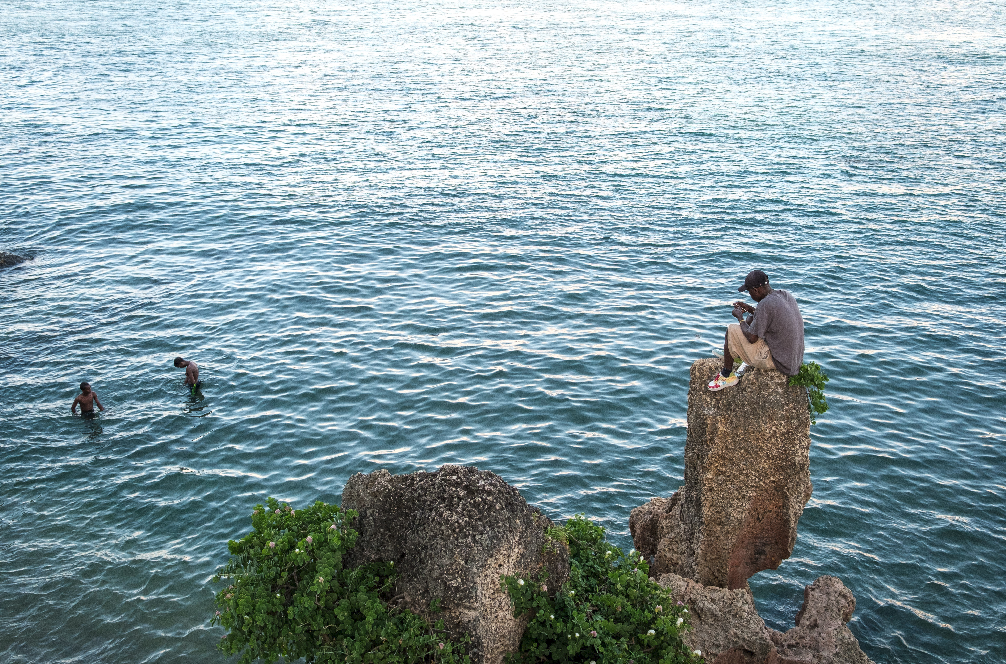
Photo: A man sits on an eroded coral outcrop while two swimmers are in the water beside the Old Town waterfront in Mombasa, Kenya, on June 5 2026. The exposed shoreline documents coastal erosion in a place where sea level rise linked to climate change increases long term coastal vulnerability
On Nyali Beach, in Mombasa, a warning on a damaged wall tells passers-by not to climb onto it or sit nearby. Erosion could bring it down. Along the shore, a staircase once leading to the sand ends abruptly: its lowest steps have disappeared. At low tide, a stretch of beach extends beneath the hotels. As the tide rises, the Indian Ocean reaches the foot of the walls, leaving little room to walk. Elsewhere, coastal cliffs have been hollowed out at their base. Some beachfront hotels have built seawalls to protect their property.
The contrast is striking in Nyali, one of Mombasa’s more affluent beach districts. Hotels and other buildings crowd a shoreline whose shape changes with the tides and, over longer periods, with erosion. A high tide alone does not establish that the coast is retreating. The ruined steps, weakened walls and undercut cliffs, however, show how exposed these developments have become.
This was the setting for the 11th Our Ocean Conference, held in Mombasa from June 16 to 18, 2026. The international gathering produced 320 voluntary commitments worth approximately $6.4 billion. Kenya announced 42 commitments, valued at about $1 billion, covering areas such as marine conservation, fisheries monitoring and the blue economy. Behind those announcements lies a practical question: how will Kenya protect a densely developed shoreline without worsening erosion elsewhere?
A study published in Frontiers in Marine Science in May 2026 offers a measure of the risk. Researchers mapped more than 7,500 sections of Kenya’s coast, combining physical conditions with population density and proximity to infrastructure. They classified 31.7% of the sections as highly or very highly vulnerable to sea-level rise, particularly along the Kilifi-Malindi corridor and around Mombasa. This does not mean that nearly one-third of the coast has already eroded. It measures exposure to harm. Tide gauges at Mombasa and Lamu also recorded an average relative sea-level rise of roughly three millimetres a year between 2000 and 2018.
Professor Maarifa Ali Mwakumanya of Pwani University, who has studied erosion around Mombasa for years, identifies several interacting causes. Rising sea levels increase exposure to coastal flooding, while waves and currents shift sand along the shore. Unregulated development and the loss of protective ecosystems, including coral reefs, seagrass and mangroves, can add to that vulnerability. The effects vary from one beach to another.
In a 2021 study of the four-kilometre Bamburi shoreline, Mwakumanya found that some stretches were accumulating sand while others were losing it. Coastal construction had altered the movement of sediment and the way waves reached adjacent beaches. He identifies "Construction of unregulated sea walls and structures" as one cause because it "increases the impact of the breaking waves and tidal currents." The barriers raised to defend a beachfront property can become part of the problem a short distance away.
For local communities, erosion can remove the places where fishing boats land and catches are stored. Mwakumanya explains that, when landing sites disappear, fishers may be forced to use privately owned waterfront land, creating disputes with developers. He also points to sediments damaging marine habitats and breeding grounds, potentially affecting catches. Tourism suffers when beaches, hotels and other recreational facilities are damaged. These losses have different consequences for a hotel owner and a fishing family, but both depend on the same narrow strip of coast.
Kenya already has policies on coastal management, development and environmental protection. The difficulty, according to Mwakumanya, is applying them consistently. He points to fragmented shoreline monitoring and different setback distances used by public agencies, leaving planners without a coherent basis for deciding where building should be permitted. Existing frameworks have helped raise awareness, he says, but "the limitation has been the enforcement." Without better data and controls, poorly designed seawalls may continue to affect neighbouring beaches.
The commitments made at Our Ocean could support broader marine conservation and coastal resilience, but the sums announced in Mombasa are pledges, not evidence of completed work on eroding beaches. Mwakumanya argues that their impact will depend on targeted financing and regulatory enforcement. He also warns that earlier promises have suffered from Kenya’s reliance on donor funding. "The implementation of these commitments is not guaranteed in Kenya," he says.
Back at Nyali, the warning on the damaged wall addresses an immediate danger. The larger problem remains unresolved: how to protect people, homes and livelihoods without simply pushing the force of the sea towards the next stretch of beach.