Kazakhstan: Political Oppression During the Pandemic
Kazakhstan: Political Oppression During the Pandemic
By Andriy Osavoliuk, Igor Savchenkо, Dana Zhanay, Kamilla Nurbol, Anna Shukeyeva, Aigul Pavel
7,399 views
In Kazakhstan, the fight against infection was not led by medical doctors, but by the National Security Committee (NSC) and law enforcement agencies. Following the example of China, the Kazakhstani authorities resorted to censorship of information concerning the spread of infection and problems in combating it.
Medical doctors and civil society activists constantly report concealment of the real extent of the epidemic, corruption, a lack of personal protective equipment, a lack of adequate social support for doctors, problems in the medical field and inefficiency of the authorities’ actions. For doing this, they are being subjected to detention and arrest, criminal and administrative liability, intimidation and information attacks. Medical doctors are also threatened with disciplinary sanctions and dismissal (Section 2.1, 2.2).
In late January 2020, a Kazakhstani medical doctor, Duman Aitzhanov, warned his friends about dozens of detected cases of coronavirus infection in Almaty. At the same time, doctors from Aktobe, Almaty and Zhanaozen received reports of the presence of patients with coronavirus. For example, an employee of a pharmaceutical company reported the detention in Aktobe of three Chinese citizens with coronavirus. However, in response, the Kazakhstani authorities brought criminal charges of “disseminating false information” against the doctors and forced them to record a video message with “words of repentance” (Section 2.1).
Thus, the authorities severely persecuted those who at the end of January spoke about the appearance of coronavirus from neighbouring China, with which Kazakhstan has a long border and close ties. At the same time, against the background of these reports, between 29 January 2020 and 3 February 2020 Kazakhstan suspended bus, rail and air connections with China. Thus, it was confirmed that at that time, infections in Kazakhstan could, indeed, have been identified; however, they were concealed.
At the same time, the authorities did not officially recognise the presence of coronavirus in the country until 13 March 2020. Let us not forget that on 11 March 2020, the WHO announced a pandemic. Two days later, the Minister of Health of Kazakhstan, Yelzhan Birtanov, announced the “import” of coronavirus into the country, namely, the first infected persons who “arrived from Germany”. Later, Kazakhstan state propaganda emphasised that the first patients arrived from European countries.
As in other authoritarian states, officially, Kazakhstan has a very low mortality rate from coronavirus infection (approx. 0.4% as of early July 2020), which may indicate the manipulation of statistics. In order to decrease the number of infected people, since June 2020, authorities have ceased to include in the statistics those who have an asymptomatic disease (Section 2.3). It was also reported that patients with pneumonia are not included in the statistics of coronavirus incidence. Since the beginning of June 2020, Kazakhstan has seen a significant increase in the incidence of pneumonia – up to 2,500 cases per day. However, the test for coronavirus in patients with pneumonia is supposedly negative.
All this indicates that the actions of the authorities of Kazakhstan to prevent the spread of coronavirus were ineffective, and the situation got out of control. The authorities decided to reintroduce strict quarantine measures throughout the country from 5 July 2020.
China’s experience has proven that the concealment of relevant information about coronavirus and untimely response may lead to even more serious consequences. As a result, the virus has spread throughout the world and reached the scale of a pandemic. Given the danger of the coronavirus infection, the purpose of this report is to document facts that refute the disinformation and manipulation by the Kazakhstani authorities, expose the concealment of information about the extent and consequences of the pandemic in the country, and also report systemic political oppression under the pretence of the pandemic.
In June 2020, the Open Dialogue Foundation, along with the Italian Federation for Human Rights, published a report on how the authorities of China, Iran, Moldova, Turkey, Kazakhstan, Russia and the occupied territories of Donbas and Crimea use the pandemic to suppress human rights. Now, The Open Dialogue Foundation, in collaboration with Kazakhstani human rights defenders – the Qaharman Human Rights Foundation and the “405” movement – is presenting an extended review of the situation in Kazakhstan. The analysis has been prepared on the basis of information obtained from primary source materials: documents, files of administrative and criminal cases, the testimonies of residents of different regions of the country.
State of emergency and arbitrary restriction of human rights
On 15 March 2020, a state of emergency (PE) was introduced throughout Kazakhstan, which was in force until 11 May 2020.
International standards in the field of human rights stipulate that in a state of emergency, restrictions of human rights and freedoms are permissible; however, they must comply with the principles of legality and proportionality.
The restrictions resorted to by the Kazakhstani authorities, were of arbitrary and discriminatory nature. The restrictions were not specified, due to which the authorities applied inappropriately harsh measures (Section 3). Residents reported cases, such as:
welding the doors in the entrances of apartment buildings shut, so that residents would not be able to get out;
bribery at checkpoints for the possibility of unhindered passage;
the prohibition of movement on personal vehicles and the evacuation of cars to impound yard for a “causeless ride”;
evacuation of vehicles that deliver food to stores, to impound yard;
a ban on trips to the store or to summer cottages more often than twice a week.
At the same time, representatives of the highest state leadership did not adhere to quarantine measures – they participated in public events without masks and did not abolish the practice of shaking hands.
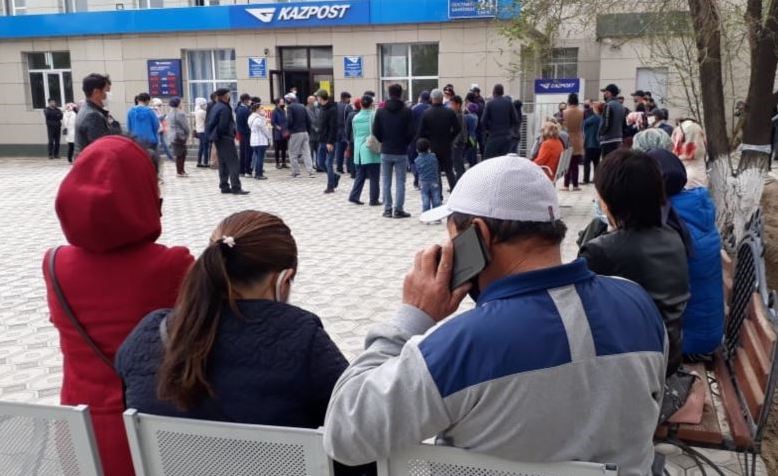
In order to stimulate social distance, the authorities banned passenger transportation. At the same time, the complicated and ineffective procedure for implementing the social assistance programme provoked nationwide crowds of tens of thousands of Kazakhstanis who gathered near banks and post offices in a bid to receive financial aid in the amount of 42,500 tenge (approx. 95 euros according to the exchange rate for April).