Kazakhstan: Massive restrictions on expression during Covid-19; sudden banning of peaceful opposition
Kazakhstan: Massive restrictions on expression during Covid-19; sudden banning of peaceful opposition
By IPHR
7,954 views
Introduction
This report covers developments on the freedoms of expression, association and peaceful assembly in Kazakhstan from April to June 2020, and was prepared for the CIVICUS Monitor by International Partnership for Human Rights (IPHR) and Kazakhstan International Bureau of Human Rights and Rule of Law (KIBHR) based on KIBHR’s monitoring of the situation in the country.
The reporting period was characterised by mass restrictions on freedom of expression and freedom of association, specifically in relation to the banning of the popular unregistered “Street Party” movement by a court decision in May 2020 after it was labelled as extremist. The reporting period also saw important legislative developments, including changing slander from a criminal to an administrative offence and the corresponding reduction of penalties from prison sentences to fines. However, insult and insulting a government representative remain criminal offences.
Association
During the quarantine, the Prosecutor General announced in a press release that on 19th May 2020 the Esil District Court in Nur-Sultan had decided to ban the Street Party as an extremist organisation. Ten activists filed appeals against the decision in Nur-Sultan City Court. In an online press conference the activists stated that they saw the decision as politically motivated and illegal, noting that the hearing was held without the presence of the defendants (representatives from the party) , and that they had learned of the ban only from the press. Lawyer Galym Nurpeisov representing the party further noted that there was no evidence presented to the public as to why the party was deemed “extremist”. On 20th May 2020, a new press release was issued from the Prosecutor’s office stating that the Street Party was seen as the successor to the banned DVK and thus considered to be extremist.
Several incidents occurred during the reporting period related to people showing their support for the Street Party and the DVK.
Before the party was banned, on 3rd April 2020, the Administrative Court in Talgar in the Almaty region fined two residents 138,500 KZT (280 EUR or 329 USD) for violating the law on public associations. Asylbek Karaev and Erkyn Sabanshiev had recorded video messages calling for citizens to join the Street Party.
On 6th May 2020 civic activist Marat Duisenbiev was sentenced to two days’ administrative detention for insulting a doctor. The incident occurred on 29th April 2020 as he was taken to hospital by ambulance staff and security services officials on suspicion of COVID-19 infection, despite having no symptoms. The pressure on Duisenbiev is believed to be related to his activities with the Street Party – he was the administrator of the Telegram chat group.
On 15th May 2020 in Oskemen, Ruslan Nurkanov was summoned for interrogation at the Ulanov District Police Station as a suspect in a criminal case under Article 405 of the Criminal Code (participation in a banned extremist organisation), in connection with his alleged links to the Street Party.
On 15th May 2020 the Petropavlovsk City Court sentenced blogger Azamat Beikenov to a year’s suspended sentence for participating in a banned extremist organisation, after he “liked” several posts on social media related to DVK.
On 22nd May 2020, 13 Street Party activists were detained outside the Esil District Court, when they demanded to see the official court decision banning the movement. The absence of the documents from the official court decision made it difficult for the lawyers to act in the case. The group was arrested by officers from the Special Forces and kept at the police station for eight hours. At the same time, even before the court decision had come into effect, numerous Street Party activists were summoned for interrogation under Article 405 of the Criminal Code (participation in a banned extremist organisation). On 25th and 26th May 2020, 20 such cases were registered, according to the human rights initiative Qaharman. There were also cases of citizens being held responsible for participating and messaging in online chats related to the Street Party.
On 25th May 2020, civic activist Sergey Shutov from Atyrau was summoned to the police station. Shutov reported that the police were attempting to take statements to understand who was responsible for adding people to the Telegram chat of the banned Street Party, and who was present in the group. Shutov refused to confirm any such information to the police, as he viewed his summons and the conversation with the police asillegal.
On 25th May 2020, Roman Reikhert, (see previous monitor update) was found guilty of participating in a banned extremist organisation by the Martuk District Court in Aktobe. He received a one year suspended sentence. Reikhert had previously posted on social media in support of DVK and about the Street Party.
On 29th May 2020 activist Zhazira Demeuova was summoned to the police station in Almaty. Demeuova was asked whether she was aware of the banning of the Street Party and was warned that participation in the party could be criminally prosecuted.
On 27th May 2020, the civil activist Bagdat Baktybaev was summoned to the police station in Shu in relation to his alleged links with the Street Party.
On 28th May 2020 activist Nurbol Talgarbekov was approached by the regional prosecutor in Talgar and given a document stating that the Street Party had been banned.
On 3rd June 2020 in Shymkent, regional director of KIBHRs Shymkent branch, Adil Seitkaziev, was summoned to the district police department. The police had earlier informed Seitkaziev that he had been identified in the Street Party’s group chat on Telegram. At the police station, a representative of the prosecutor’s office informed Seitkaziev and several other persons in a similar situation to him that the Street Party and DVK were banned extremist organisations.
Peaceful Assembly
A new draft law on holding peaceful assemblies which was rushed through during the lockdown and quarantine caused widespread concern amongst civil society actors and the international community, despite public assurances from the authorities, including President Tokayev, that the law would improve the regulation of peaceful assemblies. However, KIBHR’s analysis of the draft law shows that some of the new provisions will result in more serious restrictions on the freedom of assembly. Dauren Abayev, Minister of Information and Social Development, presented the draft law to the public on 12th March 2020. At the end of March 2020 the lower house and upper houses of parliament approved the draft law. KIBHR Director Yevgeniy Zhovtis left the draft law Working Group on 1st April 2020. In an interview with the Kazakh bureau of RFE/RL, Radio Azattyq, he stated that his decision to leave the working group was because he “did not see any point in participating” further due to fundamental disagreements with the most important provisions of the draft law. President Tokayev signed the newly revised law into effect on 25th May 2020. Kazakhstani civil society, IPHR and other international NGOs had called on the President not to adopt the law. The law has been criticised for the following reasons:
It introduces unjustified restrictions on the timing and place of assemblies;
It retains the requirement for people to obtain government approval prior to conducting peaceful marches and demonstrations;
It sets out extensive requirements for submitting notification and permit applications;
It allows for assemblies (except single pickets) to be held only in certain locations designated by the local authorities;
It stipulates that only Kazakhstani citizens will be permitted to organise and participate in assemblies;
It sets out an extensive list of grounds upon which the local authorities can reject applications to hold public assemblies;
It forbids foreign citizens, people with mental disorders, or citizens recognised to be legally incompetent by a court from participating in rallies.
In a separate development, on 1st April 2020, a small group of people went to the regional akimat (municipality) to complain about the sudden inflation of the Kazakh tenge and their financial difficulties due to the pandemic. The guards at the akimat building prevented the group from approaching politicians in the building, citing quarantine regulations. The group was later able to meet with the officials. The next day, a participant in the protest, Murat Baimaganbetov, who is disabled, was sentenced in an online court hearing to five days of administrative detention for disobeying police orders. On 13th May 2020, four activists held a small rally on the city square in Shymkent, demanding an end to the quarantine. On 3rd June, the Shymkent Specialised Administrative City Court sentenced the four activists to between five and six days of administrative detention for holding an illegal rally. The demonstration was recognised as illegal as the activists had not received prior permission for the meeting.
On 18th April 2020 in Aktobe, disabled civic activist Garifulla Embergenov was given an administrative fine of 13,850 KZT (28 EUR or 33 USD) through an online trial for allegedly violating Article 434 of the Administrative Code – petty hooliganism, when he held a single person picket. At the time of writing, Embergenov had refused to pay the fine.
On 3rd June 2020 in Karaganda, Gennady Nadyrbekov attempted to set fire to himself outside the regional court building. Nadyrbekov had been trying to get an official explanation for the change in his sentence for his fraud conviction in 2019 from a fine to a prison term. Nadyrbekov doused himself with petrol, but bystanders managed to knock the lighter out of his hands. He was taken to the police station and sentenced to 10 days’ administrative detention for violation of Article 434 of the Administrative Code – petty hooliganism.
On 3rd June 2020 Shymkent Specialised Administrative Court sentenced six activists to various periods of administrative detention and fines for holding an unsanctioned demonstration. Nurzhan Mukhamedov was sentenced to six days’ detention; Daniyar Baitleu, Marat Kudaidergenov and Marat Kasymbekov were each sentenced to five days. Two other activists were fined: Abdrakhman Kasymbekov 135,000 KZT (272 EUR or 320 USD) and Zhambyl Zhunisbekov 54,000 KZT (109 EUR or 128 USD). On 13th May 2020 the activists had held a rally in Ordabasy City square demanding that the quarantine be lifted.
On 6th June 2020 the unregistered Democratic Party, the movement “Oyan, Kazakhstan”, as well as DVK and the Street Party called for nationwide rallies, following which:
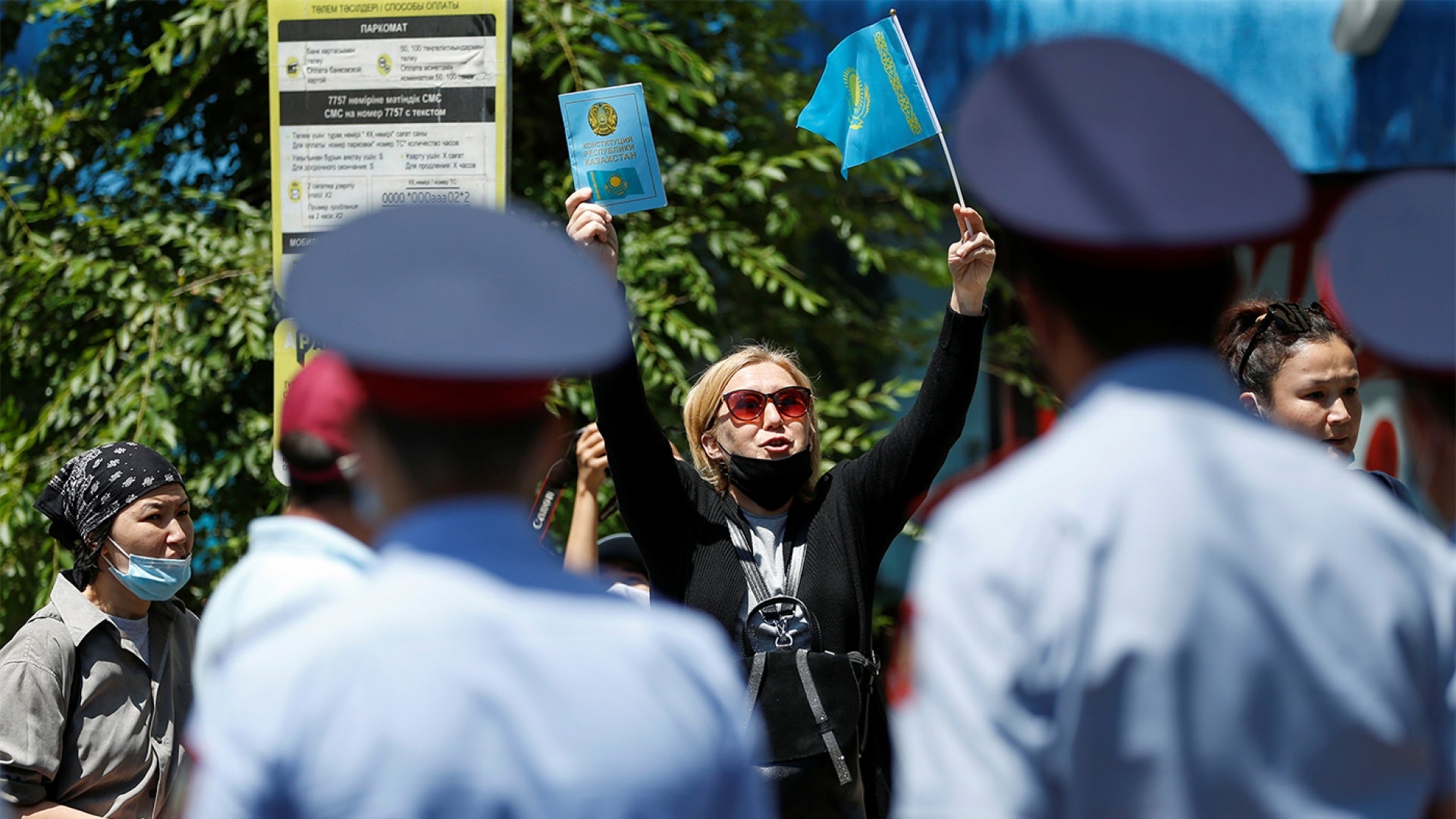
In Almaty, the police cordoned off the city centre and carried out mass arrests of activists present. About a hundred supporters of the Democratic Party attempted to demonstrate in the city centre whilst disinfection personnel in white protective suits sprayed the area and protesters with a disinfectant solution.
In Nur-Sultan, Kazakh Eli Square was cordoned off by police “for disinfection” and a group of ten people was detained.
In Uralsk, according to KIBHR monitoring, people attempting to gather in the city centre were prevented from doing so by police, who acted in a rough-handed manner.
In Kyzylorda, disabled activist Murat Baimagambetov was beaten and sustained a leg injury as he was detained together with other activists.
In Semey, police detained around 20 people at the site of a planned demonstration.
In Shymkent, dozens of people were arrested as they headed to Ordabasy Square.
Preventive arrests were also carried out throughout the country. According to several human rights organisations, 239 cases of persecution of citizens who were trying to exercise their right to peaceful assembly were made in the days around 6th June 2020. According to the authorities, on 6th June 2020, a total of 53 people outside the two largest cities were detained and taken to police stations. Seven of these received administrative fines, one received an official warning and the rest were released after a “talk” with law enforcement officials. Criminal investigations were launched against two people on charges of insult and violence against an official. Police reports stated that, in Almaty alone, 107 people were detained on 6th June 2020, 15 people were sentenced to 15 days’ administrative detention and dozens received administrative fines. In Nur-Sultan, 20 people were detained, two were sentenced to ten and 15 days’ respectively and two criminal cases were initiated.
On 10th June 2020 near the Uralsk Prosecutor’s Office, civil activist Daniyar Inzhegaliyev attempted to set himself on fire in protest at law enforcement’s inaction on a family matter and alleged pressure from the police in relation to a criminal case against him. Law enforcement provided no explanation for the charges and attempted to recruit Inzhegaliev as an informer. After the attempted self-immolation, Inzhegaliev was taken to hospital for treatment of his burns. Inzhegaliev had also tried to set himself on fire on 28th February 2020 in front of the municipal office, where a person managed to knock the bottle of petrol out of his hands. According to media, Inzhegaliev’s brother was hit by a car, but the police refused to accept a statement about the incident. After this, Inzhegaliev had attempted to hold a single picket outside the police headquarters in the city, as mentioned in the previous Monitor update.
In Nur-Sultan, a group of mothers with many children had been protesting outside the Ministry of Labour and Social Protection for two days in relation to housing issues they were facing. On 10th June 2020 they were detained by people wearing protective suits and loaded into buses. The women were then taken to the former Ramada Plaza Hotel building, where quarantined COVID-19 patients are being placed.
In a separate incident on 10th June 2020 in Nur-Sultan, around ten citizens went to the EU Delegation in protest at human rights violations in Kazakhstan. The protesters were dispersed by police and taken to the police station.
On 12th June 2020, 12 people protested outside the US Embassy in Nur-Sultan, calling for the release of three activists who had been detained in relation to opposition rallies on 6th June 2020. The protesters were detained and taken to the Esil District Police Department. One protester – Anna Shukeeva – was fined 138,900 KZT (280 EUR or 330 USD) on the same day during an online trial for calling for an unsanctioned demonstration.
On 13th June 2020, around a hundred people gathered on the Panfilov pedestrian street in Almaty to hold a procession. The activists walked through the street for three hours, and some danced and played musical instruments. The participants also chanted “Activists are not extremists” and “Forward, Kazakhstan!” Over the next week, six people were sentenced to 15 days of arrest and three people had to pay a fine for violating the law on peaceful assemblies. A criminal case was initiated against pensioner Sakhtb Zhanabaeva for participating in a banned organisation. While the detained activists were serving their sentences, the Interdistrict Administrative Court in Almaty extended the sentences of four people with new administrative detention sentences of 15 days each for participating in the 6th June 2020 demonstrations.
On 25th June 2020 in Nur-Sultan, five residents of Zhanaozen were detained near the presidential administration as they carried posters demanding to be given work. They were detained and in an online trial held on the same day they were given an official warning for violating the law on peaceful assemblies.
Expression
During the COVID-19 pandemic amendments were introduced to laws on freedom of information and digital privacy. On 25th June 2020, President Tokayev signed into law changes to legislation concerning digital security. These were adopted without any discussion with civil society. The opposition site Rukh 2019 expressed concerns about the formulation of the law on the grounds that the provisions are overly broad and could therefore be used to violate human rights and freedoms. Rukh 2019 also raised concerns about the use and protection of personal data, including sensitive biometric information, and the degree of independence of the body responsible for oversight, as well as the lack of any independent oversight for the national video monitoring system, with fears that it could be used to track people’s movements.
Slander removed from Criminal Code, but insult remains a crime
On 27th June 2020, the President signed amendments to the Criminal and Administrative codes into law. Slander (Article 130) was removed from the Criminal Code and transferred to the Administrative Code, under Article 73-3. Individuals found guilty of disseminating information discrediting the honour and dignity of a person or his/her reputation will be punishable by a fine of 444,500 KZT (930 EUR or 1076 USD) or administrative detention for 15 days; publishing such information online or in telecommunication networks will be punishable by a fine of 500,000 KZT (1045 EUR or 1210 USD) or administrative detention for 20 days; and 555,600 KZT (1162 EUR or 1344 USD) or administrative detention for 25 days if the crime is combined with a corruption allegation. Officials committing the same offence will face higher penalties.
This development is a significant improvement from the former provisions which provided for criminal punishment (Article 130 of the Criminal Code) for slander, with a fine of between 2,778,000 KZT (5800 EUR or 6700 USD) and 8,334,000 KZT (14,400 EUR or 20,100 USD), or imprisonment for up to three years. However, insult (Article 131) remains a criminal offence, as does “Insulting a government representative” (Article 378).
Arrest of Asya Tulesova
On 6th June 2020, environmental and civic rights defender Asya Tulesova was detained in relation to an incident at a protest in Almaty but was released later that day. On 8th June 2020, she was detained again – this time as a suspect in a criminal case opened against her for knocking the hat off a police officer during the 6th June 2020 protests as police officers detained protestors, including elderly persons, in a rather brutal manner. The incident was captured on video. Tulesova was charged with “non-dangerous infliction of harm to a representative of the authorities” (Article 380 of the Criminal Code) – an offence punishable by a fine of up to 8,334,000 KZT (16,800 EUR or 19,800 USD) or up to three years’ imprisonment. On 9th June 2020, 169 Kazakhstani human rights defenders and organisations published an open letter to President Tokayev in support of Tulesova, calling for an end to police impunity for using excessive force and violence against peaceful protesters, and to cease detentions of citizens exercising their right to freely and peacefully assemble. Tulesova has been targeted by police in the past when protesting peacefully. On 21st April 2019 she was detained together with several other activists as they held and filmed a peaceful protest at the start of the Almaty Marathon, holding up a banner saying: “You cannot run away from the truth”, with the hashtags #ForFairElections and #IHaveAChoice. This was a play on words designed to attract attention to the then upcoming presidential elections a few weeks later. Asya was sentenced to 15 days in administrative detention for the protest.
On 11th June 2020 IPHR and KIBHR published a letter calling for Tulesova’s release. Ahead of 18th July 2020, Nelson Mandela Day, CIVICUS launched the #StandAsMyWitness campaign calling for the release of human rights defenders who are imprisoned, persecuted or harassed. The campaign called for the release of Tulesova.
On 12th August 2020, Medeysky District Court No.2 in Almaty found Asya guilty of using violence and insult towards a state representative and sentenced her to a 1,5 year probational sentence of restriction of liberty and a fine of 55,560 Tenge (110 EUR). She was released from the courthouse.