Kazakhstan Is Building A Surveillance State. Will China Be Its Model?
Kazakhstan is expanding its surveillance network using AI-powered facial recognition systems like TargetEYE, raising concerns about potential misuse against activists.
By Zholdas Orisbayev & Reid Standish
4,968 views
As Kazakhstan forges ahead with an ambitious plan to build up a state-of-the-art surveillance network and modernize its digital infrastructure, activist Sanzhar Boqaev learned firsthand about what such a system could mean for people like him.
After arriving at Almaty airport in June, Boqaev - a former Kazakh official turned prominent political blogger - was stopped by police when he was identified through a homegrown AI-powered facial recognition system called TargetEYE and listed in its database as a "civil activist."
Boqaev recorded part of the interaction on his phone and says an officer even showed him his profile in the database, which included a biometric comparison and his personal data, before he was asked to go to a police station.
He was eventually let go after being briefly detained at the airport and Boqaev later released footage online, saying the government was using advanced technology to track activists.
The Kazakh Interior Ministry said that Boqaev was added to the database incorrectly due to his resemblance to another individual. Interior Minister Yerzhan Sadenov said afterward that the government is not compiling a database of activists and that "technology can make mistakes, too."
"You can see it in the video. It shows my photo, name, father's name, and I'm marked as a 'civil activist.' Who else could it be?" Boqaev told RFE/RL. "Moreover, it says the database was entered by the Interior Ministry's anti-extremism department. Even the officer's last name who entered it is recorded. Yet they deny this is me [in the database]."
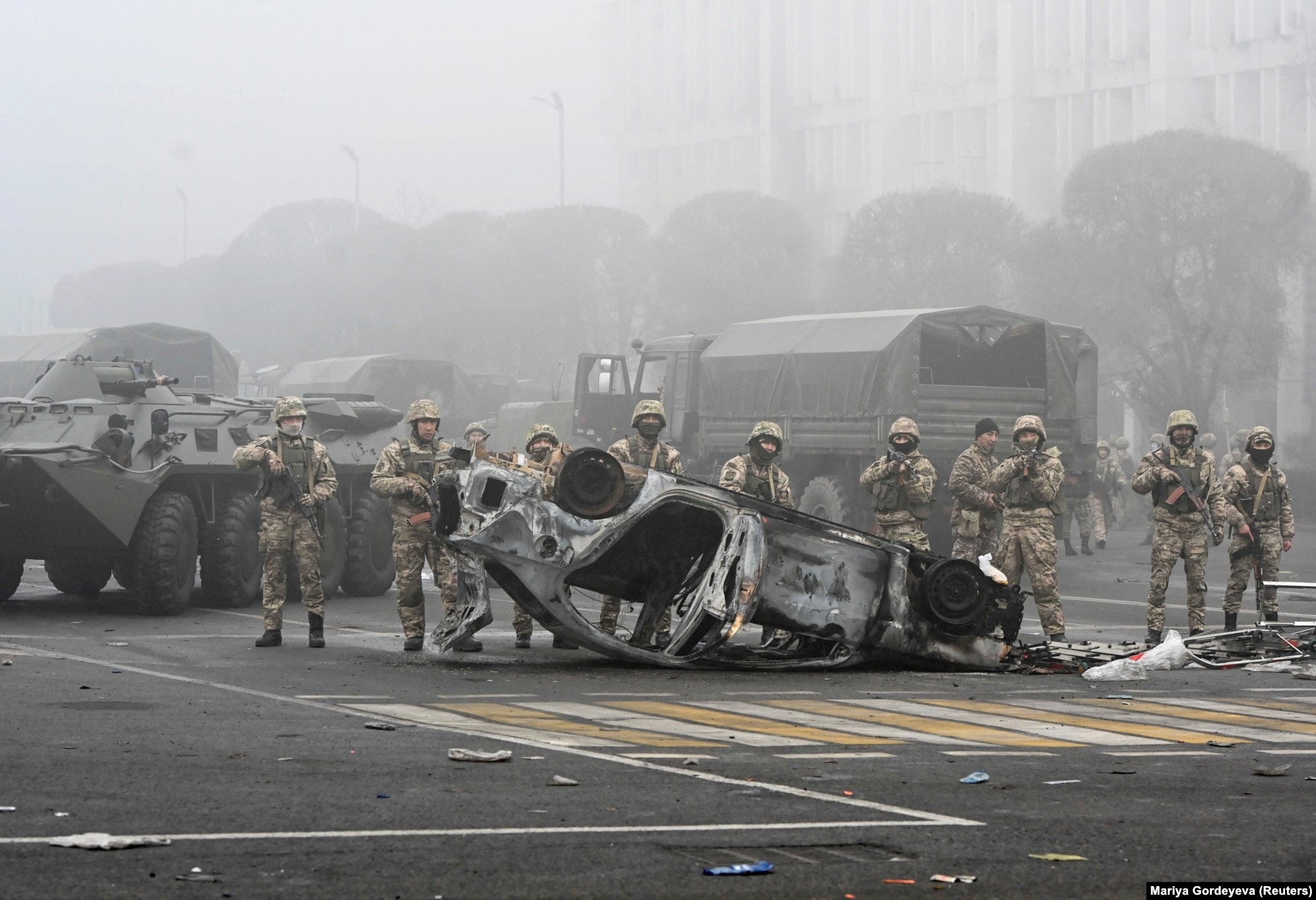
For Boqaev and other activists in the country, the incident offers a glimpse of a worst-case scenario where the government's digitalization push -- which includes tens of thousands of surveillance cameras deployed with facial-recognition software, a central digital ID system, and a major long-term investment in AI -- could be abused as the government looks to avert any replay of the January 2022 mass protests and bloody unrest that threatened Kazakh President Qasym-Zhomart Toqaev's hold on power.
Adding to those concerns is where much of the hardware and technological foundation for Kazakhstan's digitalization strategy is coming from: China.
Chinese-made data servers, telecoms equipment, microchips, and surveillance cameras have become the bedrock of Kazakhstan's digital-first ambitions, which continued to pick up steam in September when Toqaev announced the creation of a new AI ministry.
The worry, experts told RFE/RL, is not only that the Central Asian country could be left reliant on Chinese companies for its technological advancement, but that it could also adopt the public surveillance and censorship model inside China, where civil liberty and privacy needs have been eroded in favor of state control and security.
"China, both politically and socially, is not a model for how technology should be used in a democracy," Dana Malikova, a digital rights expert who has worked for multiple civil liberties groups in Kazakhstan, told RFE/RL. "China has advanced technology, but the issue at hand is how it will be used [in Kazakhstan]."