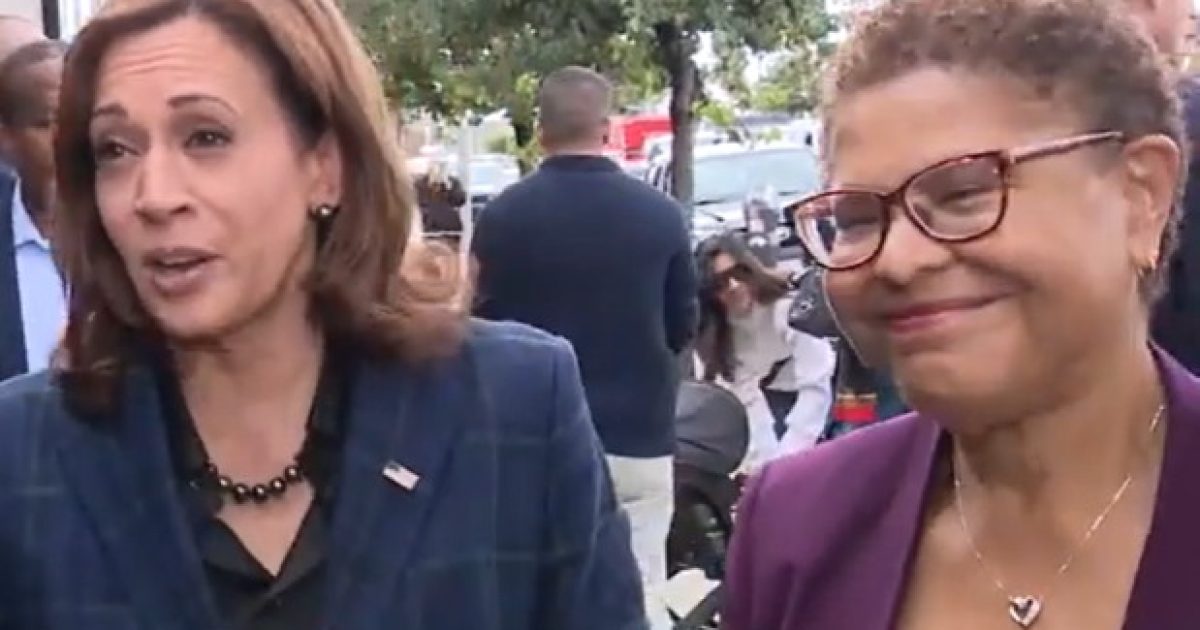
Kamala Harris Endorses Los Angeles Mayor Karen Bass for Re‑election; Critics Dispute Claims on Crime, Homelessness and Wildfire Response
Former Vice President Kamala Harris announced her endorsement of Los Angeles Mayor Karen Bass, praising what Harris described as declines in homelessness and crime under Bass’s first term. The endorsement prompted sharp criticism from opponents who dispute those claims and raised renewed questions about Bass’s handling of last year’s Southern California wildfires and the city’s recovery progress.
By Mike LaChance
976 views
In her statement, Harris leaned on the issues at the center of the campaign. "Mayor Karen Bass is the leader Los Angeles needs right now," Harris said. "She has done what so many said couldn't be done — the first ever two-year decline in homelessness, reducing crime to levels this city hasn't seen since the 1960s, and refusing to back down when the federal government came after our neighbors." Harris, who served as a U.S. senator from California from 2017 to 2021, added that Bass "has my full support for re-election."
The two are longtime allies. Then-Vice President Harris swore Bass into office in 2022, and the relationship dates back further still, to Harris's tenure as California attorney general, when the two worked together on youth homelessness and child-welfare issues. Bass welcomed the backing warmly. "I am deeply honored to have the support of Vice President Kamala Harris, who has spent her career fighting for the people of Los Angeles and our country," Bass said. "Her endorsement is a reflection of what we're building together: a Los Angeles that is safer, more affordable, and unafraid to fight for its values."
The endorsement landed at a moment of genuine uncertainty for the incumbent. Harris's is the highest-profile endorsement of the race so far, and Bass has retained backing from the Democratic establishment, including Sen. Adam Schiff, Rep. Nancy Pelosi and numerous sitting city council members. Her donor roster includes actor Samuel L. Jackson and director J.J. Abrams. The race features several prominent challengers, among them reality TV personality Spencer Pratt and City Councilmember Nithya Raman; if no candidate earns more than 50% of the vote on June 2, the election heads to a November runoff.
Polling has been mixed and the electorate notably unsettled. Recent UCLA Luskin School of Public Affairs polling showed Bass leading with 25% support, Pratt at 11% and Raman at 9%, with Huang and Miller at 3% each — but with roughly 40% of likely voters undecided just weeks out. "It is unusual for 40% of likely voters to be unsure of their choice just two months before an LA mayoralty election," said Zev Yaroslavsky of the UCLA program, underscoring why a candidate needs a majority to avoid a runoff. Fundraising has been similarly close: challengers Pratt and Raman have at times outraised Bass on a per-period basis, though Bass entered the year with a far larger cash reserve built up since 2024.
The endorsement drew an immediate and combative reaction from Spencer Pratt, who is running an insurgent campaign and has built momentum partly through viral social-media attacks. Pratt tied the endorsement to his central line of attack on Bass — her handling of the January 2025 wildfires — and leveled a serious, unsubstantiated allegation. "Obviously, Kamala Harris loves Karen Bass," Pratt said. "Because of Karen Bass letting the Pacific Palisades and Malibu burn down, Kamala Harris was able to get a $2 million discount on her new house in Malibu." He also accused Bass of a post-fire "cover-up," claiming she altered an after-action report — a characterization he framed as "obstruction of justice."
Pratt offered no evidence for the claim that the fires were allowed to burn to secure Harris a property discount, and the available facts do not support it. Harris and her husband, Doug Emhoff, purchased an $8.15 million home in Malibu, but the property is in Point Dume, a neighborhood that "is in relatively good shape compared to other parts of Malibu" and was not destroyed in the fires. No reporting has established that the purchase price reflected any fire-related discount or any connection to Bass. Pratt has separately attacked Bass as "corrupt" and a "MAGA Karen," the latter a reference to a recent White House meeting with President Trump over federal wildfire-relief funds.
Stripped of the more inflammatory allegations, there is a real and documented debate over Bass's wildfire record that opponents can legitimately press. Bass faced intense criticism in January 2025 for being abroad on an overseas trip when the Palisades Fire broke out, and over the city budget. In June 2024, Bass approved a budget of nearly $13 billion that included roughly a $17 million reduction in the LAFD's more than $800 million budget; Fire Chief Kristen Crowley wrote in a December memo that the funding deficit had affected the department's "ability to maintain core operations," including training and large-scale emergency response.
The picture, however, is more contested than a simple "budget cut" framing suggests. The LAFD's overall operating budget was growing and on track to exceed $950 million, and City Council President Marqueece Harris-Dawson noted the $17.4 million figure was a line item offset by increases elsewhere, including about $100 million in fire-department staff raises. Rep. Brad Sherman, whose district includes the Palisades, said the cuts were "chiefly for training" funds to be spent in 2025 and were "not a reason why the Palisades have suffered," while still calling them "perhaps ill-advised." Bass has consistently maintained that the reductions did not affect the response to the fires, and she has since moved to expand the department: three months after the fire, she proposed adding more than 200 positions to the LAFD in her 2025-26 budget, even as other city agencies faced layoffs.
The claims Harris cited are similarly the subject of legitimate dispute. Independent verification of "record-low crime" and a "first-ever two-year decline in homelessness" depends on the specific datasets and timeframes used, and Bass's critics argue the lived experience of many Angelenos does not match the statistics — exactly the kind of contest over interpretation that endorsements tend to sharpen rather than settle.
The dispute highlights how national endorsements can become focal points for campaign attacks, even when the underlying questions are local. Supporters of Bass and Harris say the endorsement underlines federal and local cooperation on homelessness and public safety, and reinforces Bass's viability as an incumbent. Harris's statement also cast Bass as a defender of Los Angeles against the federal government — a reference to Bass's clashes with the Trump administration, including over immigration enforcement in the city — a framing intended to portray her as standing up for local communities.
As Los Angeles moves deeper into the campaign season, the exchange illustrates the broader political stakes. For Bass, Harris's high-profile backing could mobilize Democratic and progressive voters in a crowded field; for opponents, the endorsement provides an opening to re-litigate the mayor's record on public safety, homelessness, and disaster recovery. Both Bass's office and Harris's campaign framed the endorsement as a statement of confidence in the direction of city leadership, while opponents and some commentators continue to press for accountability on wildfire recovery. With the June 2 primary approaching and a large bloc of voters still undecided, the endorsement and the responses it generated are likely to remain prominent themes in coverage of the race in the weeks ahead.