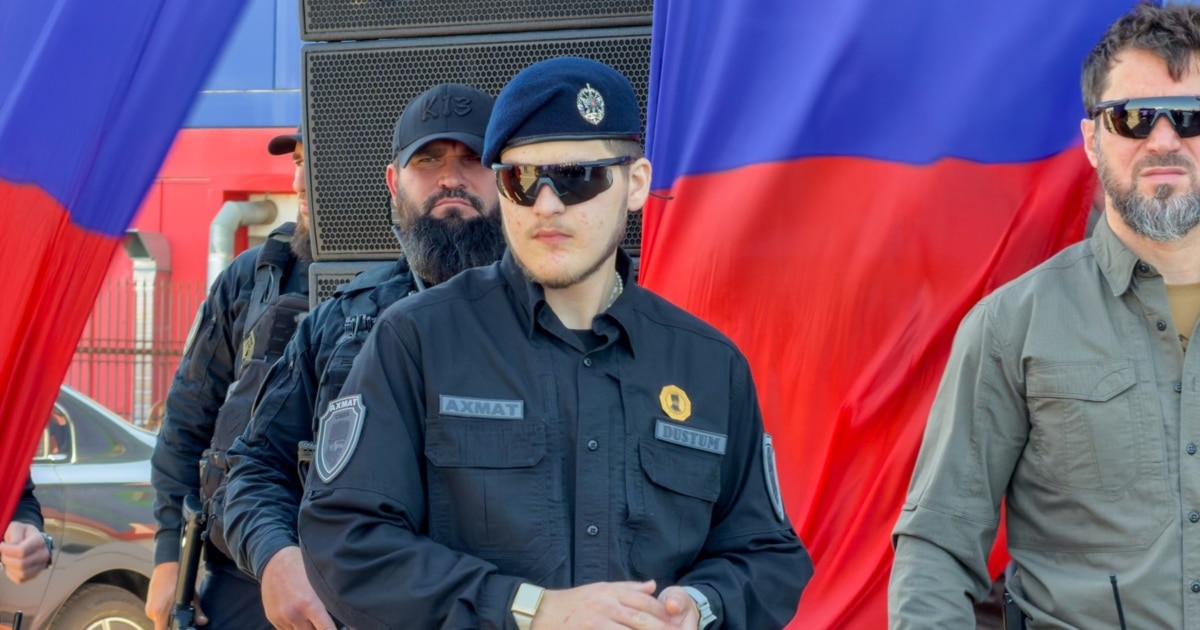
‘K‑13 Team’: Alleged Private Force Around Adam Kadyrov Sparks Denials and Questions in Chechnya
An Instagram post and related social-media activity have suggested that 18-year-old Adam Kadyrov, son of Chechen leader Ramzan Kadyrov, has assembled a personal security or paramilitary formation branded as "K-13". Chechen authorities deny the existence of any separate unit created by Adam, while analysts warn that even an unofficial force could play a role in succession politics and elite consolidation in the republic.
By Christopher Manley
917 views
A social-media posting and accompanying accounts have brought renewed attention to the question of private armed formations in Chechnya after a photo published on October 16 purportedly showed 18-year-old Adam Kadyrov surrounded by nearly two dozen young men in military-style uniform carrying weapons and wearing patches marked "Dustum" and "K-13." The photo, first highlighted by the independent outlet Verstka and later reported by Caucasus-focused media, was posted to an Instagram account styling itself as the "Team K-13."
The caption on the post stated that the group had been personally assembled by Adam Kadyrov and that its members were prepared to carry out his orders regardless of time or place. People identified in the image include relatives of Adam and members of well-connected Chechen families and security clans: Ramzan Daudov (son of the republic’s prime minister Magomed Daudov), Ramzan Matsuev (younger brother of the agriculture minister Vishan Matsuev and brother-in-law of Ramzan Kadyrov), Abubakar Kadyrov (a nephew of the head of the republic), Dokka Aidamirov and Minkail Usmanov (nephews of the head’s wife, Medni Kadyrova), Akhmat Vismuradov (a nephew of Vice‑Prime Minister Abuzayd Vismuradov), and Yakub Chalaev (son of special police regiment commander Zamid Chalaev). Reporters also identified Khas‑Magomed Naurbiev (son of a deputy commander of SOBR "Akhmat") and Shamil Iraskhanov (related to the head of the Grozny police, Apti Iraskhanov) among those pictured.
Chechen officials have rejected the claim that Adam Kadyrov has formed a separate force. Ilman Vakhidov, deputy head of the Chechen government and minister for national policy, external relations, press and information, told the TASS news agency that "no separate unit, much less one created by Adam Kadyrov, exists." Vakhidov argued that the Instagram account referenced by reporters was not an official source and speculated it was run by an "enthusiast." The denial was echoed by state information agencies RIA Novosti and the daily Kommersant. By October 21, the Instagram account attributed to "Team K-13" and a related account called dustumbaza were no longer accessible.
The names and insignia circulating online have prompted observers to note the deliberate branding around Adam Kadyrov. "Dustum" is the callsign long used by Ramzan Kadyrov and now adopted by his son; "K-13" appears to be Adam’s personal brand, with clothing and energy drinks bearing the label and reportedly promoted by the head of Chechnya. Separate reports in pro-government Chechen channels have also referenced a so-called "Central Base Dustum K-13," said to be located in Adam Kadyrov’s ancestral village Ahmat-Yurt on the grounds of an "Akhmat" SOBR unit. Videos attributed to the base’s commander Timur Edilov posted last year show training exercises, including drone operations, and formations labeled "K-13 Central Base." Those posts first appeared in autumn 2025 and include footage from December 2025 and August 2026, according to local publications.
Analysts who spoke with regional media frame the emergence of K-13 branding and associated activity in political as well as military terms. Political scientist Ruslan Aysin suggested the formation of a personal security element around Adam fits wider patterns in Chechen power politics: "Every son of a feudal lord should have his own personal guard," Aysin said, and added that a person with political ambitions "cannot be without a force that would carry out his orders if necessary." He described the new group as part of the process of grooming a potential successor and warned that history in the republic shows disputes can be decided by force.
Harold Chambers, an analyst on the North Caucasus, argued there appear to be two related phenomena: an officially integrated "Dustum K-13" base that may have been accommodated within formal structures, and a more informal "Team K-13" social-media presence that may lie outside official recognition. Chambers suggested the official denials could be designed to reassure Moscow while obscuring the real scope of the project: "Formality has never been the most important thing in Kadyrov’s Chechnya, so denial that the group is official does not cancel its existence or the ways Adam may use it," he said.
Whether Team K-13 is a ceremonial youth corps, a private security detachment, a marketing brand, or a nascent paramilitary clique remains unclear. What is clear from the reporting is that the group’s membership links it to prominent families and security elites within the republic, combining kinship and institutional ties. Analysts warn that even if the unit is not formally recognised by Moscow or Chechnya’s official command, its existence matters: it could help consolidate a new generation of loyalists around the Kadyrov family, serve succession planning, and deepen networks that are capable of coercive action.
The episode highlights broader concerns about accountability and the concentration of armed power in the hands of political families in regions with weak institutional oversight. For human‑rights monitors and policymakers, the question is not only whether an officially sanctioned unit exists, but how informal armed groupings tied to ruling elites affect the rule of law, security, and the prospects for political contestation in Chechnya and the wider Russian Federation.