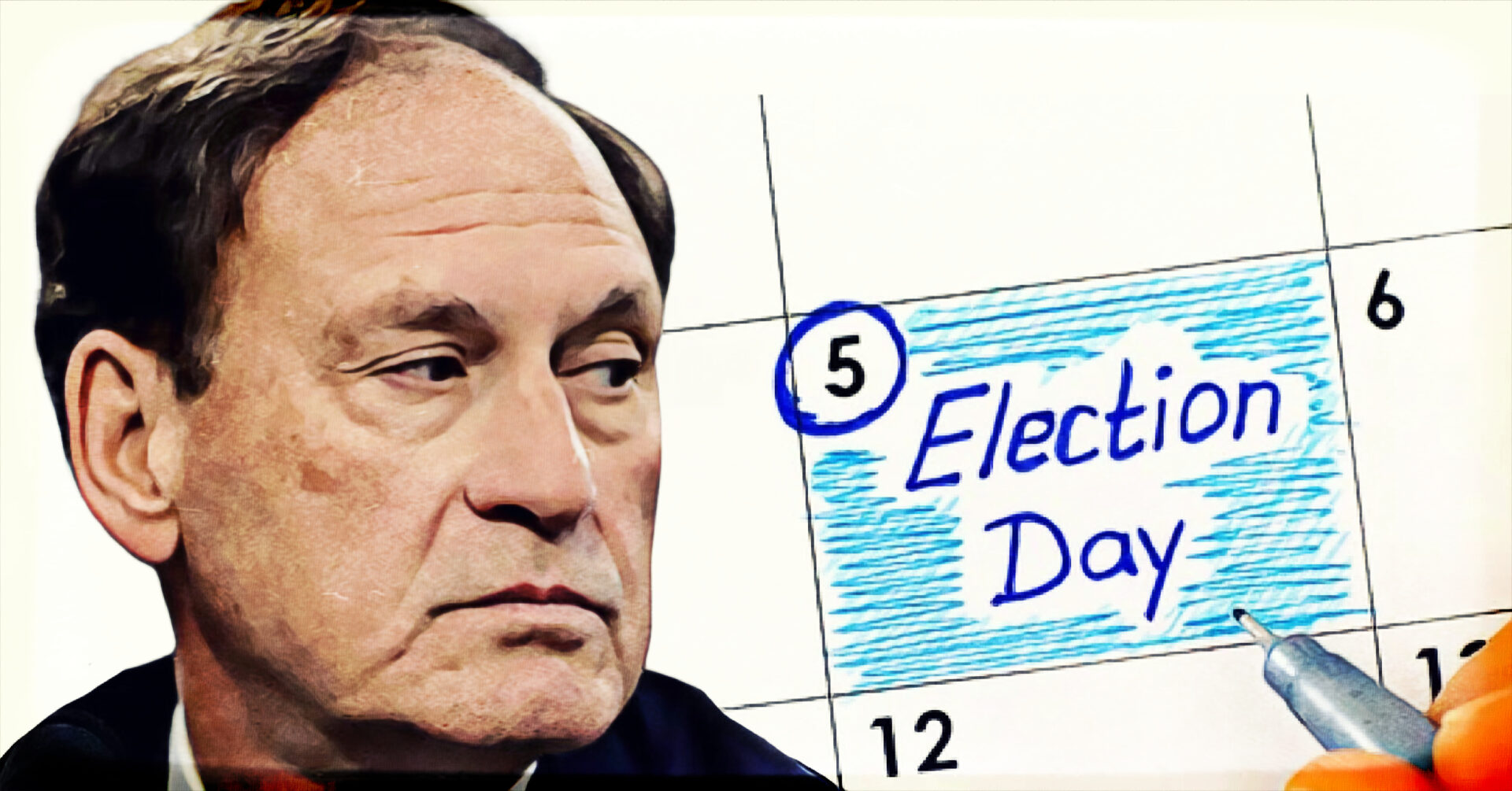
Justice Alito Appears to Advocate for a Single, Nationwide Election Day, Revolver News Reports
A Revolver News headline asserts that Justice Samuel Alito favors a single Election Day. The full Revolver News article was not available for review here; this report summarizes the headline's claim, outlines the legal and practical context of a single Election Day proposal, and explains why primary sources and the full article are needed for confirmation.
By BellaVita
823 views
A Revolver News headline published on March 2026 states that U.S. Supreme Court Justice Samuel Alito "just made it clear: He wants ONE Election DAY." The underlying article was not accessible for this rewrite, so the following report is a careful, contextualized account based on the headline’s claim and public, general knowledge about election law and administration. Because the full Revolver News text and any direct quotes or specific legal citations it may include were not available for direct quotation or preservation here, readers should consult the original article and primary sources for full details.
The phrase "one Election Day" ordinarily refers to proposals to limit voting to a single, nationwide day of in-person voting rather than allowing early in-person voting windows, absentee or mail-in ballots, or other methods that extend the period during which ballots can be cast. Such proposals can take many forms: federal legislation imposing a uniform voting day; judicial rulings that constrain state practices around early voting or absentee ballots; or policy preferences expressed by public officials. The Revolver News headline indicates that Justice Alito has signaled support for this concept, but without access to the article’s text, it is not possible here to reproduce any direct statements, legal reasoning, or specific case references that Revolver News may have cited.
If a sitting Supreme Court justice were to endorse a legal position favoring a single Election Day in the manner suggested by the headline, it would touch on complex constitutional and statutory questions. U.S. elections are largely administered by the states under the Constitution’s Elections Clause and the broader framework of federalism. At the same time, Congress has authority to regulate the times, places, and manner of federal elections, and federal statutes govern absentee voting, the Voting Rights Act, and other aspects of electoral administration. Any visible shift in the Court’s approach to cases involving those statutes or to challenges to state practices could have significant downstream effects on how elections are conducted, how many opportunities voters have to cast ballots, and how courts evaluate state and federal authority over election rules.
Practical implications of a move toward a single Election Day would be substantial. Voting patterns, turnout figures, and administrative logistics are all shaped by the availability of early voting, absentee and mail voting, and longer in-person voting periods. Narrowing voting to one day could affect voters who rely on extended periods — including working people, those with caregiving responsibilities, people with disabilities, and others — and could alter the efforts required of election officials to administer large numbers of in-person ballots within constrained timeframes. Campaigns and parties adjust strategies around voter contact and turnout operations in response to voting windows; a single-day model would further reshape those calculations.
Any public suggestion by a Supreme Court justice about election administration also carries political and institutional implications. The Court is often called upon to resolve disputes about election law, and statements from justices, whether made in written opinions, oral arguments, or commentary, can influence litigants and lower courts. Observers and stakeholders — including election administrators, civil rights organizations, state officials, and lawmakers — would likely scrutinize the substance, context, and legal basis of any such suggestion from a justice to evaluate its potential impact.
Because this rewrite is constrained by the inability to access the Revolver News article’s full content, it does not—and cannot—repeat or verify any specific claims, quotations, or evidentiary details that the original piece may include. For readers seeking a complete and accurate account, the most reliable step is to read the original Revolver News article alongside any primary-source materials it references (such as court opinions, transcripts, or public statements by Justice Alito). If the user can provide the full text or key excerpts from the Revolver News article, this piece can be rewritten again to incorporate direct citations, preserve all important details from the source, and ensure fidelity to the original reporting.