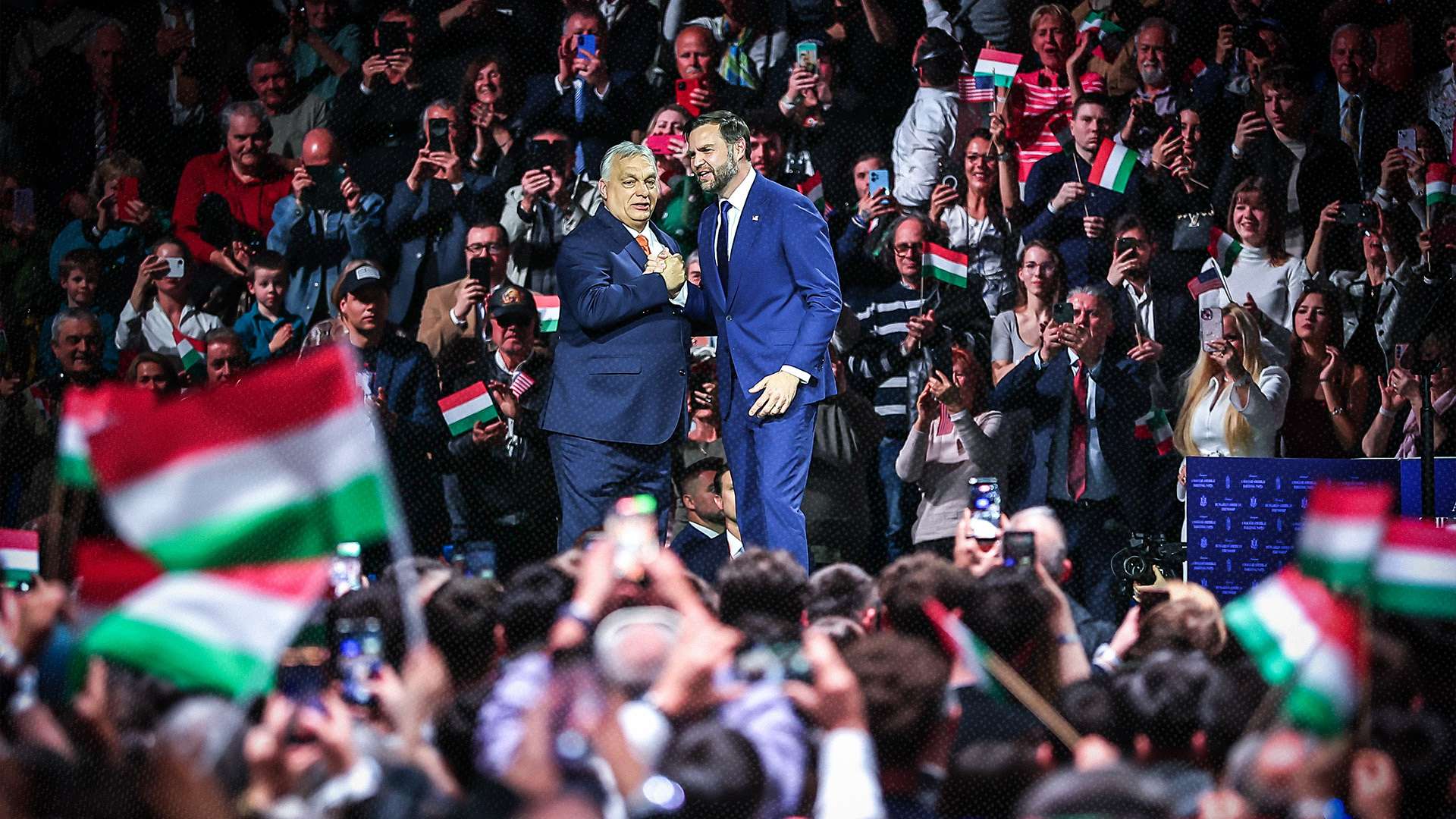
J.D. Vance Urges Viktor Orbán’s Re-election in Budapest, Stoking Debate Over U.S. Support for Illiberal Leader
Five days before Hungary's election that could unseat its longest-serving government, U.S. Vice President J.D. Vance told a Budapest crowd, "We have got to get Viktor Orbán reelected as Prime Minister of Hungary, don't we?" Vance's high-profile endorsement, echoed earlier by other American conservatives, has intensified scrutiny of U.S. involvement in a foreign vote and highlighted divisions over whether Orbán's model of governance is an exportable example.
By Matt Welch
1,010 views
Five days before a national election that threatens to dislodge Viktor Orbán’s long-entrenched administration, U.S. Vice President J.D. Vance addressed a rally in Budapest and urged supporters that “We have got to get Viktor Orbán reelected as Prime Minister of Hungary, don't we?” The remarks, delivered on the campaign trail in Hungary, represent an unusually direct intervention by an American senior official in another country's election and have sharpened debate about transatlantic ties and the appeal of illiberal politics.
Vance framed his endorsement around themes Orbán has long championed: national sovereignty, migration control, and conservative family values. At the event he told the crowd, “The president loves you, and so do I, because you're such an important part of what has made Europe strong and prosperous.” Orbán himself summarized the basis of cooperation in his remarks as “especially in four areas: one, migration; number two, gender ideology; number three, family policy; and number four, global security.” That language has found resonance among a subset of American conservatives who prioritize border security and culturally conservative social policy.
Not all American conservatives’ overtures toward Orbán are new. Secretary of State Marco Rubio visited Hungary in February and declared, “Your success is our success,” while President Donald Trump has also expressed strong support for the prime minister. The alignment has prompted questions about whom U.S. officials mean when they say “we” must elect Orbán—whether they are speaking for American political allies, businesses with investments in Hungary, or some ideological constituency that views Orbán's program as aspirational.
Critics point to contradictions between the praise and Hungary’s record under Orbán. The prime minister’s tenure has featured renationalization of sectors of the economy, the imposition of anti-foreigner windfall taxes in 2022, and high-profile interventions in the banking and pension sectors. The article points out that Orbán’s government has, according to critics, expropriated private pensions, seized foreign-owned property, and inserted political control over media, civic institutions, and judicial appointments—practices that American postliberal conservatives either overlook or endorse as models.
Economic arguments in Orbán’s defense—that Brussels bureaucrats are trying to “destroy the economy of Hungary,” as Vance alleged—are disputed. Economists have observed that Hungary has been a major recipient of EU funds; Johan Norberg authored a Cato Institute report noting Hungary’s outsized receipts as a share of GDP and per capita among postcommunist EU members. The most significant recent EU-related flashpoint in the election cycle was Budapest’s reversal in February on a December 2025 vote in favor of a €90 billion EU loan to Ukraine, a U-turn that followed disputes over repairs to the Druzhba oil pipeline. That pipeline, damaged in a Russian strike on January 27, delivers crude to Hungary and Slovakia via Ukraine, and E.U. negotiators have pushed Kyiv to expedite fixes.
Vance’s appearance came amid broader tensions over the war in Ukraine and allegations of foreign influence. The vice president has a history of downplaying Russia’s documented influence campaigns—he dismissed such efforts in a 2025 speech at the Munich Security Conference as a limited digital-advertising phenomenon—and at the Budapest event accused European institutions of coercive actions. Orbán, seated beside Vance at times, called it “an extremely strange idea to actually help the Ukrainians,” remarks that juxtapose the American official’s invocation of sovereignty with skepticism toward Kyiv’s cause.
The high-profile U.S. endorsements raise questions about what would happen if Orbán were to lose and challenge the outcome. Observers note that Orbán has reshaped Hungarian institutions—expanding and packing the Supreme Court and solidifying his party’s influence across media and civic life—which could provide legal and political levers to contest results. President Trump and other American supporters have invested unusually personal political capital in Orbán’s re-election; the U.S. National Security Strategy advanced by the Trump administration has explicitly supported “patriotic European parties” and encouraged resistance to Europe’s prevailing political trajectory, further entwining domestic U.S. partisan debates with foreign electoral politics.
As Hungary’s vote approaches, the spectacle of senior U.S. officials campaigning in support of an embattled European leader highlights an ongoing transatlantic rift: whether Western solidarity should prioritize liberal democratic norms and support for Ukraine, or whether it can accommodate an illiberal national model championed by Orbán and embraced by a segment of American conservatives. The answers could shape both Hungary’s future and the contours of U.S. engagement in Europe for years to come.