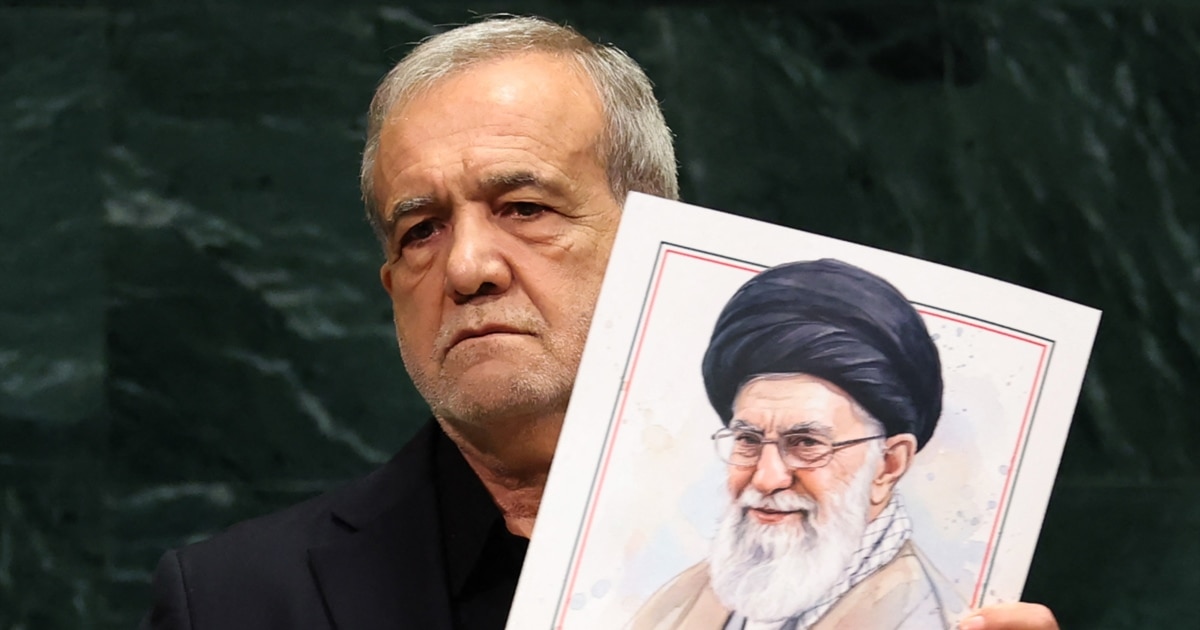
Iran's President Rejects U.S. Accusations at UN, Calls Tehran a 'Victim of Terrorism' and Cites Deadly School Bombing
Speaking from the United Nations General Assembly, Iran's President Masoud Pezeshkian pushed back against U.S. President Donald Trump's labeling of Iran as a source of terrorism, asserting instead that Iran has suffered terrorist attacks, including the killing of a former supreme leader and a school bombing in Minab that Iranian officials say killed scores of children. Pezeshkian accused the United States and Israel of using the weapons that killed the schoolchildren and said Iran has not invaded other countries in the past two centuries.
By Christopher Manley
475 views
At the United Nations General Assembly, Iran's President Masoud Pezeshkian delivered a rebuttal to remarks made by U.S. President Donald Trump, rejecting Washington's characterization of Tehran as a source of terrorism and insisting that Iran has instead been a victim of terrorist attacks. Addressing the international body, Pezeshkian said that while Trump had called Iranians "terrorists" the previous day, the reality is reversed: "We are victims of terrorism," he said.
In his address, Pezeshkian recounted a series of incidents he said demonstrated Iran's victimhood. He referenced the killing of the country's former supreme leader, Ali Khamenei, and pointed to a Feb. 28 attack on a school in the southern city of Minab. Citing Iranian official figures, Pezeshkian said that the Minab strike killed at least 120 children and 26 teachers. He explicitly accused the United States and Israel of using the bombs that struck the school and killed the students.
Those claims amplify already heightened tensions between Tehran and Washington after President Trump used his UN podium the day before to deliver a stern message to Iran. In his speech, Trump accused Tehran of destabilizing behavior in the region, warned that the United States would not allow Iran to obtain nuclear weapons, and said he expected a deal with Iran could be reached after the U.S. midterm elections in November. Trump also threatened that, if no agreement were reached, he might "destroy" the Islamic Republic — language that underscored the escalation in rhetoric between the two countries.
Pezzeshkian's speech at the General Assembly included an explicit rejection of the notion that Iran has been an aggressor state. He told delegates that Iran had not attacked any country or territory over the last two centuries, and yet it was being labeled a destabilizing force. "Now we are accused of being the source of instability in the region," he said. "They label us as terrorists."
According to the report, Pezeshkian's accusations toward Washington prompted a visible reaction in the assembly hall: the only U.S. representative present rose and left while the Iranian president was speaking. That walkout followed the two leaders' contrasting portrayals of Iran on the world stage and highlights deep diplomatic contention at the UN, where member states often use speeches to frame narratives for global audiences.
The Minab school strike — an issue central to Pezeshkian's argument — has become a focal point for accusations and demands for accountability. Iranian official counts cited in Pezeshkian's speech put the civilian toll at more than a hundred children and dozens of teachers. Such allegations, if verified, would raise serious concerns under international humanitarian law regarding the protection of civilians in conflict and the responsibility of states or non-state actors that conducted the strike. The source material for Pezeshkian's claims, as presented at the UN, comes from Iranian official statements.
Both speeches at the UN underscore how international forums are being used by national leaders to frame rival narratives about responsibility, security, and human suffering. Pezeshkian's insistence that Iran is a victim rather than a perpetrator of terrorism seeks to shift international attention toward alleged attacks on Iranian civilians and to demand scrutiny of those he accuses of carrying out those attacks. For Washington, Trump's comments reflect a continued policy posture of confronting Iranian regional activities and preventing a potential Iranian nuclear weapons capability.
The exchange highlights the broader implications for regional stability and for international mechanisms meant to investigate and address alleged attacks on civilians. Claims of deliberate or reckless attacks that result in mass civilian casualties typically prompt calls for independent investigation and accountability — steps that have not been detailed in the speech but that human rights and international law experts generally consider necessary to establish facts and determine responsibility.
As diplomatic tensions play out at the UN, the competing narratives from Tehran and Washington set the stage for further confrontation over evidence, attribution, and the appropriate international response. The Minab school deaths, the allegation of an assassination of a former supreme leader, and the U.S. warning of potential severe action together increase pressure on international institutions to assess the claims and to consider what measures, if any, should follow to protect civilians and uphold international law.