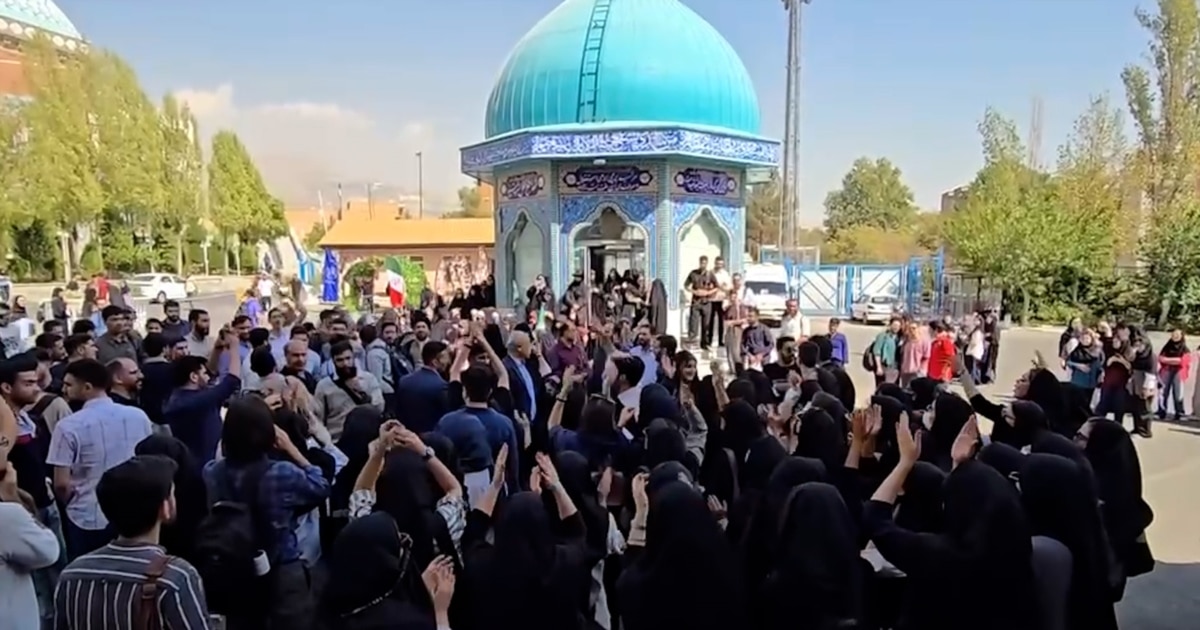
Iranian University Students Stage Rare Protest in Tehran, Clash With Basij During Crackdown
Dozens of students at Allameh Tabatabai University in Tehran staged a rare demonstration on September 28, denouncing Iran's mandatory hijab law, calling for the release of imprisoned classmates, and protesting poor campus conditions. Video verified by RFE/RL shows students chanting and clapping as members of the Basij paramilitary force moved to disperse them; protesters vowed to keep demonstrating despite fears of intensified repression.
By Christopher Manley
1,079 views
Dozens of students at Allameh Tabatabai University in Tehran mounted a rare public protest on September 28, rallying against Iran’s mandatory hijab law, demanding the release of classmates held in detention, and decrying deteriorating living conditions on campus. The demonstration comes amid an intensifying government crackdown on dissent that rights groups say has been severe since mass unrest earlier this year.
Videos verified by RFE/RL show a crowd of students gathered outside the university campus, clapping and chanting slogans in unison. The footage indicates a tense standoff as members of the Basij volunteer paramilitary force—an organization overseen by the Islamic Revolutionary Guard Corps—moved in an apparent attempt to disperse the protesters. In one clip, a Basij member is seen making a threatening comment, saying he would “put the students in a sack,” a phrase interpreted as a threat of lethal force or body bags.
Protesters at the university said they would continue their demonstrations, though RFE/RL reported that no new gatherings had taken place by September 29. The students’ demands combined cultural and immediate practical grievances: opposition to the hijab law, calls for the release of classmates who have been imprisoned, and complaints about poor campus living conditions—issues that resonate with broader public discontent in Iran.
The rally is notable because public demonstrations have been rare since authorities launched an unprecedented crackdown on mass protests that began in January. Human rights organizations estimate that thousands were killed during that initial wave of unrest, which erupted over spiraling inflation, a plunging currency and worsening living standards. Those protests represented the most serious challenge to Iran’s clerical leadership since the 1979 Islamic Revolution, according to observers cited in reporting on the unrest.
Compounding the domestic crackdown, the source reports that the Iranian government’s conflict with the United States and Israel, which the article says began in late February, has contributed to a widening of repressive measures against dissent inside the country. Rights groups monitoring Iran have documented a surge in public executions and arrests on national security charges, including accusations of espionage, intensifying a climate of fear many Iranians describe to journalists at RFE/RL’s Radio Farda.
Universities and students have long been at the forefront of calls for greater social and political freedoms in Iran. The article recalls the 1999 student protests that were sparked by the closure of a reformist newspaper and were met with a brutal raid on Tehran University dormitories that left one student dead. Over subsequent years, authorities have repeatedly targeted student activists and leaders, arresting them, sentencing them to prison and sometimes banning them from continuing their studies.
The September 28 demonstration thus reflects both immediate grievances on a single campus and a broader pattern of student activism confronting state repression. While the protest was relatively small in scale, its occurrence—captured in video and verified by RFE/RL—underscores persistent unrest among young Iranians and the continued use of hardline security forces such as the Basij to control dissent. The incident also highlights the risks faced by those who protest in Iran today: arrests, threats, and the possibility of harsher penalties under national security laws. Radio Farda and RFE/RL continue to report on and verify these events despite government censorship, providing a window into developments inside a country of about 90 million people where many describe an escalating atmosphere of fear.