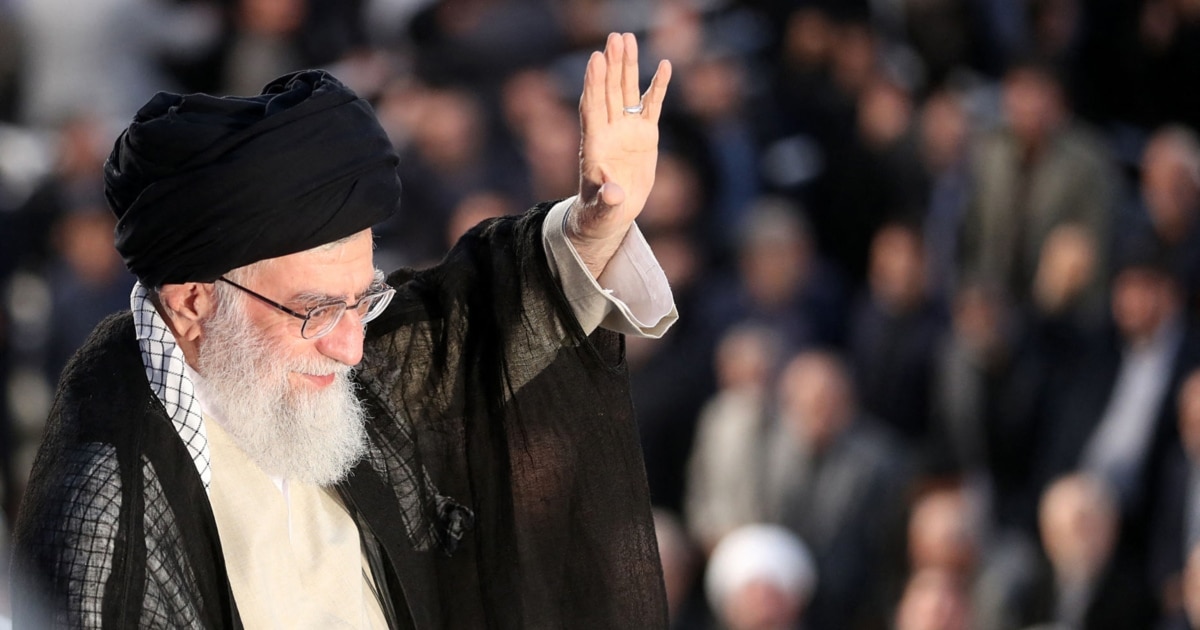
Iran Begins Five-Day State Funeral for Longtime Supreme Leader Ali Khamenei Amid Tight Security and Human Rights Tensions
Iran has launched what officials call one of the largest and most complex funerals in its history: a five-day procession that will pass through Tehran, Qom and Mashhad and make stops in Baghdad, Karbala and Najaf before interment at the Imam Reza shrine on July 9. The event, scheduled to start July 4, is being staged under heavy security and comes more than four months after Khamenei was killed in an attack on February 28, a death that has deep implications for succession and the state's relationship with a society scarred by repression.
By Alexander Walter
1,191 views
Iran has opened a five-day state funeral for Ali Khamenei, the country's supreme leader for nearly 37 years, more than four months after he was killed on February 28 in an attack the article attributes to the United States and Israel. Beginning July 4, officials have organized a procession described by state authorities as one of the largest and most complex funerals in the country's history. The ceremonies will move across Tehran, Qom and Mashhad and include planned stops in Baghdad, Karbala and Najaf in neighboring Iraq before the body is to be laid to rest at the Imam Reza shrine on July 9.
Khamenei's long rule made him the most enduring figure in the Islamic Republic's post-revolutionary leadership, a presence that shaped Iran's domestic politics and regional posture. The ruling apparatus has framed the public ceremonies as an assertion of continuity and authority following the opening of hostilities earlier this year. But human rights activists and critics argue the elaborate public pageantry also aims to deflect attention from the regime's record of repression and the deaths of protesters and dissidents during his tenure.
Taqi Rahmani, a human rights activist and the husband of Nobel laureate Narges Mohamadi, said the extended procession is intended to demonstrate to both domestic and international audiences that the state endures. He told RFE/RL that the government aims to show it "još uvek postoji" and to reassert its authority after the war. Rahmani and other critics say the funeral is also being used to obscure or minimize accountability for the deaths of tens of thousands of Iranians at the hands of security forces over decades.
The decision to hold the funeral now follows months of careful planning and repeated revisions. Officials postponed an initial March funeral soon after Khamenei's death as the country entered wartime conditions. Planners cited concerns about security threats, uncertainty over foreign attendees and unresolved questions about the succession process. In the months that followed, the body was kept in state custody while authorities worked to ensure that a public ceremony would not spiral into chaos or become a focal point for further instability.
Security is the dominant concern for organizers. Sources speaking to Radio Farda say protection has been tightened around Tehran’s Mosalla Mosque, the departure point for the funeral procession. Provincial officials in Khorasan Razavi, where Mashhad and the Imam Reza shrine are located, have proposed using helicopters to manage crowds around the coffin in an effort to avoid repeating past disasters. Iranian officials and planners are particularly anxious to prevent two notorious incidents: the crush and crowding at Ayatollah Ruhollah Khomeini's burial in 1989 that left eight people dead and thousands injured, and the deadly stampede during Qasem Soleimani's funeral in 2020 that killed dozens.
The theatrical scale of the ceremonies cannot fully conceal the legacy of repression that defined much of Khamenei's rule. For more than three decades, his leadership presided over forceful responses to dissent, from the Green Movement in 2009 to the "Žene, život, sloboda" uprising in 2022 and subsequent waves of protest, including demonstrations that erupted only weeks before the recent war. Families of those killed by security forces have expressed mixed responses to Khamenei's death: some say it brought a measure of justice or relief. "Osećao sam da je pravda prevladala nad ugnjetavanjem," Muslem Hakiki, whose son Milan Hakiki was killed in 2022, told Radio Farda.
Analysts and opponents caution that the war and the funeral both serve to bolster the regime's immediate control by intimidating opposition and consolidating fear. Rahmani said the conflict "is actually an unfortunate circumstance for the opposition," weakening civic forces and impoverishing the middle class, even as the regime seeks to restore authority. He added that the government's hold remains fragile and could still be challenged by a coherent opposition strategy.
A key unresolved political question is the public role of Modjtaba Khamenei, the supreme leader's son and a central figure in succession discussions. Modjtaba has not been seen in public since the start of the war; no new photographs, audio or video of him have appeared since his appointment, and only written statements read aloud on state television have been published. His father-in-law, Golam Ali Hadad Adel, has said he has had no contact with Modjtaba since before the war and does not know his condition. Modjtaba did not attend the funeral of his own wife on July 2, who was killed in the same attack that killed his father. Authorities organizing the state funeral have not confirmed whether Modjtaba will attend. Observers say that if he appears and leads prayers over his father’s body, that act would be the closest public symbol to a formal crowning in the succession that Iran's clerical system has so far avoided.
As Iran proceeds with the multi-city funeral and burial at the Imam Reza shrine on July 9, the ceremonies will be watched closely at home and abroad. The events carry implications for domestic stability, the treatment of dissent, and how the Islamic Republic seeks to present continuity and strength at a moment of profound political uncertainty.