Indigenous Territory in Peru: Can the State ‘Leave Them Alone’?
The Mashco Piro and other Indigenous peoples in Peru’s Amazon are seeking stronger legal protection against logging and extractive activities, as a case before the Inter-American Court of Human Rights raises concerns over territorial rights, forced contact, disease exposure, and the survival of communities living in voluntary isolation.
By Albina Kastrati
1,147 views
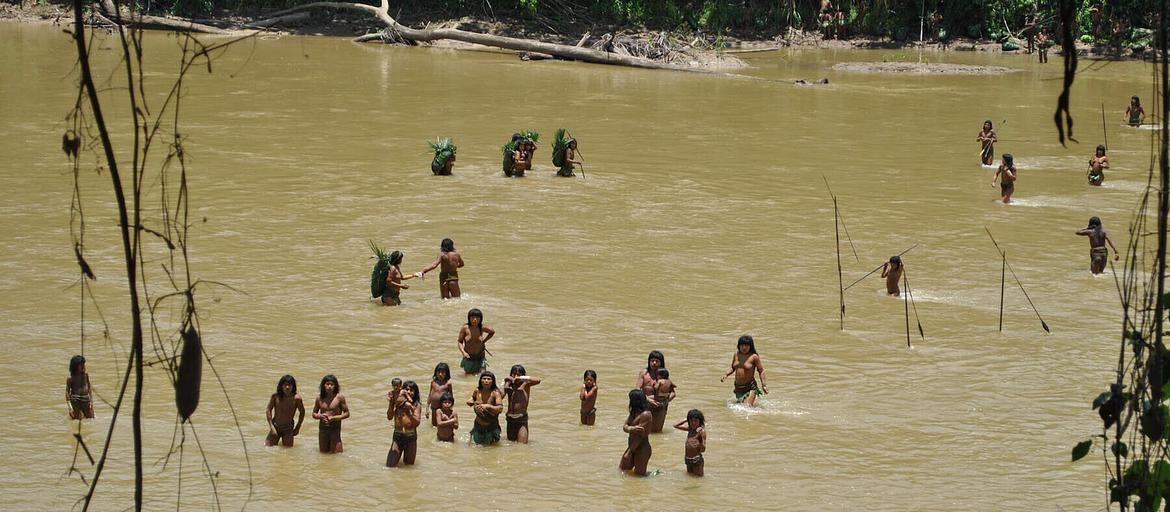
In Peru’s Amazon, Indigenous peoples face threats to their ancestral territories from extractive activities, including logging. The Mashco Piro, one of the world’s largest known Indigenous peoples living in voluntary isolation, are among three Indigenous peoples - alongside the Yora (Nahua) and Amahuaca - whose rights and territorial protection are at the centre of a legal case against the Peruvian state before the Inter-American Court of Human Rights.
At a public hearing on September 24 and 25, the Native Federation of the Madre de Dios River and Tributaries (FENAMAD) and EarthRights International presented evidence alleging that Peru has failed to adequately protect the Mashco Piro’s territory and uphold the principle of non-contact. The organisations asked the Court to strengthen territorial protections, establish protective perimeters and cancel large-scale extractive projects within the people’s ancestral territory.
The case follows decades of advocacy over the protection of Indigenous peoples in isolation and initial contact in southeastern Peru. In a 2022 report, the Inter-American Commission on Human Rights found Peru responsible for human-rights violations in the case concerning the Mashco Piro, Yora and Amahuaca peoples. The Commission’s report identified violations relating to judicial guarantees, freedom of expression, collective property, political participation, judicial protection and cultural rights. In 2024, the Commission referred the case to the Inter-American Court of Human Rights.
Indigenous organisations and human-rights advocates argue that protecting these communities requires effective territorial safeguards and action against activities that could put their survival at risk, rather than simply recognising their rights on paper.
In a written response to The Liberty Bulletin, Juliana Bravo, director of EarthRights International’s Latin America office and a lawyer representing the case, said the Peruvian government had failed to protect the Mashco Piro’s rights to life, personal integrity, health, territory and self-determination. She said the government had granted logging and oil and gas extraction concessions despite evidence of the people’s presence in the territory.
“The core issue in this case is the Peruvian government's authorization of commercial concessions and its failure to prevent incursions,” it was said in the response.
According to EarthRights International, evidence presented to the Court included more than 80 records documenting the Mashco Piro’s presence in the territory between 1973 and 2007, as well as at least 170 sightings recorded between 2010 and 2015 that overlapped with 14 forest concession areas. Bravo said the evidence included expert testimony and testimony from Indigenous communities living in neighbouring territories and FENAMAD.
Furthermore, in the written response it was said extractive activities and incursions risk exposing the Mashco Piro to infectious diseases and violent encounters with outsiders, warning that deforestation and environmental degradation threaten the forests and rivers the people depend on for hunting, fishing and gathering, potentially reducing their living space and putting their cultural and biological survival at risk.
EarthRights International argues that Peru’s existing protection system allows exceptions for resource exploitation when projects are considered to be in the public interest. According to Bravo, this can allow logging concessions and other extractive projects to overlap with the ancestral territories of Indigenous peoples living in isolation. The organisation argues that these exceptions conflict with international human-rights standards.
EarthRights International is asking the Court to require Peru to protect the territorial integrity of the Mashco Piro’s ancestral lands, establish territorial and health protection zones in coordination with Indigenous organisations, and cancel large-scale extractive projects within their territory. It is also calling for the completion of the process to convert the Madre de Dios Territorial Reserve into an Indigenous Reserve and for Peru’s legal framework for protecting Indigenous peoples in isolation and initial contact to be brought into line with international human-rights standards.
Peruvian anthropologist Beatriz Huertas Castillo has also warned that logging threatens the Mashco Piro’s access to the forests and rivers they depend on for food and survival. In a 2024 analysis published by Debates Indígenas, she explained that logging camps, heavy machinery and roads can drive away animals, reduce access to food and fragment the territory the Mashco Piro use for hunting and gathering. She also warned that the presence of outsiders increases their exposure to infectious diseases. Huertas argues that protecting the Mashco Piro requires safeguarding the wider forest corridors they depend on, including areas that extend beyond existing reserve boundaries.
“Effective coordination with indigenous organizations within the reserves and their inhabited territories is essential,” Huertas wrote in her analysis. “Given their cross-border mobility, policies with a binational perspective are also proposed.” She also highlighted the importance of agreements with neighbouring communities to respect the ways of life and subsistence areas of Indigenous peoples living in isolation.
A 2023 survey commissioned by CooperAcción and the National Human Rights Coordinator and conducted by the Institute of Peruvian Studies (IEP) found that 72% of respondents believed Peru’s political crisis was connected to racism and discrimination against Indigenous peoples, with 51% stating that the connection was strong. The survey addressed public perceptions of Indigenous peoples more broadly and was not specific to the Mashco Piro or the case before the Court.
The Liberty Bulletin contacted Peru’s Ministry of the Environment for comment, and the ministry requested the journalist to provide an identity document number and further details of the enquiry through its official consultation process. It did not provide a substantive response to the questions by the time of publication.
According to the Peruvian Ministry of Culture, the National Institute of Statistics and Informatics (INEI) did not enumerate any communities that identified themselves as Mashco Piro in its 2007 Census of Indigenous Communities in the Amazon. As a result, estimating the population of Indigenous people is difficult. However, records for the Madre de Dios and Mashco Piro Territorial Reserves estimate their populations at approximately 600 and 150 people, respectively. These figures are estimates associated with the reserves, rather than a current census of the Mashco Piro population. Mashco Piro people have been identified in the middle and upper basins of the Manu, Los Amigos, Pariamanu, Las Piedras, Tahuamanu and Acre rivers within the Madre de Dios Territorial Reserve, as well as in the upper Purús River basin and along the Curanja River within the Mashco Piro Territorial Reserve.
The Ministry also identifies around 265 Nahua people in the community of Santa Rosa de Serjali, while its profile estimates a total population of 4,668 across Amahuaca communities. However, the Nahua and Amahuaca figures refer to broader community populations and should not be interpreted as counts of people living in isolation.
The parties are due to submit their final written arguments to the Court by October 26, Bravo told The Liberty Bulletin. The Court has not set a deadline for its ruling, and, according to Bravo, a decision could take months or more than a year.