In Casablanca’s changing Habous, a pastry shop keeps its place
Bennis, a family-run pastry shop in Casablanca’s historic Habous district, has been serving traditional Moroccan sweets since 1938. Now in its fourth generation, the business has survived economic challenges, changing customer habits and growing competition while preserving its neighbourhood roots and hoping to reach its centenary in 2038.
By Martin Bertrand
936 views
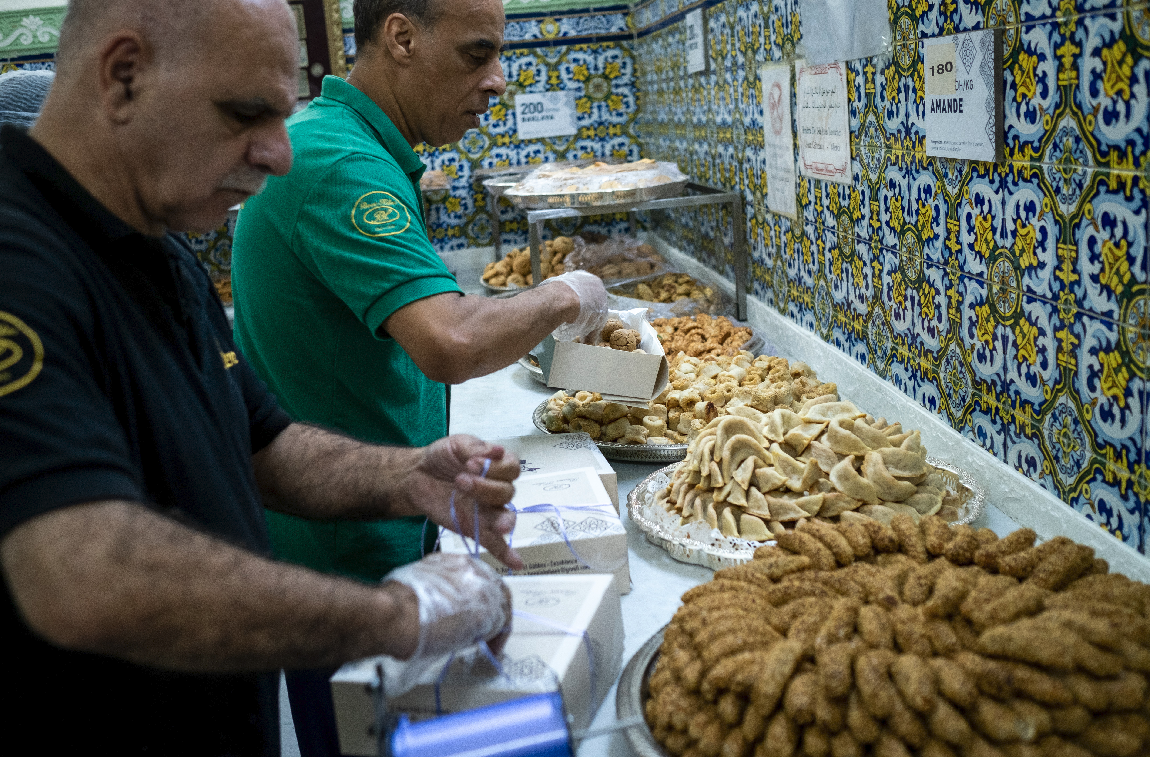
Photo: Vendor filling a box of cakes in the sales area of the Bennis patisserie in Casablanca, Morocco on October 14th 2023. Bennis is a highly reputed family bakery established in the Habous district since 1930, offering traditional home-made Moroccan dishes
The traffic and horns of central Casablanca fade as the streets narrow around the Habous district. Small shops sit beneath arcades, and cars are less noticeable. On Rue Fkih El Gabbas, the public entrance to Bennis is a small room where Moroccan pastries are packed closely together. Customers choose what they want, the selection goes into a box, and the box is weighed. Beyond the shopfront lies a family business whose history has unfolded alongside that of the neighbourhood.
The Habous looks like an old medina, but its origins are much more recent. Planned under the French protectorate, the district began taking shape in 1917 as Casablanca attracted increasing numbers of people from elsewhere in Morocco. Albert Laprade worked on the original plans, later developed by Auguste Cadet and Edmond Brion. Courtyards, arcades and traditional architectural forms were incorporated into a planned neighbourhood built to serve a rapidly growing city. The old-looking streets were themselves a response to urban change.
Hakim Bennis, a fourth-generation member of the family, says his greatgrandfather settled in the Habous in the 1930s. “At first, it was a house,” he explains. He began making ghribas, traditional Moroccan biscuits, for neighbours before the activity developed into a business. Hakim considers 1938 its commercial starting point. With the next generation came cornes de gazelle, crescent-shaped pastries filled with almonds, sesame sweets and other specialities. “Sales of pastries really took off from around 1940-1945,” Hakim says. In the 1980s and 1990s, the family added cooked Moroccan dishes, including pastillas, tagines and stuffed chickens.
The district changed around the shop. Its arcades still shelter local businesses, but many stalls now sell carpets, leather goods, ceramics and traditional clothing to visitors. The Habous is both a working neighbourhood and a stop on Casablanca's tourist circuit. For Hakim, that distinction matters. “Originally, the pastry shop was created for the people of the neighbourhood, the residents of the Habous. It was the Habous district that later became a tourist site.” Today, he estimates that Moroccan customers still generate about 80 percent of Bennis's revenue, with tourists accounting for the remaining 20 percent. During our visit, the customers included people familiar to Hakim, whom he greeted personally, as well as other visitors arriving to choose their pastries. Cornes de gazelle, almond mhancha, briouates, semolina cakes and sesame pastries remain popular among Moroccan customers, he says. The clientele has widened without turning Bennis exclusively towards visitors.
The city's pastry trade has changed too. Amoud, another Casablanca business, began in 1982 and opened a second branch in 1999 before expanding further. The original Bennis shop has stayed at its Habous address, although members of the family have also pursued other ventures, including the separate Secret de Famille pastry concept developed by Hakim's sister Sabrina and her husband. Asked about the historic shop, Hakim has little interest in following the multi-branch model. “We have kept just one, and that is more than enough for us, because it is in a historic neighbourhood, in a historic place. It is very good as it is.” He is under no illusion that longevity eliminates competition. “There will always be competition,” he says. Hakim points to other established names in Casablanca, including Madame Fhal, Maison Serraj and Les Quatre Cerises. But he also notes how many businesses have disappeared. “The pastry shops around in the 1930s, 1940s or 1950s are not the ones you see today. Many also close down. But the old ones that have remained can be counted on the fingers of two hands.”
Bennis has endured its own difficult periods. It closed for about two months during the Covid-19 pandemic, according to Hakim. More recently, rising ingredient costs forced several increases in shop prices. In 2023, Morocco's average annual consumer price index rose by 6.1 percent, with food prices up 12.5 percent, according to the High Commission for Planning. “When the price of raw materials goes up, we also have to raise our prices. That has happened several times in recent years,” Hakim says. His father had previously spoken to him about the economic effects of the Gulf War on the business.
The family has adapted in smaller ways too. Some doors and ceilings have been altered, while the old zellige tiles and many of the walls remain. At the time of the interview, Hakim was preparing to open a Moroccan restaurant on the same street, expanding the business's activities without leaving the neighbourhood. The original pastry shop remains the point of reference. Looking ahead to 2038, a hundred years after the date he gives for its commercial beginnings, Hakim hopes for a different kind of recognition. “If we can reach one hundred years and then see it become a historic monument, that would be something extraordinary for us.”