Hungary–Ukraine Relations After Orbán: The Billboards Are Gone, but the Path Is Far from Straight
Since former Hungarian PM Viktor Orbán was voted out of power, the official state campaigns against Ukraine disappeared. However, several blockades during Ukraine’s EU pathway show the still existing differences, mostly about minority rights. We show the relationship’s key events, since PM Péter Magyar took office in May, on a timeline, with Ukrainian and Hungarian experts commenting on the patterns.
By Kristóf Ábel Tarnay
1,173 views
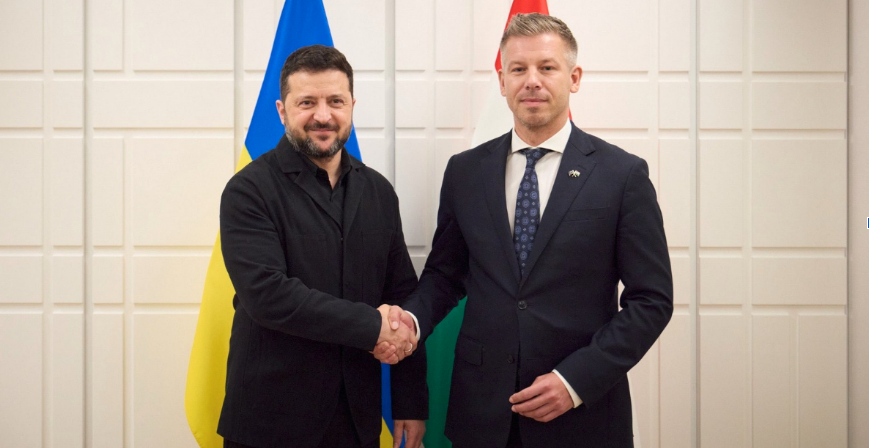
Photo: Ukrainian President Volodymyr Zelenskyy and Hungarian Prime Minister Péter Magyar at their first bilateral meeting amid EU leaders’ summit in Brussels. (Photograph: Andrii Sybiha, X)
The former Hungarian Prime Minister Viktor Orbán ran a harsh official anti-Ukrainian campaign almost constantly in the last four years, including government billboards with the face of Ukrainian President Volodymyr Zelenskyy nationwide. Orbán accused the now-ruling Tisza Party that they serve Ukrainian interests instead of Hungarian ones and would drag the country into the war that has been waged since Russia’s full-scale invasion in 2022.
Since he was voted out of power this April, his rhetoric became only an opposition opinion instead of the official position. However, the change of government didn’t mean that all of the differences between the two countries disappeared overnight. Still, recent events show huge improvements in bilateral diplomacy and suggest a more open approach for compromise. Here’s the timeline of the most important events regarding the Hungary-Ukraine relations since the new Hungarian administration, led by PM Péter Magyar took office this May.
4 June: Magyar announced that after a few weeks of intensive expert-level negotiations, the two countries reached a “historic” comprehensive agreement expanding the linguistic, educational, cultural, and political rights of the Hungarian minority in Ukraine, including restoring the minority school system and allowing national symbols in communities with a Hungarian population over 10%. Per Telex and an official government website, Kyiv committed to formally incorporating these measures into its legal system and the EU Minority Action Plan. Magyar stated that the government will agree to opening the first negotiation cluster once these are legally secured.
15 June: Following Ukraine’s formal inclusion of the negotiated minority protection guarantees into its EU Action Plan, Hungary and other EU member states officially vote to open Cluster 1 (Fundamentals) of Ukraine's accession negotiations at an intergovernmental conference in Luxembourg.
23 June: According to the weekly Kárpátalja, the Education Department of the Transcarpathian Regional State Administration forwarded a letter from the State Language Protection Commissioner to local educational institutions. While noting that minority languages remain permitted for instruction during regular classes, it stresses that the Ukrainian language must be strictly used in official school communication and all extra-curricular activities, including sports sessions, clubs, and events.
21 August: On Ukraine’s Independence Day, Zelenskyy awarded the State Order "For Service" (3rd Class) to Kerekes-Nagy Gáspár, co-founder of the Transcarpathian Dragon Supply Foundation, a civilian charity providing non-lethal supplies, and László Helmeczi, the Mayor of the Hungarian-Ukrainian border town of Záhony, recognising their outstanding humanitarian support and assistance to Ukrainian forces and refugees.
1 September: Hungary refused to approve the screening results for Ukraine’s next negotiation phases, specifically blocking Cluster 2 (Internal Market) and Cluster 3 (Competitiveness and Inclusive Growth), according to European Pravda. Budapest demanded specific legislative steps regarding the Hungarian minority, formally maintaining the veto in subsequent follow-up meetings on 8 September.
3 September: The Ukrainian Parliament condemned the mass repressions against the civilian population by the Soviet totalitarian regime in Transcarpathia between 1944 and 1946, explicitly naming the ethnic Hungarian population targeted by the forced labour deportations – locally known as "malenkiy robot" –as well as extrajudicial executions and persecution based on nationality and religion.
8 September: Following assessments by local authorities, the Hungarian government officially expelled 10 Russian diplomats. Foreign Minister Anita Orbán stated that the individuals had engaged in activities deemed "unacceptable under the Vienna Convention."
21 September: Magyar firmly stated that Hungary would not participate in the Ukraine-led “Carpathian Eight” (C8) alliance, sharply criticising Kyiv for presenting Hungary's membership as a done deal "without prior consultation or consent". The Hungarian government also blocked a proposed Ukrainian fuel and oil storage project on Hungarian territory, citing national interests.
25 September: Following high-level talks at the UN General Assembly, FM Anita Orbán stated that Hungary remains open to eventually joining if subsequent bilateral negotiations align strictly with national interests. Ukraine's FM Andrii Sybiha praised the decision as "very timely and sensible," saying it will "strengthen the security of Hungary."
12 October: Zelenskyy signed into law a bill reinforcing the educational rights of Ukraine's national minorities, after it was passed by the parliament. According to The Kyiv Independent, this law would give Ukraine's Hungarian-speaking community and other EU-language national minorities more room to use their language in education. Hungarian FM Anita Orbán welcomed the decision, calling it a “positive result of months of joint work and constructive dialogue.” The next day, Cluster 2 and 3 were officially opened for Ukraine, according to The Kyiv Independent.
16 October: Zelenskyy and Magyar held their first bilateral meeting amid EU leaders’ summit in Brussels, agreeing to continue talks at ministerial level, with a special focus on improving the situation of minorities in both countries. The Ukrainian President thanked Magyar for his “principled steps” and for opening two more EU negotiating clusters. “We are working to open the remaining two by the end of the year,” said Zelenskyy.
20 October: Hungary blocked the opening of the final two negotiation clusters, Cluster 4 (Green Agenda and Sustainable Connectivity) and Cluster 5 (Resources, Agriculture and Cohesion). According to The Kyiv Independent’s sources, Budapest stated only that its position remained unchanged. The outlet reported that the block is expected to be temporary – allowing the Hungarian government to avoid domestic opposition claims of being "soft" on Ukraine – with senior EU officials predicting the clusters will formally open in December.
The minority rights issue is not new
To understand the nature of the differences, we conducted interviews with a Ukrainian and a Hungarian expert. Yaroslav Smovzh, the head of the "Europe" Research Program at the Ukrainian analytical center ADASTRA, whom we conducted an interview on 12 September, highlighted that the issue about minority rights between the two countries is not new. In 2019, new legislation about language was introduced to make Ukrainian language used extensively and exclusively in public governance.
“The initial intention in 2019 with those laws was against Russification. More specifically, the aftermath of Russification that took place back when the Soviet Union was here,” he told The Liberty Bulletin. “As a result, back when I was a schoolboy, we used to talk in Russian to one another [during] the school breaks, despite having mostly Ukrainian ancestry”. However, it still curtailed minority language usage, so Orbán’s government wanted a full restoration in terms of those. Countries of other affected national minorities, such as Romanian and Bulgarian, if not as loudly, but also expressed their dissatisfaction, he noted. While the law still remains in force, it was amended following EU integration requirements to grant substantial education and cultural language rights specifically to official EU minority groups, while excluding the Russian language.
Later, in 2024, the previous Hungarian administration created a 11-point list of demands regarding minority rights, from which Smovzh thinks some elements, such as Hungarian language municipal administration in predominantly Hungarian settlements, make sense. Others, such as amending the constitution to include national minorities' representation in parliament, don’t, since it would need a referendum, not possible during wartime, he explained. While he adds that a supposed representative’s amount of votes would be “very insignificant,” there were also concerns about having someone at the parliament connected to Orbán’s network, which he thinks is eased by the new political landscape in Hungary.
Asked about the June expert-level agreement, he emphasised that it was a result of “quiet and subtle bargaining”; however, it was still based on the 11-point list, he said. According to Válasz Online, the talks used the 11-point proposal as a baseline, but the agenda was significantly broader, also addressing several unlisted issues. Regarding the September blocking, Smovzh explained that there was a question after the June agreement about the level at which the amendments to Ukrainian legislation should be introduced.
This looks resolved with the now-passed new bill about education rights. Roman Hryshchuk, a member of the Ukrainian Parliament’s education committee told Telex, that with the new legislation, in schools, where the minority student proportion exceeds 51 percent, documentation is prepared and classes – except subjects such as Ukrainian language and literature, or civil education – are conducted in the minority language, without restrictions on minority language usage during breaks. In such schools, the principal or the vice principal have to speak the ethnic minority’s language. Once a school is granted this ethnic minority status, it can keep it as long as the proportion does not fall below 20 percent, László Zubánics, president of the Hungarian Democratic Alliance of Ukraine told the same Hungarian outlet. In other schools, an ethnic minority class may still be established with the same language rights. Zubánics, also a professor at the University of Uzhhorod, called the law “a historic document”.
Ukraine swallowed the bitter pill
About the previously forwarded letter about Transcarpathian schools that caused some stir in the Hungarian press, Yaroslav Smovzh said that if there is such a demand – which he thinks there isn't – it would be very hard to enforce. Besides all the hopeful negotiations, he expressed concern that the years of Orbán’s anti-Ukraine campaign still had an effect. “The Orbán government used to weaponise relations with Ukraine in the internal political discourse. It's something that was instrumentalized to also mobilise [the] electorate. And it's something that created structural obstacles for the Magyar government,” he said. “The opposition creates an expectation in Hungarian society that the policy on Ukraine must continue to be hardline,” he added, referring to the formerly governing Fidesz-KDNP party alliance.
“It seems to me that the adoption of the bill in question was indeed the prerequisite for opening the 2nd and 3rd Clusters, and it most likely came down to this during the technical negotiations that have been going on since the change of the government in Hungary,” Smovzh replied to our questions via email on 25 Oct regarding the latest developments. “This decision and the Parliament’s approval did not spark any backlash in Ukraine whatsoever. EU accession remains a paramount objective whose salience definitely outweighs questions of national pride.”
He referred to a mid-September analysis by the European Pravda which claimed that “Magyar aims to humiliate Kyiv and block its EU future,” citing what the outlet’s editor described as a "diplomatic slap in the face" and "demonstrative contempt" toward Ukraine, such as the C8 incident and the ghosting of the Ukrainian Parliamentary Speaker during his visit to Budapest. Smovzh noted that the latest developments followed this pattern, adding, “But Ukraine basically swallowed the bitter pill and made pretend as though nothing happened”.
“As for Clusters 4 & 5, even though they are equally as unrelated to the issue of minority rights as the 2nd and 3rd ones, I might assume that their opening also hinges on the effective observance of the newly adopted law or any other steps confidentially approved among the representatives of the two nations,” he noted. Adding that the recent developments mark a very promising development in the relations. “It definitely feels like a relief now. Safe to say, leaders of both societies took it that way too.” He highlighted a statue of Imre Nagy , the martyr PM of the 1956 Hungarian Revolution and Freedom Fight, at Uzhhorod, the capital of Ukrainian Transcarpathia, recently unveiled, with Budapest Mayor Gergely Karácsony and the ethnic Hungarian Ukrainian Ambassador to Hungary, Sándor Fegyir. “Meanwhile, a number of heads of Hungarian regions made a call to increase support for Ukraine ahead of another difficult winter," he added.
There was a misunderstanding
According to Hungarian foreign policy expert and former Hungarian ambassador to Slovenia István Szent-Iványi, with whom we conducted an interview on 28 September, regarding the blocking of 2nd and 3rd clusters, there was a misunderstanding between the two countries. The Hungarian party thought that they should only open those clusters when the agreement was implemented by the Ukrainian parliament, while Ukraine expected Hungary to go along with the agreement since they are within the framework and the schedule accepting those until the end of the year. According to Válasz Online, when Magyar announced the "comprehensive agreement", just 16 days after negotiations began, it completely surprised the Ukrainian partners, as it was made without prior coordination only hours after negotiators had finalised the agreement's text.
Regarding the letter about school language usage, that caused stir in the Hungarian media, Szent-Iványi said it has been withdrawn after the dispute and anxieties, but the official argument regarding such measures was that these are not targeting Hungarian, but Russian language. He explained that there are almost half a million people in the Transcarpathian region who escaped from the Russians leaving the eastern part of Ukraine. Many of them, while considering themselves Ukrainians, speak Russian. Their children used Russian outside classes, which the authorities wanted to ban. According to Telex, this issue was cleared before the 1 September blocking, so the reason for that were rather disagreements about specific legislation that was prepared at that time, including about schools’ ethnic minority status.
He also mentioned that the new government is still negotiating based on the previous administration’s 11-point proposal, which he doesn’t consider good. He pointed out that at least two of the demands were included despite being inherently unfulfillable for the Ukrainian counterpart. One is the automatic parliamentary representation for national minorities.
“Ukraine does have more than 20 more or less significant minorities and it will be very unrealistic that only one minority will have an automatic seat of the parliament and the other minority is dropping very much since the beginning of the war that dropped under 100,000 [people],” he explained. The other one is the comprehensive use of the mother tongue across all offices in the entire territory of Transcarpathia. He considers the latter unrealistic since a large part of the region has no Hungarian population at all, though he emphasised that this right remains essential in areas with significant minority concentrations, mostly in the southern part of Transcarpathia.
Regarding the Carpathian Eight cooperation, Péter Magyar posted a reply to an X post by Ukrainian FM Andrii Sybiha, in which the Hungarian PM criticised Kyiv for presenting Hungary's membership as a done deal without prior consent. As revealed by a Válasz Online insider source within the Ukrainian Presidential Office, the Hungarian government had been invited to the C8 summit from the beginning of its planning stage, but failed to provide a definitive response until the last minute. The Hungarian outlet also cites a source within the Hungarian Foreign Ministry, who said that both sides made communication errors, as Kyiv likely learned from Facebook that Magyar was holding a rally instead of attending the summit, while the event was also poorly organised.
Szent-Iványi said that Magyar’s X reply was not only a “very tough and harsh comment”, but the Hungarian FM should have replied instead. What Anita Orbán did, but Magyar was faster. For context, it’s important to notice that Magyar is extremely active on social media, frequently posting comments under Facebook posts by news outlets, politicians and other public figures. He sometimes even posts replies for other people’s comments under these posts.
Normalising the relationship is a strategic interest
About the lasting effects of Orbán’s anti-Ukraine campaigns, István Szent-Iványi mentioned recent incidents at recent Ukraine-Hungary football matches. The national anthems of both teams were heavily booed by opposing fans, and some Hungarian spectators threw objects at Ukrainian players during a late-game brawl in Budapest. However, he argued that neither the approval of the 90 billion EUR loan for Ukraine, before, nor the enablement of opening the 1st and the 6th cluster, after the change in government, caused much reaction in the Hungarian public.
While he thinks that the Ministry of Foreign Affairs wants to normalise the relations, “the government as a whole has got some ambivalent approach”, fearing public opinion. “It's a strategic Hungarian interest to normalise the relationship between Hungary and Ukraine, and the government is playing a central role in that,” Szent-Iványi emphasised. Adding that currently average Ukrainian people consider that Hungary is a hostile country towards them, which hurts ethnic Hungarians living there.
Regarding the latest developments, Szent-Iványi highlighted in an email reply on 21 October that in exchange for the upcoming amendments to the education laws, the Hungarian side has promised to support the opening of Cluster 2 and Cluster 3. However, Budapest is conditioning the unblocking of Cluster 4 and Cluster 5 on the full restoration of language rights, which is reportedly expected to take place by the end of the year, he summarised. We sent questions to Hungary’s Ministry of Foreign Affairs to understand the latest blocking better, we will update this article if they respond.