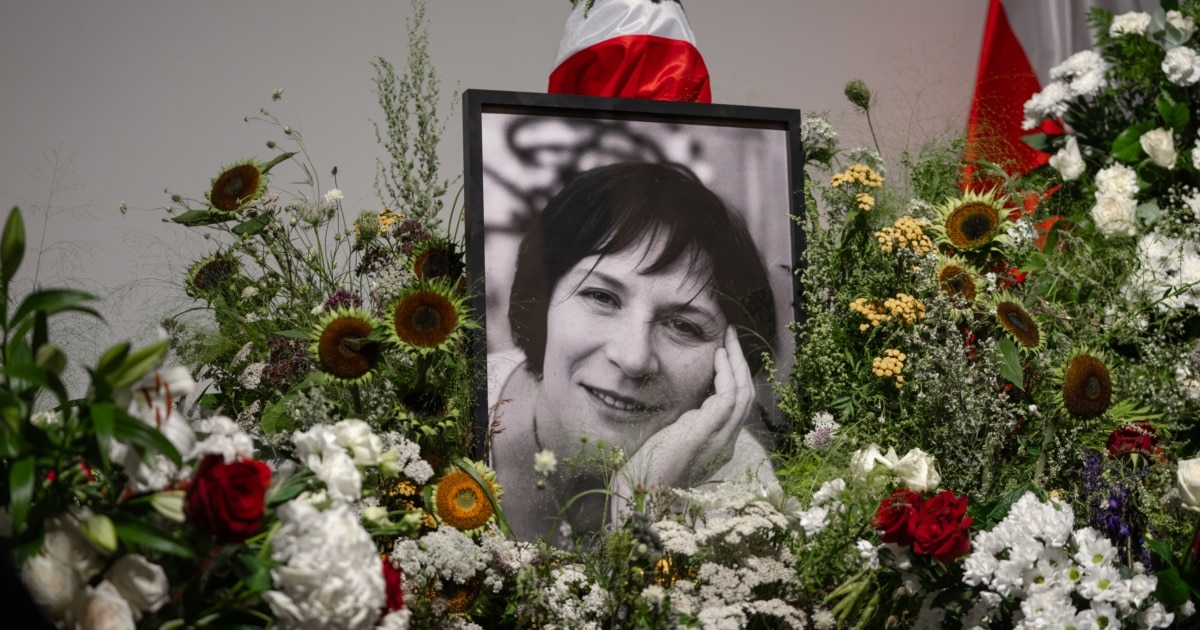
Hundreds in Warsaw bid farewell to Belarusian writer Sviatlana Kurs (Eva Vezhnavec); urn to be returned to Belarus for burial
Hundreds of people attended a Belarusian-language funeral mass in Warsaw and a subsequent public farewell at the Museum of Free Belarus for writer Sviatlana Kurs, who wrote under the pen name Eva Vezhnavec and died on July 19 at age 54 after a prolonged battle with cancer. An urn with her ashes rested on a white-red-white flag during the mass; family said she was cremated in accordance with her wishes and asked mourners to limit flowers and refrain from taking photos, though many ignored the latter request.
By Clémence Desjardins
926 views
Hundreds of people gathered in Warsaw in late July to say goodbye to Belarusian writer Sviatlana Kurs, who published under the pseudonym Eva Vezhnavec and died on July 19 at the age of 54 after more than a year of treatment for advanced cancer. According to relatives, Kurs was cremated in accordance with her last wishes; an urn containing her ashes was placed on a white-red-white flag during a Belarusian-language funeral mass at the parish of St. Alexander in Warsaw.
The funeral mass, celebrated by Father Vyachaslaw Barok, drew a large crowd of Belarusians and Poles, with conversations in Belarusian, Polish, Russian and even German audible among those present. Barok opened the service with the words «Бог сатрэ зь іхніх вачэй кожную сьлязу». During his sermon he warned against losing hope and referenced Kurs’s final Facebook post about the book «Ад вясны да вясны», saying that she had been waiting for “the spring of her life, the spring of Belarus.” He also told attendees that Kurs had confessed and reconciled with God before her death, an element he emphasized as important for Christians.
Relatives had asked visitors to limit the number of flowers and to refrain from taking photographs; many followed the request about flowers, placing single blooms by the urn in sequence, while the request to avoid photos was widely ignored. Attendees approached one another in silence, embraced and wept. Some discussed what Kurs herself might have thought about dress codes for mourning; informal conversations touched on whether people should wear black or more personal colors to honor her memory.
The mass was notable for personal touches: Father Barok had returned from a pilgrimage in Kóstomłoty to celebrate the service, and music accompanying the ceremony included hymns and several melancholic pieces performed on the organ and violin, one of which Kurs had helped to create. Many in the congregation recalled Kurs’s public engagement in Warsaw, including an open Belarusian-language lesson she led at the same parish and regular services held by the city’s Belarusian pastoral community.
After the liturgy, a funeral procession moved to the Museum of Free Belarus, where the public farewell continued. The museum screened photographs of Kurs at different stages of life while a violin played, and a succession of speakers paid tribute to her literary work, civic engagement and personal warmth. Among those who spoke were Belarusian democratic opposition leader Sviatlana Tsikhanouskaya, politician Pavel Latushka, Anatol Shyrvel — head of the Belsat website — and other cultural figures and colleagues. Tsikhanouskaya described Kurs as the embodiment of qualities associated with Belarusians: industriousness, humanity and empathy, and said she radiated “light and optimism.”
Speakers also highlighted Kurs’s work with archives of repression victims. Sebastian Karwat, director of the Katyń Museum, recalled her contribution to the museum’s archive of victims of repression and said Kurs had dreamed of writing a book about “her boys” — people who had been victims of political repression. Karwat praised her humility and daily dedication, saying that despite notable achievements she remained modest and focused on everyday work.
Kurs’s literary career included the 2020 novel Па што ідзеш, воўча?, written over a decade and translated into several languages, and a volume of short stories Шлях дробнай сволачы. She worked as a social worker with elderly people, contributed to outlets including Nasha Niva, EuroRadio, Radio Svaboda and Arche, and spent many years living in Poland. In the final year of her life she remained active in public life, attending book festivals and public meetings and giving interviews between hospital stays. The writer destroyed drafts of her last book shortly before her death, relatives said. She is survived by her husband, son, mother and brother.
Organizers said the public farewell at the museum continued until early evening and concluded with an open microphone for attendees to share memories and anecdotes. The urn with Kurs’s ashes is scheduled to be transported to Belarus for burial on her native soil in line with family plans. The large turnout in Warsaw underlined Kurs’s place in the Belarusian diaspora and in networks of cultural memory and civic activism that connect exiled Belarusians and victims of past and present repression.