Between January and June 2026, 136 LNG ships arrived at EU ports. The ships came from Russia's Yamal Peninsula and passed Norway, Denmark and the Netherlands before being unloaded in the heart of Europe.
By Jesper Enerstvedt
1,030 views
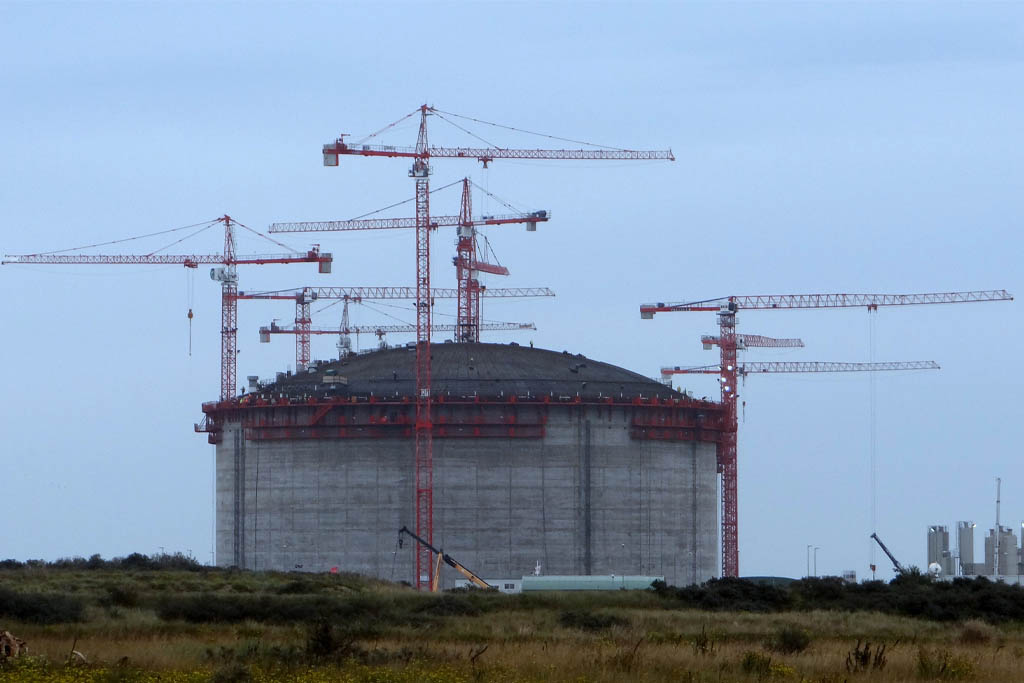
Photo: Photo: Serge Ottaviani/CC BY-SA 3.0 (A cryogenic storage tank under construction at the Loon-Plage LNG terminal in the Port of Dunkirk, France — one of the ports that has received cargoes of Russian LNG from the Yamal project.)
Officially, the EU has banned the transshipment of Russian LNG in Europe, but unofficially the trade is going stronger than ever. The EU ban on transshipment is just a show for the gallery. It only applies to transshipment to countries that have no ban on Russian gas. The EU itself unloads as much gas as it wants for its own use. A full ban on LNG imports starts from the beginning of 2027. Given how many previous deadlines on Russian energy have already slipped, there is little reason to expect this one to hold.
The list of port calls so far this year
- Zeebrugge (Belgium) – 37
- Dunkerque (France) – 26
- Montoir (France) – 25
- Bilbao (Spain) – 17
- Gate/Rotterdam (Netherlands) – 12
- Mugardos (Spain) – 10
- Barcelona (Spain) – 4
- Sagunto (Spain) – 2
- Sines (Portugal) – 2
Of the 140 cargoes shipped in the first half of the year, 56 were carried by vessels linked to the British company Seapeak, 49 by vessels linked to the Greek company Dynagas, and 35 by vessels linked to Japan's Mitsui O.S.K. Lines (MOL) and China's COSCO, according to Urgewald's cargo count. These are named, publicly known companies, and the trade itself is not illegal — no sanctions currently prohibit carrying Yamal LNG to the EU.
The German environmental organization Urgewald published an analysis of this traffic on 8 May 2026, based on shipping data from Kpler. The figures show that EU countries imported 6.69 million tonnes of LNG from the Russian flagship project Yamal LNG between January and April 2026. This is an increase of 17.2 percent compared with the same period in 2025.
The EU's ban on short-term Russian LNG contracts is a step in the right direction, according to statements made by Sebastian Rötters, sanctions campaigner at Urgewald, in connection with the report — but he argues the long-term agreements remain the real problem. As long as those contracts exist, he says, Europe will keep funding a Russian gas project with little future without EU buyers. Urgewald has not responded to The Liberty Bulletin's request for comment on the 2027 ban and the prospects for continued trade in Russian LNG.
Russian icebreakers of the Arc7 class carry the gas out of the ice-bound area on the Yamal Peninsula to the city of Murmansk, close to the Norwegian border. There, the gas is transferred to European LNG tankers. Now the ships run a daily shuttle service to receiving terminals in Belgium and other European countries. This is a trade that was planned long in advance.
The market analysis from the Centre for Research on Energy and Clean Air (CREA) from May 2026 shows the same as Urgewald has found. The report shows that the EU is still Russia's largest customer for gas. It documents that the EU swallows almost half of all the LNG Russia exports globally. The total bill for all Russian fossil fuels was roughly 2.3 billion euros in May. IEEFA estimates that EU imports of Russian LNG rose by 16 percent to about 6.9 billion cubic metres, the highest quarterly figure since the war began.
In the EU, creative politicians have therefore devised a "theatrical" ban on the transshipment of Russian liquefied natural gas (LNG). Many who read about the ban in European media are led to believe that it applies to transshipment for consumption in Europe. That would be logical, since it is Europe that makes the bans and sanctions. But the ban does not apply to Europe. It applies to everyone else. The EU itself unloads as much as it wants for its own use. That means enormous quantities of Russian LNG. The gas is sent straight into the insatiable European market. To put it very bluntly: the European sanctions regime allows direct import of Russian LNG for its own consumption.
“The report shows that the EU is still Russia's largest customer for gas.”
It is a paradox that the European press presents it as if the EU has an import ban on Russian gas and is hunting ships in the so-called shadow fleet. The truth is that a convoy of EU-registered ships is fetching energy from the Russian bear. In the EU, most people believe that gas imports from Russia have stopped. Reality is not quite so romantic. Officially, the EU has stopped buying Russian oil and gas.
Unofficially, sales are going stronger than ever.
On 26 January 2026, the Council of the EU gave final approval to a stepwise ban on Russian gas: a full ban on LNG imports from the beginning of 2027, followed by pipeline gas from autumn 2027. Not many believe the EU will manage to uphold the ban. TotalEnergies and SEFE hold long-term contracts that will formally become illegal from 1 January 2027. The law nevertheless gives them the right to invoke force majeure to get out of those contracts. Naturgy's general counsel has pointed out that to use force majeure, they must show they have tried to sell the gas to markets other than Europe. This opens a grey zone in which the companies keep handling Russian LNG, only with an attempt at redirection first. Countries such as Spain and France are expected to seek delays.
The EU's 21st sanctions package also includes an exemption that lets European companies buy, transport and insure Russian LNG, as long as it is forwarded to countries outside the EU, and not intended for consumption within the bloc. Critics point out that this weakens the European Commission's earlier principle that the ban should apply regardless of the final destination.