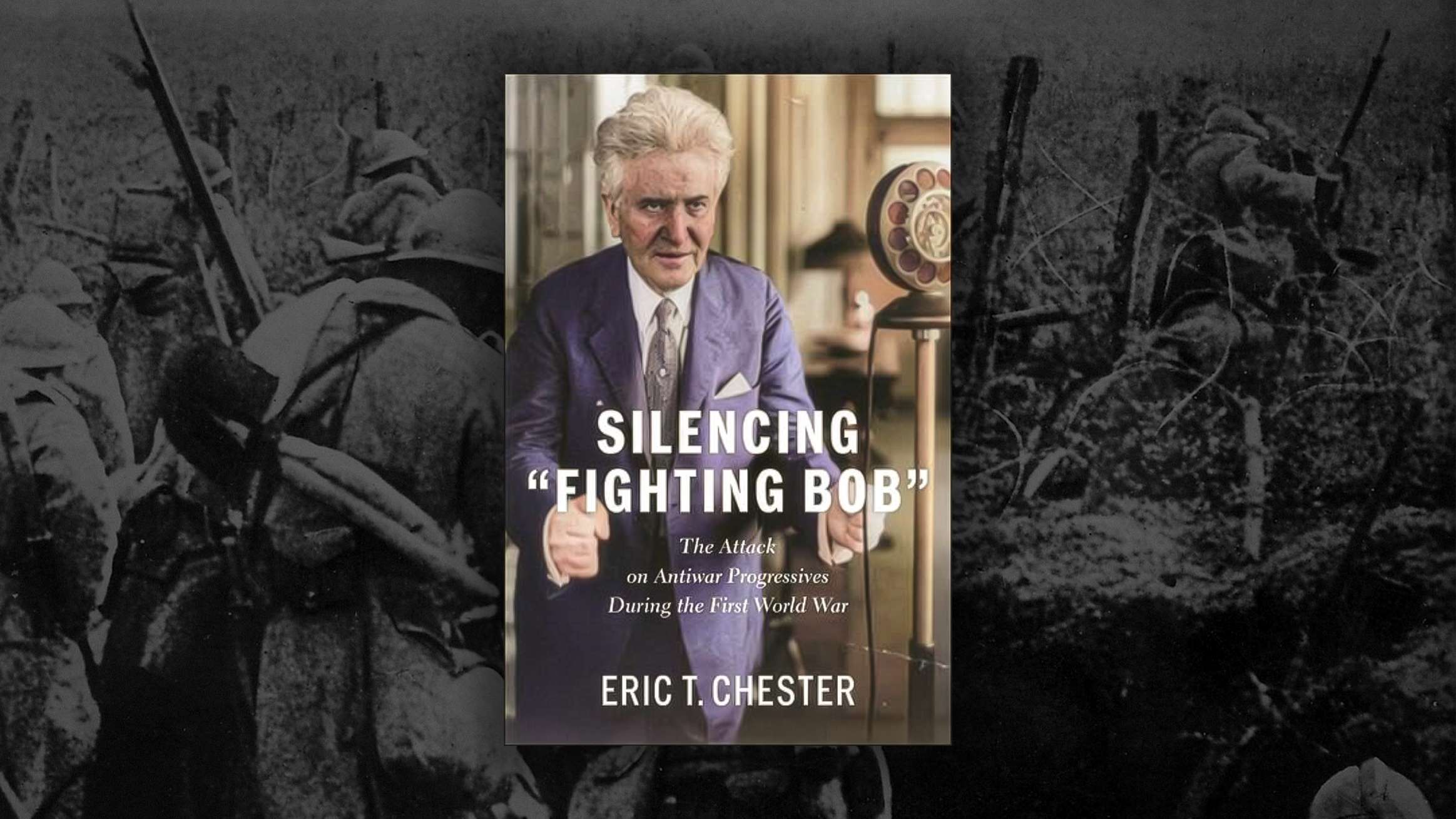
How the U.S. Government Targeted Antiwar Progressives in World War I: The Campaign to Silence "Fighting Bob"
Eric T. Chester's Silencing "Fighting Bob" chronicles a coordinated wartime campaign by federal agencies and allied private groups to undermine antiwar progressives, including Senator Robert "Fighting Bob" La Follette. Drawing on archival material, Chester shows how propaganda, legal threats, and covert operations narrowed the space for dissent and left a lasting mark on American civil liberties.
By Brandan P. Buck
955 views
In Silencing "Fighting Bob": The Attack on Antiwar Progressives During the First World War, historian Eric T. Chester reconstructs a deliberate and multifaceted campaign by federal authorities and allied private organizations to suppress dissent against American intervention in World War I. Chester focuses on the months between the debate over intervention and the peak of U.S. mobilization in 1918 to show how officials used the Committee on Public Information (CPI), the Bureau of Investigation, and nominally private intermediaries to intimidate, discredit, and co-opt antiwar voices.
The book is organized around four central targets: the largely antiwar Jewish community of New York's Lower East Side, the People's Council of America for Democracy and the Terms of Peace (PCA), the Midwestern Nonpartisan League (NPL), and Senator Robert "Fighting Bob" La Follette Sr. Chester draws on press reports, speeches, pamphlets, and private correspondence to document what he terms "open and covert operations directed at suppressing progressives and the social democratic left." His detailed narrative emphasizes how legal prosecution, propaganda, infiltration, and financial pressure worked in concert to narrow the bounds of permissible political speech.
Chester gives particular attention to the role of the CPI, the wartime propaganda agency led by progressive journalist George Creel. Under Creel's direction, the CPI did not confine itself to rallying public support for the war; it also engaged in micromanaged efforts to neutralize opponents. In La Follette's case, when legal avenues for silencing the senator proved limited, the government "opted to discredit La Follette by initiating a coordinated effort to malign him through a covert operation of psychological warfare," carried out through the CPI and nominally private allied organizations. The CPI provided the prowar American Defense Society with confidential government documents, aided in its fundraising, and coordinated anti–La Follette messaging that reached major outlets such as The New York Times, which published claims that the senator's advocacy of negotiated peace amounted to being "disloyal to the government" and "giving aid and comfort to the public enemy."
Chester also details how government actors exploited fissures within the broader progressive movement. Ethnic, regional, and ideological divisions—particularly within New York's Jewish community and among labor organizations—created openings for the state to isolate dissenters. In some cases the CPI subsidized prowar progressives while undermining their antiwar rivals. To blunt the influence of the PCA, the CPI helped nurture a front known as the American Alliance for Labor and Democracy (AALD), through which establishment labor leaders, including Samuel Gompers, were able to marginalize opponents aligned with the PCA. State authorities at times supported these efforts with force; Chester recounts that the Illinois militia was deployed to break up PCA meetings.
Legal pressure accompanied these propaganda and organizational efforts. Chester shows how the Espionage Act, already a blunt instrument criminalizing a wide range of speech, was stretched further through threats and selective enforcement. An example involves the Nonpartisan League and a pamphlet titled War Program: CPI officials focused on what one agent called "one paragraph which is rather close to the line," a single passage the government found sufficient to threaten prosecution. The pamphlet's objectionable sentence—saying the war supported an "economic system based upon exploitation" and "a deadly game for commercial supremacy"—was enough to compel the NPL to recall and destroy its literature.
According to Chester, the combined pressure of legal threat, propaganda, and covert operations succeeded in silencing or muting key opponents. La Follette, once a vigorous antiwar voice, "retreated into silence" under sustained attack, illustrating how even elected officials can be driven to self-censorship. The repression was not purely partisan: many architects of the campaigns, including Creel and other progressives, supported American intervention and prioritized state power over dissenting elements within their own political milieu.
Chester places these wartime practices in a wider historical frame and draws out their contemporary resonances. He argues that the wartime curtailment of civil liberties prompted a postwar backlash—pardons of wartime prosecutions and a partial easing of the First Red Scare—and helped raise Americans' expectations of individual rights. Yet he warns that the mechanisms that enabled suppression in 1917–18—discretionary executive power, public-private partnerships, cultivated media allies, and selective legal enforcement—remain available to modern governments. Chester notes parallels such as the renewed use of selective deportation to discipline dissent, the routing of public funds through nominally private organizations, and state-level penalties for foreign policy activism, concluding that the historical record should counsel vigilance in defense of free expression.
Silencing "Fighting Bob" is a compact but detailed account of how wartime exigency reshaped the boundaries of acceptable dissent. By tracing the nuts and bolts of repression—who did the targeting, how they did it, and why certain tactics proved effective—Chester's study contributes to the broader literature on civil liberties in wartime and offers an implicit warning about the ease with which democracies can curtail dissent when pressed by external threats.