How Macron blew up France’s old political order, then struggled to govern
This piece traces how Macron blew apart France's old left-right order in 2017 and built a new centre around himself, only to struggle to govern once voters stopped giving it a majority, raising the question of what remains once he is gone.
By Martin Bertrand
959 views
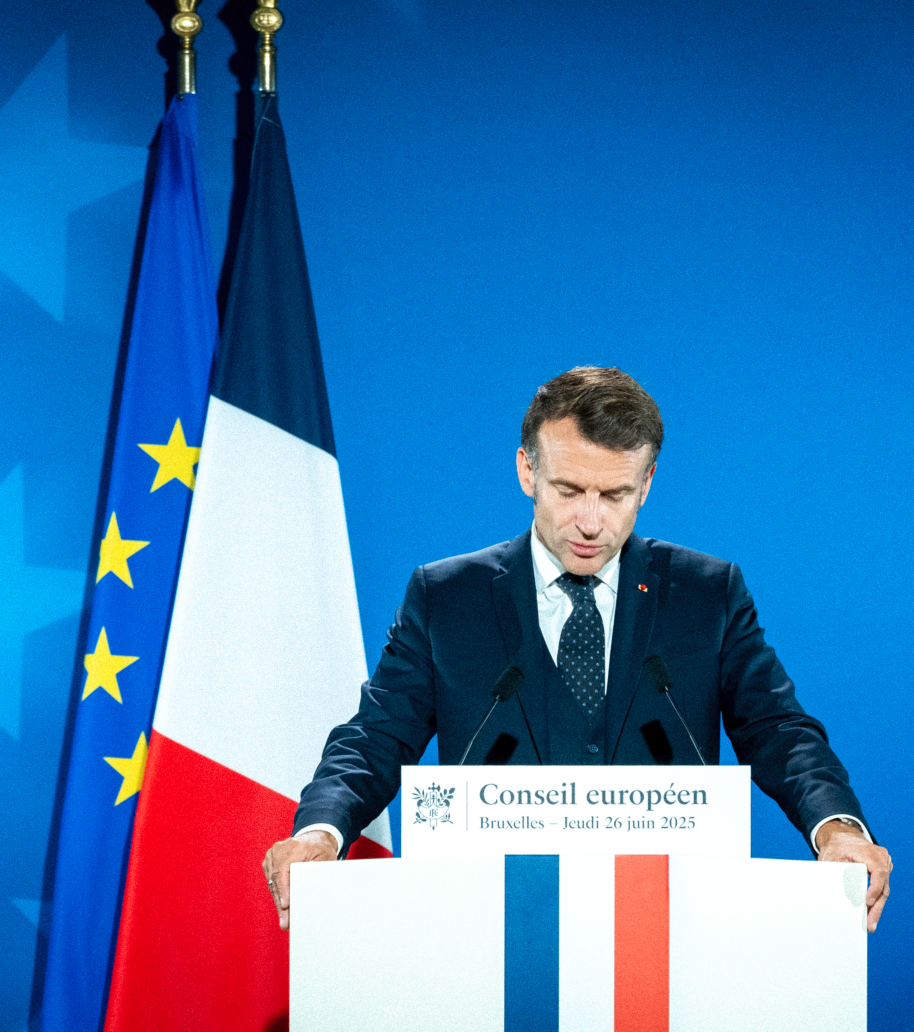
Photo: President of France Emmanuel Macron at the summit of Heads of State and Government of the European Union at the European Council in Brussels, Belgium, 20 March 2025.
Emmanuel Macron did not create the collapse of France’s traditional parties. He saw the opening, and drove straight through it.
In 2017, the two political families that had governed France for decades were already badly weakened. On the left, François Hollande ended an unpopular presidency without seeking re-election. The Socialist primary then chose Benoît Hamon, from the party’s left wing, whose flagship proposal was a universal basic income that could eventually reach €750 a month. It was a clear break with Hollande’s more centrist presidency, and part of the Socialist electorate no longer recognised itself in its own candidate.
On the right, François Fillon unexpectedly defeated Nicolas Sarkozy and Alain Juppé in the conservative primary. His programme was economically liberal and socially conservative: 500,000 public-sector job cuts, a retirement age of 65, and a proposal to reserve plenary adoption for heterosexual couples while leaving simple adoption available to same-sex couples. Fillon had support from the conservative Catholic movement that emerged from opposition to same-sex marriage. Then his campaign became engulfed by the parliamentary jobs given to his wife Penelope. He has since been definitively convicted of misuse of public funds in that case, and in 2025 received a four-year suspended prison sentence, a €375,000 fine and five years of ineligibility.
Between Hamon and Fillon, Macron suddenly had an enormous political space. François Bayrou, the historic centrist candidate, rallied behind him. Social democrats joined him. So did moderate conservatives. The planets had aligned unusually well.
Macron presented himself as “neither left nor right”. He won 24.01 percent in the first round, ahead of Marine Le Pen on 21.30, Fillon on 20.01 and Jean-Luc Mélenchon on 19.58. Weeks later, his movement, created barely a year earlier, won 308 seats in the National Assembly, with another 42 going to its MoDem allies. A new president had not simply won an election. He had swallowed large parts of the old left, centre and right and built an absolute parliamentary majority around himself.
For a while, it looked as though Macron had replaced the old political system with himself.
By 2022, French politics had reorganised into something closer to three blocs: the presidential camp, a left increasingly structured around Mélenchon, and a far right dominated by Le Pen. The Socialist Party and Les Républicains, once the natural parties of government, had become secondary forces. But Macron’s new centre was much more dependent on the presidency than the old parties had been on any single leader.
The first real warning came after his re-election in 2022. His coalition won 245 seats in the legislative elections, well short of the 289 required for an absolute majority.
That should have changed the practice of power. Instead, the government largely tried to continue as before. Prime Minister Élisabeth Borne used Article 49.3, allowing legislation to pass without a vote unless the government is censured, 23 times between 2022 and the end of 2023. One of its most politically explosive uses came during the pension reform raising the legal retirement age from 62 to 64. Constitutionally, the procedure was perfectly legal. Politically, it exposed the central contradiction of Macron’s second term: a presidency accustomed to commanding Parliament was now governing without a majority.
Then came June 2024.
Macron’s European election list received 14.60 percent. Jordan Bardella’s National Rally won 31.37 percent. Macron immediately dissolved the National Assembly, asking the country for what he called a political “clarification”. Instead, he obtained an Assembly even harder to govern.
The left, which had fought the European elections divided, reunited within days under the Nouveau Front Populaire. It emerged as the largest bloc, with 178 seats under the Interior Ministry’s classification. Macron’s coalition fell to 150, while the National Rally won 125 and another 17 went to its allies. Nobody was remotely close to an absolute majority.
This is where Macron’s interpretation of presidential power became particularly revealing.
The NFP argued that, as the largest bloc, it should be given the first opportunity to try to form a government. There is no universal European rule saying that the largest parliamentary group automatically governs. In parliamentary systems, the real test is whether someone can command the confidence of Parliament. In Spain, for example, the king consults the parliamentary groups and proposes a candidate, who must then win the confidence of Congress. In Germany, the federal president proposes a chancellor whom the Bundestag must elect. The head of state does not simply decide which political direction should continue.
Macron chose not to test the left’s proposed government in that way. After almost two months, he appointed Michel Barnier, a veteran conservative and former EU Brexit negotiator from Les Républicains, a party that had won just 39 seats. The election had weakened the presidential camp, but the political direction of government remained anchored around Macron’s bloc and the traditional right.
It did not produce stability. Barnier was brought down by 331 MPs in December 2024. François Bayrou followed, losing a confidence vote in September 2025. Macron then appointed Sébastien Lecornu, one of his longest-serving loyalists. Lecornu resigned after just 27 days, only for Macron to reappoint him four days later. As of October 2026, he remains prime minister.
There is something almost circular about Macron’s decade in power. He arrived by blowing apart the old left-right alternation and succeeded spectacularly in doing so. But the political centre he created was heavily dependent on him, on presidential elections and on the immense gravitational pull of the Élysée. Once voters stopped giving that centre a parliamentary majority, the limits of the model became increasingly difficult to hide.
Macron changed French politics. The question now is what remains once Macron himself is gone.