Georgian youth attend large Russian state-organized forum as critics warn of hybrid influence campaign
Dozens of young Georgians, including participants from the Russian-occupied regions of Abkhazia and South Ossetia, took part in a state-backed youth festival in Yekaterinburg that drew thousands from around the world. Russian officials, including Foreign Ministry spokeswoman Maria Zakharova, used the event to encourage Georgians to visit Russia, while Georgian security experts and some politicians described the initiative as part of a broader hybrid campaign to increase Russian influence in Georgia.
By Christopher Manley
1,068 views
Dozens of young people from Georgia — some reportedly aged 15 to 21 — travelled to Yekaterinburg in mid-September to take part in a high-profile youth festival organized by Russia’s Federal Agency for Youth Affairs. The festival, held from September 11 to 17, was billed by organizers as an international event with some 10,000 participants from 191 countries. Full participant lists were not publicly released.
Georgian media and organisers gave differing figures and descriptions of the delegation. Mamuka Pifia, leader of the party “Solidarity for Peace” and one of the Georgian figures promoting participation, said about 40 Georgians attended and that many of them were minors. He told reporters the delegation was selected through an application process and that the ‘‘best’’ applicants won places. Pifia also said some participants and their parents have faced pressure at home and that several underage attendees declined requests for interviews.
Ahead of the trip a Russian diplomat, Dmitry Olisov — who heads Russia’s interests section at the Swiss embassy in Tbilisi — met on September 8 with four of the Georgian participants, according to the diplomatic mission. Olisov told the participants about the festival programme and the professional, educational and networking opportunities it purportedly offered to young people from Georgia.
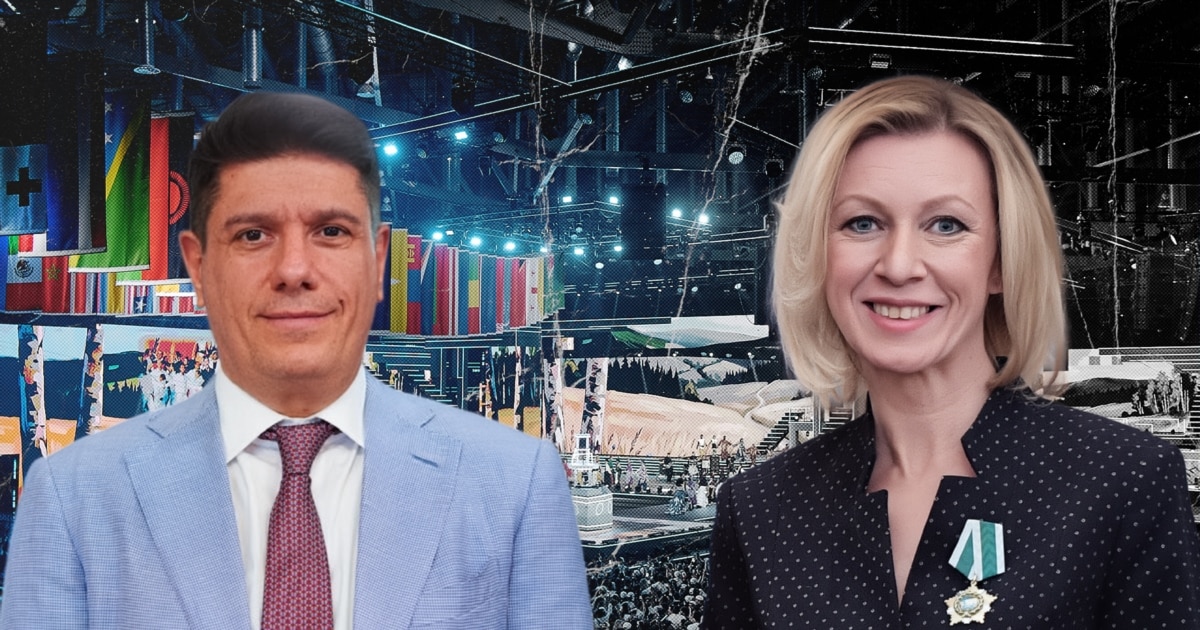
At the festival itself, Russian Foreign Ministry spokeswoman Maria Zakharova took to the stage and urged Georgians to travel to Russia, meet Russians and visit cultural institutions. In her remarks — translated from Russian — she said: "Come, see for yourselves, speak to our citizens, go to our theatres, museums and restaurants. You can even compare where Georgian cuisine tastes better, in Moscow or in Tbilisi. This is not soft power, it is tasty power." Zakharova also praised President Vladimir Putin’s decisions to abolish visa requirements for Georgian citizens and to restore direct flights, and repeated narratives blaming the West for fomenting anti-Russian sentiment, including in Georgia.
The Yekaterinburg festival included visible participation by representatives of the two Georgian regions under Russian occupation. Media reports said around 100 young people from Abkhazia and 100 from the Tskhinvali (South Ossetia) region were sent to the event. The so-called de facto Abkhaz delegation included officials styled as ministers and vice-premiers: de facto foreign minister Oleg Barcizi; de facto vice-premier and head of the youth and sports committee Taras Khagba; de facto vice-premier Maia Tsibulevskaya; and de facto culture minister Daur Kove. Observers noted that such high-level representation from the occupied territories, and the inclusion of their flags at the forum alongside the Georgian national flag, carries clear political symbolism.
Differences in internet access at the festival generated additional attention. According to Russian media, foreign participants were given access to internet networks that bypassed Russian restrictions and allowed sites and social networks blocked inside Russia to be reached without VPNs, while Russian participants were limited to a separate Wi‑Fi network subject to Roskomnadzor’s controls. Access to the foreign network was apparently available only via accreditation badge numbers.
Security and civil-society voices in Georgia warned the event should be viewed in the wider context of Moscow’s efforts to shape opinions among young people in neighboring countries. Security expert Theona Akubardia described the educational programmes and recruitment of Georgian youth as a distinct dimension of Russia’s hybrid warfare strategy, arguing Moscow has stepped up such activities since Georgia slowed its drift toward the West. The State Security Service of Georgia has previously flagged similar threats in its annual reports.
The festival was organized by decree of President Vladimir Putin and featured high-level participation from the Russian state: Foreign Minister Sergey Lavrov was listed among attendees, and cultural programming included a concert by Russian singer Dmitry Bilan. Some Georgian participants were also linked with pro-Russian organizations in Georgia, such as the Primakov-named Georgian–Russian public centre: the festival included figures like Dimitri Lortkipanidze, named by some reports as a delegation head, and Lali Moroshkina, a journalist and political commentator supportive of Georgia’s ruling party, Georgian Dream.
Critics say the festival functions as more than a cultural exchange. They contend it serves to normalize Russian influence among Georgian youth, including minors, and to amplify narratives favorable to Moscow at a time when Russia has used military force repeatedly against neighbors — historically as an empire and the Soviet Union, and in recent decades through the 2008 invasion of Georgia and the 2022 large-scale war in Ukraine. Organizers and some Georgian participants portray the event as an opportunity for professional education and cultural exchange; opponents urge caution and call for transparency about who is recruited and how selection is managed.
The Yekaterinburg festival underscores the contest over narratives and influence in the region: for Moscow, such gatherings are an instrument of state outreach; for many in Georgia and Western-aligned analysts, they represent targeted efforts to weaken pro-Western orientation and expand Russian leverage among the next generation. The debate over the scale, transparency and intent of Russian youth diplomacy in Georgia is likely to continue as officials, activists and families evaluate the consequences of participants’ exposure to state-run events in Russia.