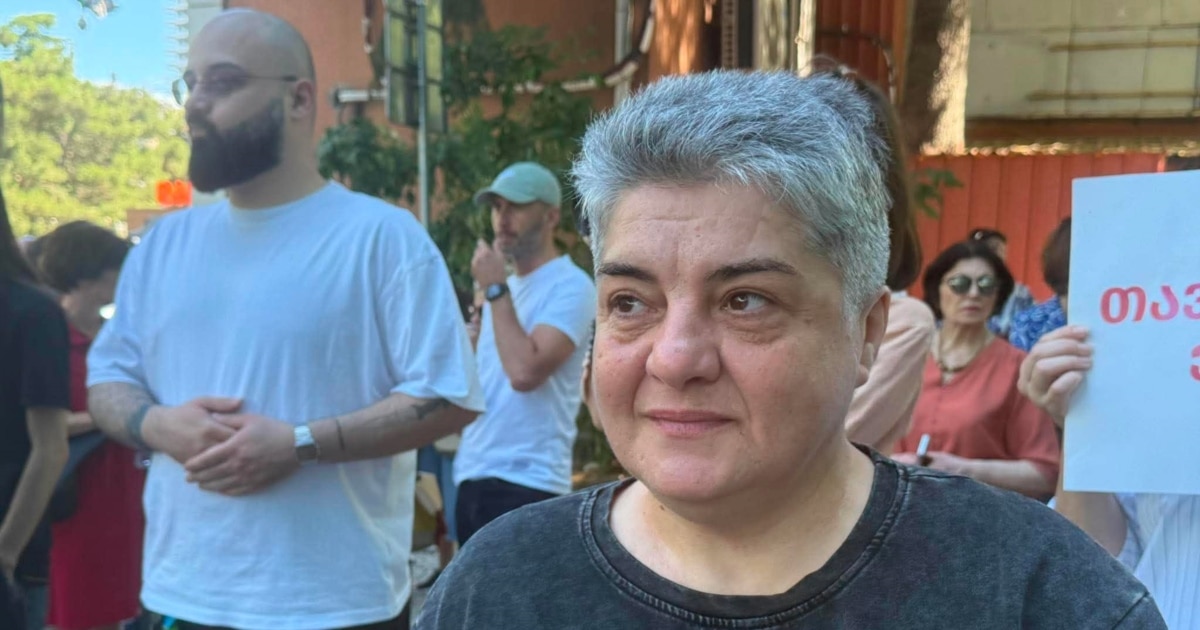
Georgian activist fined 3,000 GEL for social media post about Bidzina Ivanishvili after hate-speech unit referral
A Tbilisi court fined pro-Western activist Tamuna Giorgadze 3,000 lari for a social media post about Georgian Dream founder Bidzina Ivanishvili after a case brought by the Interior Ministry’s hate-speech unit. Giorgadze said she will appeal and told reporters she does not view a curse as an insult.
By Clémence Desjardins
805 views
A Tbilisi court on June 29 imposed a 3,000 Georgian lari fine on activist Tamuna Giorgadze for a social media post about Bidzina Ivanishvili, the founder and honorary chairman of the ruling Georgian Dream party. Judge Tornike Kochkhiani issued the penalty after the Interior Ministry’s Department for Combating Hate Speech referred the case to the court, the ministry confirmed.
Giorgadze, a participant in pro-Western protests, did not attend the courtroom hearing and waited in the court yard as the panel delivered its ruling. Speaking to journalists outside the court, she said she would challenge the decision in a higher court. Giorgadze also defended the content of her post, telling reporters: „Does not consider cursing an insult" and later adding, „I wrote a "post" on my personal page where cursing was considered an insult." — remarks the court evidently treated as public insult under Georgian administrative law.
Prosecutors in the case relied on Article 166, Part 1, of Georgia’s Code of Administrative Offenses, which covers petty hooliganism and public insults in a public space and carries a fine between 500 and 3,000 lari or up to 20 days’ administrative detention. The Interior Ministry has also been using a separate provision, Article 173, paragraph 16 prima, that specifically targets verbal insults of state or public officials; that clause prescribes fines of 1,500–4,000 lari or up to 45 days’ detention, with higher penalties for repeat offenses.
Courts in Georgia have been processing numerous cases brought by the hate-speech department in recent weeks. The article notes that the new unit’s inspectors began what officials describe as social-media “monitoring” from June 1 and that several people have already been fined in the range of 2,000–4,000 lari after similar proceedings. Many of these cases concern alleged public insults toward politicians and other public figures posted on social networks.
The prosecutions have sparked public debate about the balance between tackling hate speech and protecting freedom of expression. Parliament Speaker Shalva Papuashvili defended the work of the hate-speech unit in remarks on June 29, arguing that "Today, hatred in the eyes of Georgians is associated with pro-Europeanism. Those who sympathize with pro-Europeanism are the sources of hatred, the main spreaders of obscenity." and suggesting the initiative could improve political discourse: "The results show that hatred imposed from outside will decrease in Georgia. This is important, among other things, for political debates.". He also said, according to the report, that the EU’s damaged reputation could be partially repaired by the effort and that the EU should back the initiative so pro-European forces would "Return to polite, non-obscene rhetoric".
Critics warn that the pattern of administrative prosecutions may chill online political speech, especially criticism of powerful figures such as Ivanishvili. Human-rights advocates and free-speech defenders have previously expressed concern that broad public-insult and public-order statutes can be used selectively against government critics and activists. The Interior Ministry and its Department for Combating Hate Speech argue that the measures are aimed at curbing abusive, hateful speech in the public domain.
Giorgadze said she intends to appeal the monetary penalty. The case forms part of a broader trend of increased legal scrutiny of online posts in Georgia, raising questions about how hate-speech enforcement will be balanced with constitutional guarantees of free expression and the right to criticize public officials.