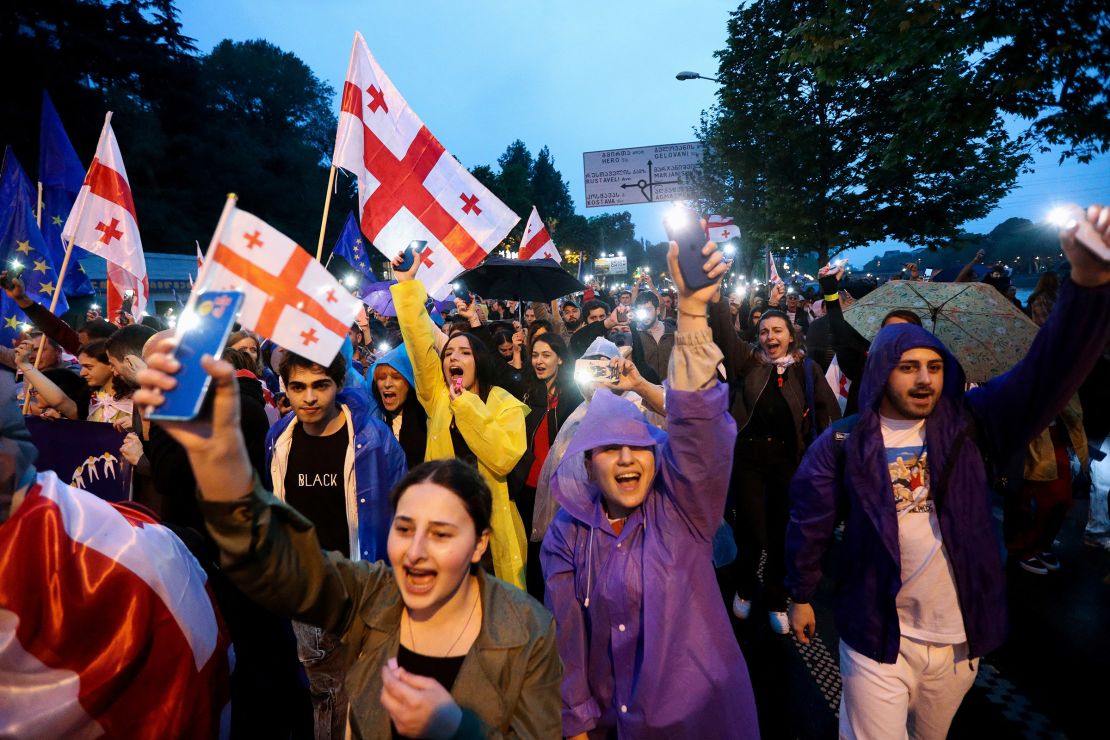
Georgia is undergoing a major identity crisis, with significant implications for both its regime type and its geopolitical alignment. Since restoring their independence from the Soviet Union in 1991—and in many ways long before then—Georgia’s people have consistently rooted their national identity in belonging to the European community of democratic states and opposing Russian domination. With over 80% of the population embracing this identity, the prime minister’s announcement on November 28, 2024, suspending Georgia’s negotiations on joining the European Union profoundly shook their sense of national self, heightening societal anxieties and sparking a surge in public mobilization. Mass protests have now been ongoing for more than 120 consecutive days.
Despite the government’s shift toward Russia and authoritarianism, the resilience of Georgia’s civil society offers a compelling reason for hope. Political scientists and commentators tend to equate nation-states with their governments and, hence, underestimate society’s agency. Georgia’s ongoing crisis underscores the power of a mobilized public when its government deviates from long-established and widely shared national objectives. Given the extent and endurance of Georgia’s protests, the notion of transforming the country into a pro-Russian dictatorship appears overly ambitious. It is one thing for leaders to attempt an authoritarian shift but another for them to maintain power amid increasing public discontent and resistance. Mzia Amaghlobeli, the imprisoned Georgian journalist who staged a hunger strike for over 35 days, captured the defiant spirit of these protests best: “Freedom is far more valuable than life. Fight before it is too late.”
A Neighbor’s War
Georgia’s current crisis is best understood in the context of Russia’s ongoing war against Ukraine. Georgian Dream assumed power in 2012, positioning itself as a party of “peace.” Considering the instabilities of the 1990s, Russia’s 2008 invasion of Georgia, and the country’s lack of membership in European economic and security organizations, the party pledged to avoid further conflicts with Russia while upholding Georgia’s pro-European aspirations. Its message initially resonated with many citizens amid the unpopularity of outgoing President Mikheil Saakashvili. Moreover, the new administration made progress toward integration with the European Union, achieving an EU-Georgia trade agreement (DCFTA) and visa liberalization for Georgian citizens. Despite occasional public backlash against specific rhetoric or actions seen as too pro-Russian, the government’s declared foreign policy strategy of “non-irritation” appeared sustainable until 2022.
Russia’s invasion of Ukraine in February 2022 disrupted this fragile stability. For many, the war triggered memories of Russia’s 2008 invasion of Georgia. Seeing the war in Ukraine as their own, citizens demanded moral clarity from their leaders. Then-Prime Minister Irakli Gharibashvili and the ruling party initially adopted a neutral stance, expressing solidarity with the Ukrainians and backing international resolutions against Russia but also denouncing pro-Ukraine demonstrations as “provocations” and opposing sanctions on Russia. Meanwhile, President Salome Zourabichvili diverged from the party line, consistently and unambiguously condemning Russia and championing Georgia’s enduring desire for European integration. These contrasting responses to the distinct and contradictory insecurities created by the Russia-Ukraine war illustrate what I call a compartmentalization of insecurities: The prime minister emphasized mitigating Russia’s military threat and ensuring economic stability, while the president focused on reaffirming Georgia’s long-standing identity and European integration.
By 2024, the ruling party had accelerated its shift toward a more explicitly pro-Russian stance, making negative statements about Western leaders and strengthening economic ties with Russia. It coupled these moves with increasingly authoritarian measures at home, adopting laws aimed at consolidating power and silencing dissent, and granting awards to police involved in violent crackdowns. Following a hotly contested parliamentary election last October, Georgia’s political life has grown increasingly tumultuous. Opposition parties have boycotted parliament, citing widespread fraud and demanding a rerun of the election. Even after leaving the presidential palace on December 28, Zourabichvili has continued supporting public protests, meeting international leaders, and claiming to be the country’s only legitimate leader until a new election is held. Meanwhile, Georgia’s parliament has operated under one-party rule, backed by billionaire Bidzina Ivanishvili. In short, the ongoing mass demonstrations reflect a clash between the government’s shift toward Russia and authoritarianism, on the one hand, and Georgian society’s steadfast commitment to democracy and a pro-Western foreign policy, on the other hand.
Identity Crisis
Russia’s 2022 invasion of Ukraine has proved a watershed moment for Georgia, provoking controversy over fundamental questions of national identity: Who are we? Who are our friends and enemies? What is our place in the community of nation-states? Such foundational questions typically have relatively stable answers, even as they remain subject to contestation. Thus, disrupting such fundamental self-understandings sparks an ontological crisis—a desire to reestablish a lost sense of stable identity.
Georgia’s ongoing protests are motivated primarily by this desire to reaffirm its identity as a European nation in opposition to Russia. The public majority’s conflict with the ruling party reflects a struggle over which side truly represents the Georgian nation. With young people at the forefront, the pro-democracy and pro-European protests have attracted individuals from diverse political ideologies, demographic backgrounds, and occupations, united in a public discourse centering on the question of who speaks for the country. Protest banners, speeches, manifestos, graffiti, songs, and poems bear slogans such as “We Are Georgia” and “Georgia Is Ours.”
Why are pro-European and anti-Russian sentiments so strong in Georgia? Its national identity is rooted in founding myths and historical achievements, legacies of ancient and medieval kings, long-standing linguistic and literary traditions, and a rich religious heritage. Yet national identities derive not only from shared traits and experiences but also from narratives about a nation’s relationships with others. Georgia’s formation as a modern nation-state occurred in the shadow of the Russian Empire and then the Soviet Union, which situated Moscow as the central threat to its independent statehood. Accordingly, the Georgian nation has routinely defined itself in opposition to Russia as its significant negative “other,” while simultaneously identifying positively with European democracies.
Noe Zhordania, leader of the first democratic republic of Georgia, affirmed in 1920: “Our present life, as well as our path to the future, has been intimately, without mediation, intertwined with the West, and no power can break this union.” Ironically, that connection was broken one year later when the Soviet Union forcibly annexed Georgia, but such sentiments persisted through periodic anti-Soviet uprisings and dissident movements. They reemerged in a powerful way in the late 1980s, informing Georgia’s postindependence national identity and foreign policy direction. Then-Parliament Chair Zurab Zhvania celebrated Georgia joining the Council of Europe in 1999 with a statement that continues to resonate with many: “I am Georgian, and therefore I am European.”
Since 1991, Georgia’s foreign policy has largely aligned with this overarching national identity. Each administration encountered challenges, flaws, and criticism, but EU and NATO membership remained a guiding priority—even enshrined in the Constitution. While many countries have provided economic and military support to Ukraine, Georgians stand out as the largest non-Ukrainian group to fight and sacrifice their lives in defense of Ukraine. Over 60 Georgian citizens have died in Ukraine since the 2022 invasion, with hundreds more fighting, mainly through the Georgian Legion, a private volunteer organization. These volunteers claim that they fight alongside Ukrainians not only to support a friendly nation but also to defend their own country, as “The history of Georgia is repeating itself in Ukraine,” which “has given them the opportunity to avenge their fathers.” Many countries witnessed public demonstrations in solidarity with Ukraine following Russia’s 2022 invasion, but Georgia’s demonstrations also expressed its people’s own emotions amid their ongoing struggle for freedom from Russia’s overbearing shadow. Georgian, Ukrainian, and EU flags together have become commonplace at Georgian protests, along with slogans like “We Are Europe” and “Never Back to the USSR.”
A significant portion of Georgian Dream’s electoral base shares these sentiments, and it is notable that the party maintained power until 2022 largely by emphasizing its commitment to peace while upholding Georgia’s pro-European foreign policy (and also partly thanks to the weaknesses and divisions within Georgia’s opposition parties). Russia’s full-scale invasion of Ukraine raised fears that it might similarly attack Georgia, which the party exploited by positioning itself as a “guarantor of peace.” At the same time, it decoupled this “peace” message from its prior pro-European foreign policy. For many, this undermined the party’s legitimacy, likely necessitating the widespread fraud observed in the October 2024 parliamentary election. Notably, Georgian Dream’s decision to suspend EU integration negotiations was announced only after the election, illustrating its awareness that this public turn away from Europe would further erode its public support. The latest public polls, conducted in January 2025, indicate that over 82% of respondents believe Georgia is experiencing a political crisis, with 78% attributing the situation to the ruling party.
Society Responds
Political commentators often overlook the agency of society, equating states with their political leaders and institutions. While it is often convenient to view states as unitary actors in this way, doing so can obscure important aspects of domestic and international affairs. Crises present vivid opportunities to observe societal agency, particularly when a regime’s perspectives and actions diverge from its citizens’ prevailing expectations, as is currently the case in Georgia.
With approximately 80% of Georgia’s public consistently expressing a European identity, Georgian Dream’s shift away from a pro-Western foreign policy has sparked widespread backlash. The ongoing protests showcase the Georgian public’s dedication and creativity in employing diverse forms of civil disobedience, even as demonstrators are beaten, detained, and imprisoned. For over 120 consecutive evenings, thousands of citizens have blocked Rustaveli Avenue, Tbilisi’s main thoroughfare. Self-organized marches have occurred throughout the country, and the Georgian diaspora has protested in cities worldwide. These largely leaderless protests have been coordinated via social media and included participants from diverse backgrounds and professions, showcasing defiant artistic expressions from singers, dancers, and actors. On December 28, 2024, hundreds of thousands formed a human “Chain of Unity” that stretched for kilometers—an homage to the “Baltic Way,” a 1989 anti-Soviet demonstration uniting millions of Estonians, Latvians, and Lithuanians. On New Year’s Eve, thousands of protesters set up a kilometer-long line of tables for a communal feast, filling the evening air with polyphonic songs featuring lyrics that emphasized unity and freedom.
There have been daily protests in front of the Channel 1 office, with protesters criticizing the public broadcaster’s alleged pro-government bias. Vaso Abashidze New Theater has been on a long-running strike since the arrest of actor Andro Chichinadze, who compared his situation with that of Josef K. from Kafka’s The Trial—uncertain of the reasons for his trial and imprisonment. On January 23, the theater unveiled a poignant outdoor protest manifesto: “This Country Is Mine!” Many individuals have continued to protest from prison by writing letters and participating in hunger strikes. As the philosopher Judith Butler observes, forms of nonviolent civil disobedience like hunger strikes may appear to be a form of “opting out,” but they are actually powerful statements against systemic injustice, “indicting the carceral powers that are already attacking the existence of the incarcerated.” The abovementioned Amaghlobeli’s hunger strike prompted international solidarity, her words from prison further galvanizing the protesters: “Today it is me, tomorrow it could be anyone who dares to dream of a just, democratic, European Georgia, untouched by Russian influence, unshaken by oppression.”
Some more institutionalized forms of public mobilization have emerged, as well. On February 8, 2025, over 20 groups and more than 2,000 individuals founded an organization called Public Assembly to promote democracy and enable broad public participation in the country’s political life. On February 17, the left-wing Movement for Social Democracy was established, criticizing both the current and previous ruling parties, Georgian Dream and the United National Movement, for their usurpation of power and repressive policies, and promising to promote people-oriented, just, and democratic political and economic systems instead. Notably, the ongoing protests draw upon Georgia’s rich history of public mobilization and self-organization. The Democratic Republic of Georgia (1918–1921), Europe’s first social democratic state, was notable for its decentralized power structure and strong public participation. Periodic protests occurred under Soviet rule too. In August 1924, Georgians organized large-scale armed uprisings against the Bolsheviks, and in 1978, peaceful demonstrations compelled Soviet authorities to reinstate Georgian as the official state language. After regaining independence from the Soviet Union in 1991, Georgia struggled to reestablish democracy due to weak institutions, but periodic protests served as a crucial check when government actions deviated too far from the will of the people. The country has exhibited traits of revolutionary democracy, although the current authoritarian shift has surpassed previous regimes’ democratic backsliding. It remains to be seen whether Georgia’s current public mobilization will ultimately succeed, but the protesters’ unwavering commitment in the face of violent crackdowns underscores that the country’s future is far from settled.
Implications
Georgia’s public protests for democracy and European integration since 2022 have produced some tangible results. In June 2022, the European Union declined to grant Georgia candidate status alongside Ukraine and Moldova—widely seen as punishment for the Georgian Dream party’s increasingly anti-Western stance— but it eventually did extend that status to Georgia in December 2023, following mass pro-EU protests. EU leaders overtly described this achievement as a testament to the people of Georgia rather than its government. European Parliament President Roberta Metsola stated, “Congratulations to the people of Georgia,” while other European MPs similarly told the Georgian people, “You did it. Your European spirit, your commitment to democracy and freedom made all the difference.” In 2023, public outrage compelled Georgia’s government to withdraw a proposed foreign agent law designed to undermine civil society and stifle dissent, widely seen as analogous to Russia’s. The subsequent revival of that law in 2024 marked a key step in the government’s accelerating authoritarian turn, and the struggle between the contrasting futures for Georgia remains ongoing.
For 30 years, Georgia’s democratic aspirations and commitment to achieving EU and NATO membership, in the face of Russia’s open and hybrid warfare, have exemplified success in the Caucasus region. In contrast, the entrenchment of a pro-Russian regime in Georgia could enable Russia to reassert regional influence at a moment when Moscow has suffered significant geopolitical setbacks, including a prolonged and costly war in Ukraine, international sanctions, lost influence in Syria, and pro-West shifts in Moldova and Armenia. In such a scenario, a likely next step would be for Georgia to join Russia-led regional initiatives. Unlike most post-Soviet states (aside from the Baltic countries, which successfully integrated into the EU and NATO), Georgia has largely stayed out of such organizations, staying true to its envisioned European future. For example, Georgia is the only holdout for the regional 3+3 initiative proposed by Russia, Turkey, and Iran, which aims to counter Western influence in the South Caucasus nations of Armenia, Azerbaijan, and Georgia. Since the vast majority of Georgia’s citizens hold deep pro-European views, completing any such pro-Russian realignment could be achieved only by abandoning any semblance of democracy. If Georgian democracy were to collapse and its geopolitical orientation shift, this would have consequences beyond Georgia’s borders, potentially bolstering nearby authoritarian regimes and further emboldening the imperial ambitions Putin has vocalized amid his ongoing war in Ukraine.
The nondemocratic path is not the only one in front of Georgia, and large segments of Georgia’s society are working to forge a future with a firmer democracy. The vitality of the protests signals that maintaining an authoritarian regime in pro-European Georgia would be costly and potentially unsustainable. The combined effects of each individual expression of protest and civil disobedience can create significant pressure when sustained over time. As Hannah Arendt noted, even authoritarian governments require some public support to govern. Foreign states can support Georgia’s prodemocratic and pro-European protests by applying pressure to its government. The United States and the United Kingdom have sanctioned several Georgian leaders, and the United States has suspended its strategic partnership with Georgia. On February 13, 2025, the European Parliament passed a resolution declaring the Georgian Dream party’s government illegitimate and recognizing Zourabichvili as the legitimate president. If the public protests succeed in this historic moment, Georgia will have an opportunity not only to restore but also to improve upon its democracy. Crises often contain transformative potential, and the current government’s authoritarian and anti-European turn has spurred mass mobilization that is horizontal, inclusive, and creative. The stakes are significant; the future of Georgia and regional politics alike hinge on the outcome.