Georgia cracks down on civil servants amid anti-government dissent
Georgia cracks down on civil servants amid anti-government dissent
By Clément Girardot
11,074 views
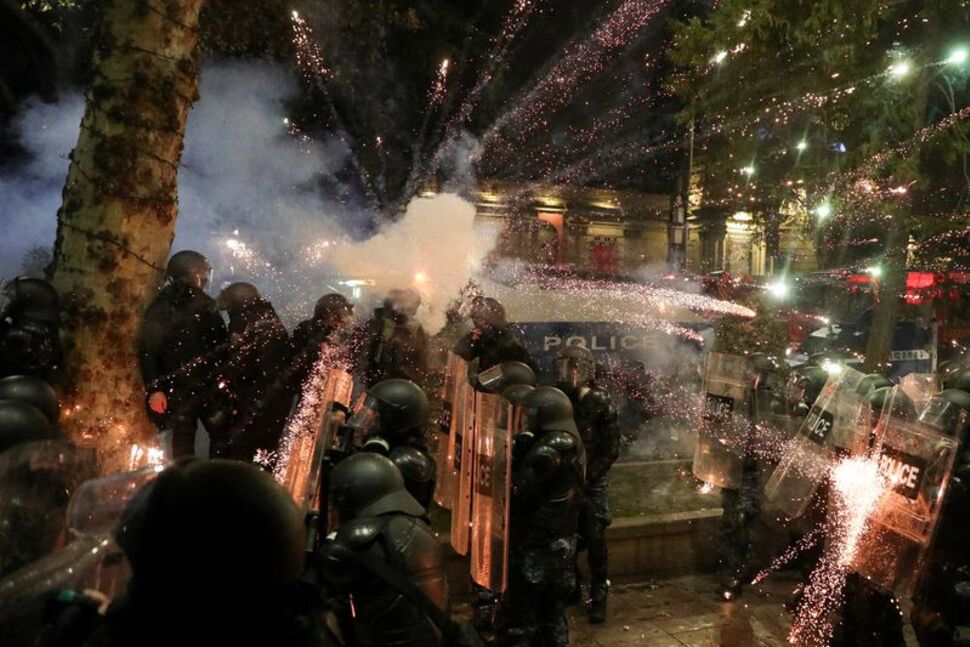
Since 28 November 2024, daily protests have gripped Tbilisi and other cities across Georgia, as citizens voice their anger over the suspension of the country’s EU accession process – announced that day – and, more broadly, a steady drift towards authoritarian rule.
In recent months, the ruling Georgian Dream party – re-elected for another four-year term in the widely discredited parliamentary elections of 26 October 2024 – has stepped up its crackdown on dissent and pushed through a raft of repressive legislation. Founded by billionaire oligarch Bidzina Ivanishvili, Georgian Dream has held power in the South Caucasus nation of 3.7 million since 2012. Its rise to power was once hailed as Georgia’s first peaceful democratic transition, following the 2003 Rose Revolution and the turbulence of the post-Soviet 1990s
A political catch-all with little in the way of firm ideological convictions, Georgian Dream nonetheless long positioned itself as a relatively moderate, pro-European force – a stance reflected in the signing of the EU-Georgia Association Agreement in 2014 and the easing of visa restrictions with the Schengen zone in 2017. In the face of the threat of renewed Russian influence, Euro-Atlantic integration remains a widely shared aspiration, both among the country’s elites and much of its population.
The implementation of the EU Association Agreement was meant to usher in civil service reforms aimed at making the system more efficient, transparent and professional. But instead of living up to its reformist ambitions, the Georgian government has chosen to take another path.
“When we talk about Georgian Dream, we’re really talking about one man: Bidzina Ivanishvili. At a certain point, he had a choice – to genuinely step away from power or to consolidate it through an authoritarian regime. He chose the latter,” says lawyer Vakhushti Menabde, founder of the Movement for Social Democracy, a new political party formed in February 2025 following the recent wave of protests.
Over 800 politically motivated dismissals in the civil service
Like thousands of citizens from across the political spectrum, members of this left-wing movement are out on the streets almost daily. In response to the sustained wave of protest, the authorities have deployed a strategy that combines police repression, political intimidation, and financial and professional reprisals. According to the International Trade Union Confederation’s (ITUC) 2025 Global Rights Index, Georgia was downgraded from category 3 to 4 between 2024 and 2025, amid a sharp rise in violations of civil liberties and trade union rights.
Around 50 protesters – most arrested in December – remain behind bars. Civil servants, too, have been targeted: “Most of those who stood up to defend the Constitution when the regime turned its back on Georgia’s historic geopolitical choice have been removed from their posts,” says Menabde.
Several hundred civil servants signed petitions backing Georgia’s European future, and an even greater number took part in anti-government demonstrations. According to a report by the NGO Transparency International Georgia, published in April, these were the individuals most frequently targeted for dismissal. While the scale and methods of the firings vary from one institution to another, the crackdown has largely focused on middle management.
In many cases, dismissals follow the government’s announcement of a ‘reorganisation’ and are often carried out through the non-renewal of employment contracts. The Ministry of Foreign Affairs announced the latest in a long line of such ‘reorganisation’ in early May – just months after an order from the minister of foreign affairs Maka Bochorishvili stripped certain senior staff of their job security.
An active participant in protests for several years, he was dismissed from his role as programme coordinator for people with disabilities in the Georgian capital. “I’ve worked with different mayors since 2016, and now my contract isn’t being renewed because, supposedly, all the programmes have finished. That’s a blatant lie. If you look at Tbilisi, the city is still a long way from meeting European standards on accessibility,” he says.
These redundancies have been made easier by the fast-tracked adoption of a series of amendments to the Public Services Act between December 2024 and April 2025 – changes that further erode already weak labour protections for both civil servants and private sector workers. Key measures include the scrapping of legal protection against dismissal for senior public officials, the reclassification of permanent contracts as short-term ones, easier dismissals during institutional ‘reorganisations’, shortened notice periods, reduced severance pay, and stricter performance evaluations that can result in pay cuts or termination.
In its annual review of the application of standards, the International Labour Organization (ILO) noted in June that “this reform creates unprecedented job insecurity and weakens the labour protections of civil servants against arbitrary dismissal. Such conditions severely undermine the environment necessary for civil servants to freely exercise their trade union rights, raising serious concerns in relation to the Convention no. 87 on Freedom of Association and Protection of the Right to Organise and the Labour Relations (Public Service) Convention, 1978 (no. 151), which Georgia ratified in 2003.
A dozen institutions have already been affected by these dismissals – the latest step in a broader campaign that began with Georgian Dream’s takeover of public cultural institutions back in 2021. The wave of purges has reached agencies, ministries, and central government departments, as well as regional administrations and municipal offices. Two bodies have even been dissolved entirely: the Parliamentary Research Centre and the Civil Service Bureau, which had been chiefly responsible for evaluating and recruiting civil servants.
Outside the major cities – where opposition media and trade unions have a stronger foothold – repression mainly takes the form of intimidation and social control. This strategy plays out most visibly in schools, which in many rural areas are both the sole public institution and the main employer.
“If you don’t follow orders or if you speak out, you’re treated with suspicion and added to a blacklist. Headteachers read the names out loud in front of the rest of the staff,” says an activist living in Tbilisi, originally from the western region of Imereti, who asked to remain anonymous. Because of his activism, his mother – a teacher who is not politically active – has also been stigmatised: “She hasn’t been dismissed yet, but simply being on that list is already a form of psychological pressure.”
Towards a Russian-style party-state
These dismissals and the pressure exerted on civil servants point to a fundamental shift in the Georgian state – one that no longer aspires to democratisation, however imperfect, and has sidelined the business of public policy in favour of consolidating power.
Political control over the civil service has tightened significantly. According to several observers, one of the main aims of the current crackdown is to fully bring public service under the party’s control. Following the Russian – or even Azerbaijani – model, Georgian Dream is steering the country towards a system of governance where the ruling party and the state apparatus become virtually indistinguishable.
Certain senior posts can once again be filled without going through a competitive selection process – a move that could fuel nepotism and demoralise the most capable employees, who now see no prospect of advancement. Dismissed civil servants, meanwhile, have no realistic path to reinstatement, effectively losing their livelihoods in a job market where their chances of private sector employment are slim.
“We’re unable to secure the reinstatement of dismissed civil servants, even when we win cases in the labour courts, because their posts have been abolished as part of these reorganisations,” explains archaeologist and paleo-anthropologist Nikoloz Tsikaridze, president of the Union of Science, Education and Culture Workers.
This strategy – openly hostile to workers’ rights and freedom of association – runs counter to international conventions signed by Georgia, in particular ILO Convention No. 98 on the Right to Organise and Collective Bargaining. In addition, Convention 87 protects trade union freedom and guarantees workers the right to form organisations without prior authorisation from the state.
The GTUC, has also filed a complaint with the ILO over recent reforms that it says undermine the rights of civil servants and trade unions more broadly. At its 113th Conference on 6 June, the ILO’s Evaluation Committee issued the following statement: “We urge the government to review the recent amendments to the Civil Service Act through a genuine consultation process with representative workers’ organisations.”
According to GTUC vice-president Liparteliani: “We plan to use this report to defend civil servants’ rights both nationally – before the Constitutional Court, the tripartite commission and Parliament – and internationally.”
Will the positions of international organisations – as well as the European Union, which is threatening the country with visa sanctions – influence the Georgian Dream government, which increasingly sees any criticism as part of a Western conspiracy? Repression within the civil service is likely to continue as long as the political standoff between an unyielding government and a mobilised public persists.
As long as the political standoff between an inflexible government and a mobilised public continues, repression within the civil service is likely to continue, just as it does in the rest of society, where more and more opponents find themselves facing the justice system in some form, even detention.
Freedom of association addresses a widespread need for collective organisation across various sectors of society. Operating within a repressive environment, political and trade union movements committed to democracy and Georgia’s pro-European direction now face the challenge of improving coordination and strategic planning in order to effectively shake Georgian Dream’s grip on power.