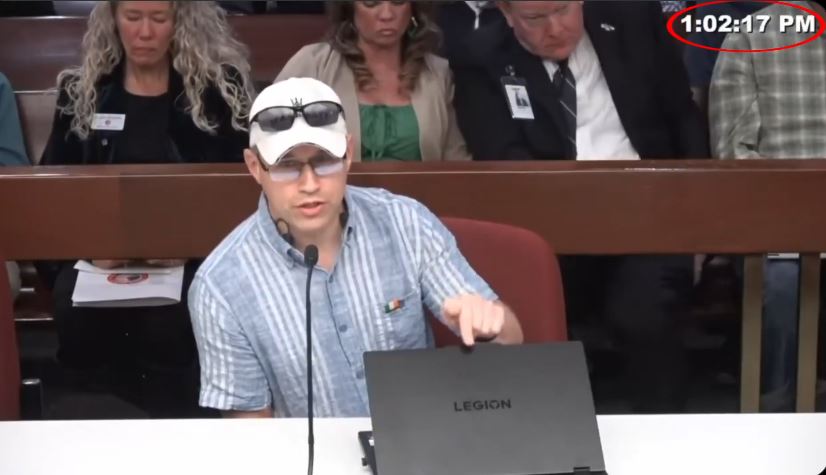
Georgia Committee Recording Omits 10 Seconds of IT Expert’s Testimony on Voting-Machine Vulnerabilities
During a March 17, 2026 hearing, IT professional Mark Cook offered to demonstrate alleged backdoors and other vulnerabilities in electronic voting systems, but footage of his public comment appears to have been cut. Timestamps on the committee's posted recording show an abrupt jump that coincides with the portion Cook and others say was removed.
By Brian Lupo
1,111 views
A segment of public comment by a longtime information technology professional was removed from the online recording of a Georgia legislative hearing, according to timestamps and copies of the full audio provided by the speaker and reported by media outlets. Mark Cook, who testified as an expert witness in the 2024 Tina Peters trial, addressed the Georgia House Governmental Affairs Committee during a March 17, 2026 session considering an election bill and offered to show the committee evidence of alleged vulnerabilities in the election software used in the state.
The committee’s posted video of the hearing contains a recording of Cook’s testimony, but the footage shows an apparent discontinuity. According to the timestamp shown in the top right corner of the video, Cook’s public comment appears to jump instantly from 1:02:18 to 1:02:29, creating a roughly 10-second gap at a moment when Cook was speaking. The gap appears to excise part of his remarks about alleged built-in access to voting systems.
In the version of Cook’s comment that was recovered and circulated, he made the following statement that was removed from the committee’s posted video: "I have evidence right here, that I was hoping to show you, that can show that there are absolutely, and I know you guys have heard this, but I’ve got the proof right here, backdoors built-in to electronic voting systems that allow flipping, changing of votes, infiltrating the system, all built in, set up in a way that makes it easy, and untraceable. I can demonstrate this to you even while I’m still here in this building and I’m happy to do so . The testing labs all missed this. Then they’re blindly certified. Then we’re told that everything is safe and secure. It’s absolutely not." That longer passage does not appear in the version posted by the committee.
Cook publicized the discrepancy on social media, posting what he described as the recovered full audio and alleging an intentional removal: "🚨 Georgia House Governmental Affairs CENSORED my Dominion backdoor public testimony—10 seconds SLICED OUT mid-sentence!
That’s the EXACT part exposing the truth they wanted hidden. Timestamps prove it. Everyone in the room heard it. ON RECORD.
So I recovered the full audio,… pic.twitter.com/OLSa614TCZ" The post has drawn scrutiny and calls for clarification.
Kari Lake, who at the time of the controversy was serving as a senior advisor to the U.S. Agency for Global Media, publicly questioned the removal and asked who ordered it. She tweeted: "Why would they remove this 10 seconds of Mark’s testimony? And who ordered the removal? https://t.co/SoGDrM17Ew" Her comment has been circulated by critics of the posted recording as part of broader demands for transparency in state election oversight.
The concerns raised by Cook echo earlier technical findings about voting equipment. The Gateway Pundit and others have previously reported that tests and open-records reviews identified passwords and encryption keys stored in plain text in some voting system software. Phil Davis, another IT expert who has testified before the Georgia State Election Board, reportedly found a vendor password in plain text during an open-records request. Those discoveries follow earlier examinations, including work by the Cyber Ninjas in Maricopa County in 2021, which identified a hardcoded password often reported as "dvscorp08!" and an administrative user login "SAdmin." Similar issues have been reported in multiple states and were part of the basis for a voluntary seizure of Dominion Voting machines in Puerto Rico after problems during the June 2024 primary election.
Issues with hardcoded credentials are not new to the industry. In 2007 the California Secretary of State withdrew approval of Sequoia Voting Systems after finding hardcoded passwords in the company's software. The presence of easily discoverable credentials has drawn public attention in Georgia, where critics have produced T-shirts referencing the password "dvscorp08!" as a way to highlight the alleged vulnerability. Observers and participants in the political debate have posted and shared images and commentary referencing that discovery; for example, a Twitter post quoted in coverage reads: "I’m sure they have no idea that the hard-coded vendor password is dvscopr08! or that the encryption keys are stored in plain text in the election database. But even if they did know, they would never exploit that because that wouldn’t be cricket." — Harry MacDougald (@HarryMacD) January 12, 2025
The apparent removal of a portion of Cook’s testimony raises questions about how official recordings of legislative hearings are produced, preserved and shared, and whether edits are made after the fact. Committee staff and legislative officials have not provided a public explanation in the material reviewed for this article. The episode has renewed calls from some lawmakers and members of the public for greater transparency around both the security of voting systems and the handling of public-record hearings.
The Gateway Pundit reported on previous discoveries concerning voting-system software and noted local grassroots responses. The matter of the edited clip is likely to continue to draw attention from advocates concerned about election security and from lawmakers asserting a need for clear, verifiable records of committee proceedings.