From Anders’ Army to a New Wave of Emigration: 80 Years of the Association of Belarusians in Great Britain
On November 16, 1946, Belarusian veterans and displaced persons in Britain secured permission to form what became the Association of Belarusians in Great Britain. Over eight decades the organisation has preserved the traditions of the Belarusian People’s Republic, supported émigré communities across Britain, and is now seeking to connect its wartime legacy with newcomers who left Belarus after 2020.
By Alexander Walter
1,048 views
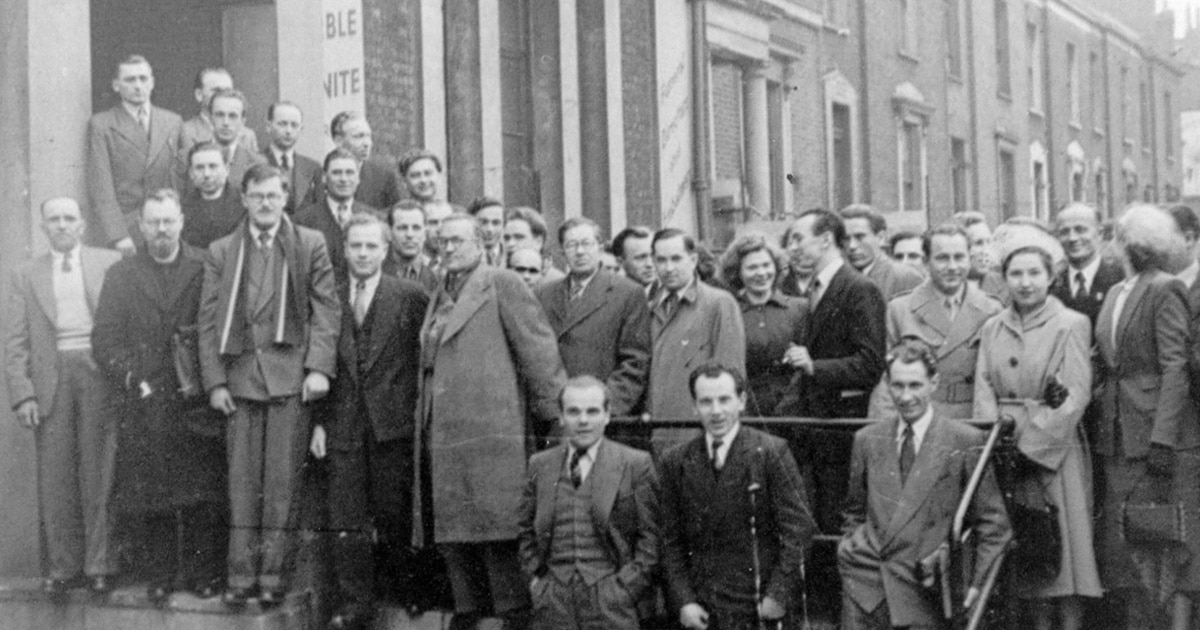
On November 16, 1946, Belarusian soldiers and displaced persons in Britain took the first official step toward founding the Association of Belarusians in Great Britain. That permission, granted by the Polish military authorities associated with General Władysław Anders’ forces, followed an initial meeting in London on September 22, 1946. The Association held its first constituent congress in early 1947 and obtained formal registration in 1948. Over the next eight decades the organisation became one of the oldest Belarusian public bodies in the world and a central institution for preserving non‑Soviet Belarusian traditions in exile.
The founding membership was dominated by veterans of the Second Polish Corps who had fought under General Anders in Italy, accompanied by Belarusian youth and scout members who arrived from displaced persons’ camps. Many of these émigrés came from Western Belarus and had little lived experience of life in the Soviet system. For a considerable period after the war they did not see their new lives in Britain as permanent; members harboured hopes that the Soviet system would collapse and that return to Belarus would be possible. Mikola Pachatayeu, the Association’s current leader, recalls that some émigrés even included return clauses in marriage agreements with British spouses—an indication of the persistent expectation that exile would be temporary.
From its earliest years the Association took a clear political and cultural orientation: at its second congress in 1948 it affirmed allegiance to the tradition of the Belarusian People’s Republic (BPR). That choice positioned the organisation within the strand of the diaspora that held to ideas of an independent, democratic Belarus, religious tolerance and national sovereignty distinct from the Soviet order. Pachatayeu notes that British Belarusians were not politically uniform, but the BPR tradition offered a common reference point for the Association’s activities.
The Association’s practical work extended well beyond political advocacy. It helped émigrés settle and organised community infrastructure: Belarusian houses and clubs in London, Bradford and Manchester provided meeting places while schools for children, celebration of national and religious holidays, journals, brochures and communications sustained cultural life. The Belarusian House in London, and the Frantsishak Skaryna Library and Museum housed unique book and archival collections, while clergy and cultural figures such as Bishop Cheslaw Sipovich, priest‑scholar Alexander Nadsan and activist Vincent Zhuk‑Hryshkevich played leading roles in building religious, educational and cultural institutions for the diaspora.
For decades the Association and its members sustained the memory and practice of a non‑Soviet Belarus from abroad. Many continued to support cultural and civic initiatives in Belarusian communities in Canada and the United States as well. Over time, however, it became clear—by the early 1960s to many—that a postwar return to Soviet Belarus was unlikely. When Belarus regained independence in 1991, many of the Association’s founders were already elderly; nonetheless, they continued to contribute to Belarusian cultural life and to assist émigré and homeland initiatives.
The profile of Belarusian emigration to Britain has changed markedly in recent years. Pachatayeu points out that people arriving after 2020 generally lack direct experience of the Belarusian Soviet Socialist Republic but are also farther removed from the wartime and immediate postwar traditions carried by the Association’s founders. Despite these differences, a shared commitment unites older and newer members: a desire for a fully independent and democratic Belarus. Pachatayeu says the Association aims to offer a platform for co‑operation and to pass on elements of the wartime émigré tradition to newcomers, believing that a free Belarus of the future can integrate diverse experiences and histories.
Today the Association reports around two dozen active members and is preparing to mark its 80th anniversary with a series of events. Beginning November 16 the organisation will publish archival photographs on its website and social networks, showcasing materials that date back to the late 1940s. Early next year, during the Association’s congress in London, organisers plan a public event featuring a researcher of the Belarusian diaspora and the military émigré movement in the West; the meeting will also be broadcast via Zoom. The Association says it intends to recruit new members and continue bridging its historic legacy with the needs and activism of the new Belarusian émigré generation.
The story of the Association of Belarusians in Great Britain is thus both historical and current: founded by wartime exiles fearing Soviet repression, it built institutions of language, faith and culture in Britain and sustained the idea of a non‑Soviet Belarus through decades of exile. Eight decades on, it confronts fresh challenges and opportunities as many Belarusians arrive to Britain for political reasons after 2020. The Association’s leadership frames its role as custodial and connective—preserving memory, serving an émigré community, and helping to forge a shared path toward democratic renewal in Belarus.