FRANCE: Has Years of Neglect Finally Caught Up With the System?
French students are protesting years of neglect in the country’s education system, citing teacher shortages, overcrowded classrooms and poor school conditions. As university students join the movement, concerns are also growing over police violence, unaffordable student housing and the rising cost of living.
By Albina Kastrati
1,192 views
Photo: Pascal Lachenaud/AFP/Getty Images
Since mid-September, actions that began in the Paris region have spread to other parts of France, with students raising concerns about school conditions, teacher shortages and access to higher education. Reports differ on the precise start date of the movement, with Euronews tracing its beginnings to 17 September, while Le Monde reported that the movement began on 21 September at Lycée Saint-Exupéry in Créteil, where several teaching positions had not been filled. By 29 September, actions had been recorded at nearly 410 schools across France, representing more than 11% of the country’s public and private high schools, according to Le Monde.
According to the French Education Ministry’s 2026 statistical overview, France had 12.46 million pupils and apprentices in the 2025–2026 school year, including approximately 2.26 million high-school students. In 2025, the country also had 485,450 secondary-school teachers and 3,700 high schools.
As for the scale of the demonstrations, 71,500 people participated in protests nationwide on 8 October, including 24,500 in Paris, according to figures from the French Interior Ministry reported by Reuters.
More than three weeks after the protests began, university students had also joined demonstrations in solidarity with high-school students. To understand the concerns driving the movement, The Liberty Bulletin spoke to several sources, including Clelia Imperato, a 20-year-old master’s student from Montpellier, Occitanie, who participated in a demonstration in support of high-school students.
“I went to support high school students and their rights. Many of them have to deal with very difficult school conditions such as complicated timetables and overcrowded classrooms. I think every student deserves to study in good conditions. University students also joined the movement to defend their own demands. These problems have existed for a long time, but we decided to bring different struggles together and show solidarity,” Imperato told The Liberty Bulletin.
The 20-year-old master’s student urged the public to look beyond police confrontations and blockades and consider the concerns driving the protests. She said students had been raising concerns about their education for a long time but did not always feel that they were being taken seriously. According to Imperato, the movement also reflects concerns among university students, who have joined high-school students in solidarity.
“People have to understand that these students are not just troublemakers. I also think it is important to talk about solidarity between high school and university students because different struggles can be connected,” Imperato told The Liberty Bulletin.
In a written response to The Liberty Bulletin, the Académie de Créteil, the regional education authority, acknowledged ongoing teacher shortages, particularly in mathematics and some vocational subjects. It said that nearly 95% of absences in secondary schools across the district were covered by substitute teachers.
The authority also said that, as of 12 October, 145 teachers of mathematics, French and physical education had been assigned to 110 priority schools. It acknowledged student concerns about school facilities, staff shortages, workloads, timetables and Parcoursup.
The authority also relayed the French Ministry of Education’s announcement regarding its response to student concerns:
“In response to your request, the French Ministry of Education is inviting high school students to share their demands, expectations, and ideas for improving their educational experience on a platform that will be available until Friday, October 23, 2026. This consultation supports the ongoing dialogue with high school students and their representatives, which is taking place with elected representatives at several levels: in schools, in school districts, and at the national level. The contributions collected will be summarized at the end of October.”
A 20-year-old living in France, who asked to remain anonymous, also shared his perspective on the protests. Last year, he obtained a vocational diploma after leaving the general education track, citing pressure to move to vocational education. Although he did not participate directly in the demonstrations, he said he had followed them from a distance and watched videos shared by his younger brother, who is currently a high-school student.
The anonymous source described serious shortcomings in France’s education system, including overcrowded classrooms, teacher shortages, inadequate heating during winter and excessive heat in classrooms during summer. He argued that these conditions make it more difficult for students to learn and succeed.
He also expressed concern about reports of police violence during demonstrations, including incidents involving minors. He called for incidents to be properly documented and investigated, stressing the need to establish responsibility where unlawful violence has occurred.
“I sincerely believe that young people should not have to fight for decent learning conditions or simply to be heard. They represent the future of the country. Treating them with contempt, dismissing their demands or turning a blind eye will only make the situation worse,” the source told The Liberty Bulletin.
Concerns over police conduct have intensified following several serious injuries during the protests. On 5 October, a 15-year-old student lost his hand in an incident involving a police stun grenade during a police intervention outside Lycée Auguste-Béhal in Lens, according to Le Monde.
An investigation was opened into the incident, and French authorities temporarily suspended the use of the EF-SON stun grenade at high-school protests while the circumstances were investigated.
Imperato recalled helping younger students after police fired tear gas during a demonstration. She said she and others provided saline solution and masks and helped students regroup, advising them not to run in panic because it could put them in greater danger.
“The most memorable demonstration I attended was one on October 6, where many very young high school students were protesting. At first, we were simply chanting slogans and expressing our demands peacefully. Suddenly, the CRS (the French riot police) fired tear gas at us, even though we were not doing anything violent. The gas affected many young students who were not prepared for this kind of situation. I tried to help them by giving out saline solution and masks. We helped them regroup and explained that they should avoid running in panic because it could put them in greater danger,” Imperato told The Liberty Bulletin.
Beyond solidarity with high-school students, university students face their own challenges, including access to affordable accommodation and adequate living conditions. France’s CROUS network provides subsidised student housing and affordable meals, making it an important option for students seeking lower living costs. However, access to affordable accommodation does not necessarily guarantee decent living conditions.
Rania Benita Hilali, a 20-year-old business administration bachelor’s student, said that affordability should not come at the expense of basic hygiene and dignity. According to Hilali, such concerns are raised every year, but little effort is made to address them.
“The CROUS, which is supposed to support students by providing affordable accommodation and meals, is also a source of concern. Some student residences have extremely poor living conditions, including rooms that are not properly maintained or suitable for living in, with reports of insect infestations such as cockroaches. Students should not have to live in unhealthy or undignified conditions simply because they cannot afford private accommodation.
There is also the issue of university catering. CROUS restaurants provide essential, affordable meals for many students, but capacity and availability can be insufficient to meet demand in some places. Access to affordable, nutritious food should not be something we have to struggle for. No student should have to choose between eating properly and paying rent or other essential expenses,” Hilali said.
Hilali also pointed to differences in how students at public and private universities participate in protests, explaining that high tuition fees can make missing classes more costly for private-school students. As she put it, “many of us are prepared to participate in demonstrations during the weekends, when we can express our solidarity without missing classes.”
Efforts were made to contact the French Ministry of Education, the French Ministry of the Interior and the SNES-FSU teachers’ union for comment. By the time of publication, The Liberty Bulletin had not received a response from any of them.
The protests expanded beyond education on Saturday, 17 October, as students, trade unionists and Yellow Vest activists joined demonstrations over the cost of living, rising fuel prices and declining public services. Organisers estimated that 800,000 people took part nationwide, although estimates of the turnout varied.
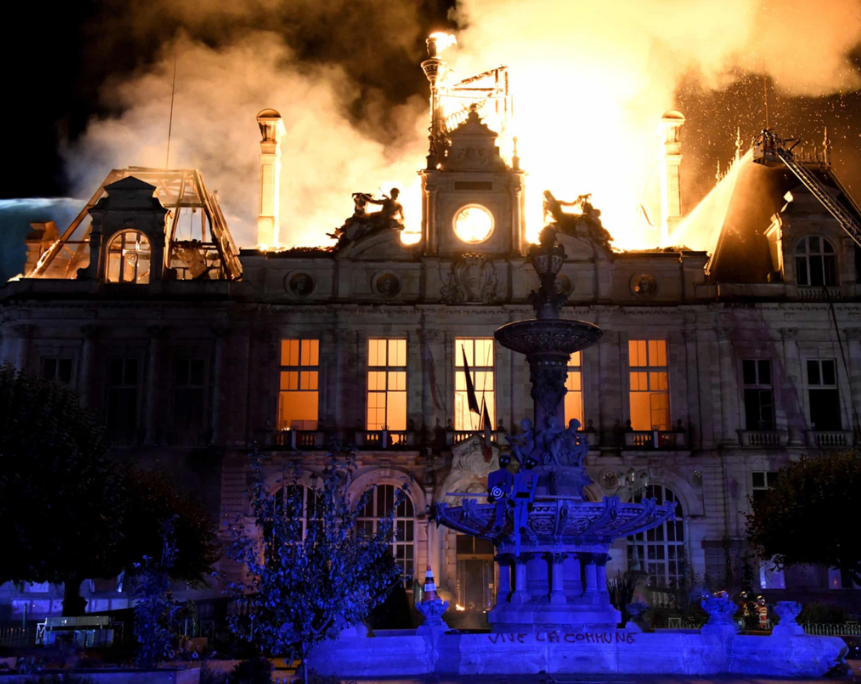
The demonstrations were also marked by widespread clashes and property damage. On Sunday, France’s Interior Minister Laurent Nuñez said more than 1,800 people had been arrested and more than 500 police officers, gendarmes and firefighters injured. In Limoges, the town hall was severely damaged by fire.
President Emmanuel Macron condemned the violence on Sunday and announced a review of possible failures in intelligence gathering or police preparedness. He also said the government would bring together students, teachers, lawmakers, trade unions and business representatives this week to develop proposals addressing the crisis. The details of those proposals had not yet been announced.
“We are not asking for luxury or special treatment. We are asking for decent classrooms, properly maintained buildings, realistic timetables, affordable housing, access to food and sufficient financial support to live and study in dignified conditions. We should not have to choose between our basic needs and our education. We want to be able to study, live and prepare for our future without constantly having to fight for the bare minimum,” Hilali concluded.