France 2027: three blocs, and the voters who could break them
As Macron’s centre fragments, France’s 2027 race is forming around three blocs led by Le Pen, Mélenchon and a crowd of Macron’s former prime ministers, with the contest’s wild card being the millions who have stopped voting and a two-round system that rewards two very different coalitions.
By Martin Bertrand
1,188 views
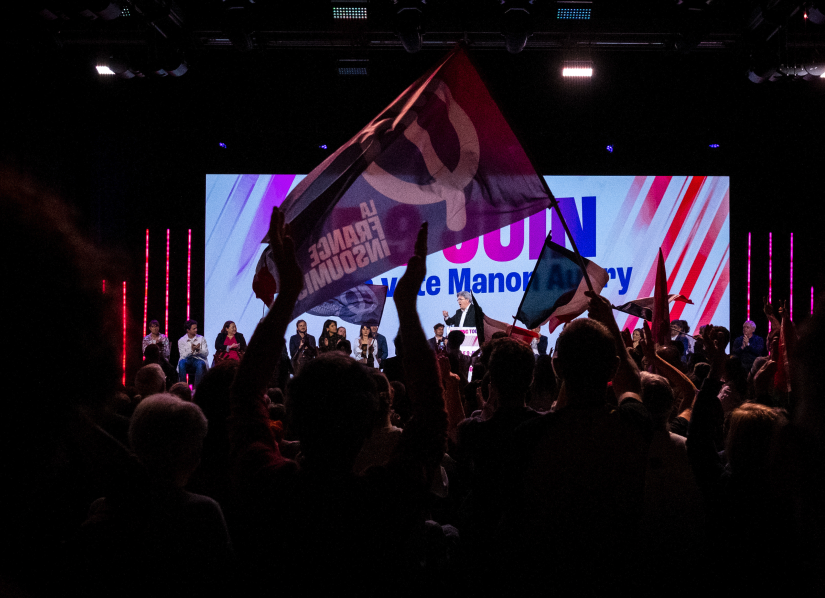
Photo: Jean-Luc Mélenchon in Saint-Brieuc, 27 March 2019. Photo: Martin Bertrand / Hans Lucas
Emmanuel Macron will leave behind a political landscape that looks nothing like the one he inherited in 2017. The old alternation between Socialists and conservatives has largely collapsed. In its place, three blocs now structure most of the presidential race: the far right around Marine Le Pen, the political space stretching from Macron’s centre to the traditional right, and a left whose strongest presidential pole currently remains Jean-Luc Mélenchon. Then there is what Mélenchon calls the “fourth bloc”: people who have stopped voting, or vote only intermittently.
For now, Marine Le Pen possesses the strongest measured electoral base. An Ipsos BVA survey conducted in September among 13,060 registered voters placed her between 33 and 35 percent in every scenario tested. Mélenchon stood between 15.5 and 17 percent, while former prime minister Édouard Philippe ranged from 14 to 21 depending on who else was running. These are polls seven months before an election, not votes. But they already create pressure in France’s two-round system, where finishing second can matter considerably more than finishing third.
Le Pen enters the campaign with an extraordinary contradiction: she is simultaneously a leading presidential candidate and a politician convicted over the misuse of European Parliament funds. In July 2026, an appeals court upheld her conviction and sentenced her to three years in prison, two suspended, a €100,000 fine and 45 months of electoral ineligibility, 30 of them suspended. The court considered the remaining effective period already served, clearing a path for her candidacy. She has appealed to the Cour de cassation.
In another political culture, such a conviction might overwhelm an entire campaign. France has accumulated enough scandals for the picture to be more complicated. Former president Nicolas Sarkozy has faced several convictions. Former prime minister François Fillon was definitively convicted over the fictitious employment of his wife. Another former prime minister, Alain Juppé, was convicted in the Paris municipal jobs affair. And Jérôme Cahuzac, once the minister responsible for fighting tax fraud, was himself convicted of tax fraud. None of this proves that judicial scandals alone caused political disengagement, but they form part of a climate in which tous pourris, “they’re all corrupt”, has become an easy conclusion. In 2026, only 15 percent of French respondents told CEVIPOF they trusted political parties.
The RN also carries a history it has spent years trying to escape. The Front National was founded in 1972 around Jean-Marie Le Pen alongside figures from the post-war extreme right, including former Waffen-SS member Pierre Bousquet. Marine Le Pen’s strategy of dédiabolisation has largely consisted of making the party appear capable of governing without constantly being dragged back to those origins. That makes the recent controversy surrounding Jordan Bardella particularly uncomfortable. Mediapart attributed antisemitic and conspiratorial messages from 2013 to the current RN president. Bardella denies writing them. Mediapart later published evidence based on Messenger archives supplied by Meta and an extraction process certified by a judicial officer, which it says supports their authenticity and attribution.
There is another ambiguity around the RN: its economic identity. The party has moved over the years between a harder liberal right and a much more protectionist, socially oriented discourse aimed at working-class voters. On 6 October, Le Pen presented a programme promising around €140 billion in net savings over five years, alongside tax cuts, reduced public spending and a constitutional rule on deficits. It is an attempt to appear economically credible while maintaining policies such as national preference. Whether all the projected savings are realistic is already disputed.
Facing her is not one obvious heir to Macron, but several politicians who have already exercised power during his presidency. Édouard Philippe was Macron’s first prime minister. Gabriel Attal was another. Bruno Retailleau served as interior minister under governments appointed during Macron’s second term. All three are now positioning themselves for the presidency. Philippe currently has the strongest polling position among them, but his numbers vary sharply depending on whether Attal and other candidates are also tested. Macron once managed to gather much of this political space behind a single candidacy. In 2027, it is fragmented again.
There is a social-democratic left as well, notably around Raphaël Glucksmann, who stood between 11.5 and 13.5 percent in the September survey. It should not be ignored, but the mechanics of the election create powerful incentives for tactical voting, particularly when several candidates compete for neighbouring electorates. The central question for that part of the left will be how much political space remains between Mélenchon and the candidates trying to inherit Macron’s electorate.
Mélenchon’s position is different. His programme proposes a return to redistribution, ecological planning and a Sixth Republic intended to reduce the presidential concentration of power described in the first article of this series. His criticism of the European Union also comes from almost the opposite direction to the RN’s historical Euroscepticism: LFI attacks European economic rules as too liberal, while the RN has traditionally placed sovereignty, immigration and national preference at the centre of its criticism.
But Mélenchon’s most interesting calculation is not about the three visible blocs. It is about those outside them. LFI talks about a “fourth bloc” made up of abstention. That does not mean abstentionists constitute a coherent Mélenchon electorate waiting to be activated. They include occasional voters, citizens who reject the existing political offer and people much further removed from electoral politics. What LFI is betting on is that part of this population, particularly younger and working-class voters, can be brought back to the polls. CEVIPOF found in April that 76 percent of people who had abstained in the 2026 municipal elections still expressed interest in the presidential election.
The current high-school protests give that argument an unexpected echo. Students have mobilised over teacher shortages, overcrowding and deteriorating school buildings. The movement has also revived France’s recurring debate over policing. A 15-year-old lost a hand when a police grenade exploded during a protest in Lens, after which the government suspended use of the weapon during the student demonstrations pending investigation. None of this makes these students LFI voters. But deteriorating public services, youth disengagement and criticism of police violence are subjects Mélenchon’s movement has been raising for years.
That fourth bloc is therefore not an electoral army. It is a gamble. Even mobilising part of it would only solve the first-round problem: reaching the runoff. The second round requires something else entirely, assembling voters far beyond one’s original political camp.
And that is what makes 2027 so difficult to read. France has three large visible blocs, a two-round system that encourages tactical voting, and millions of citizens whose participation cannot simply be taken for granted. Current polls describe the starting positions. They do not decide who will still be standing when France reaches the second round.